
Discover the transformative power of zoom microscopes for unparalleled precision, clarity, and versatility in optical examinations.
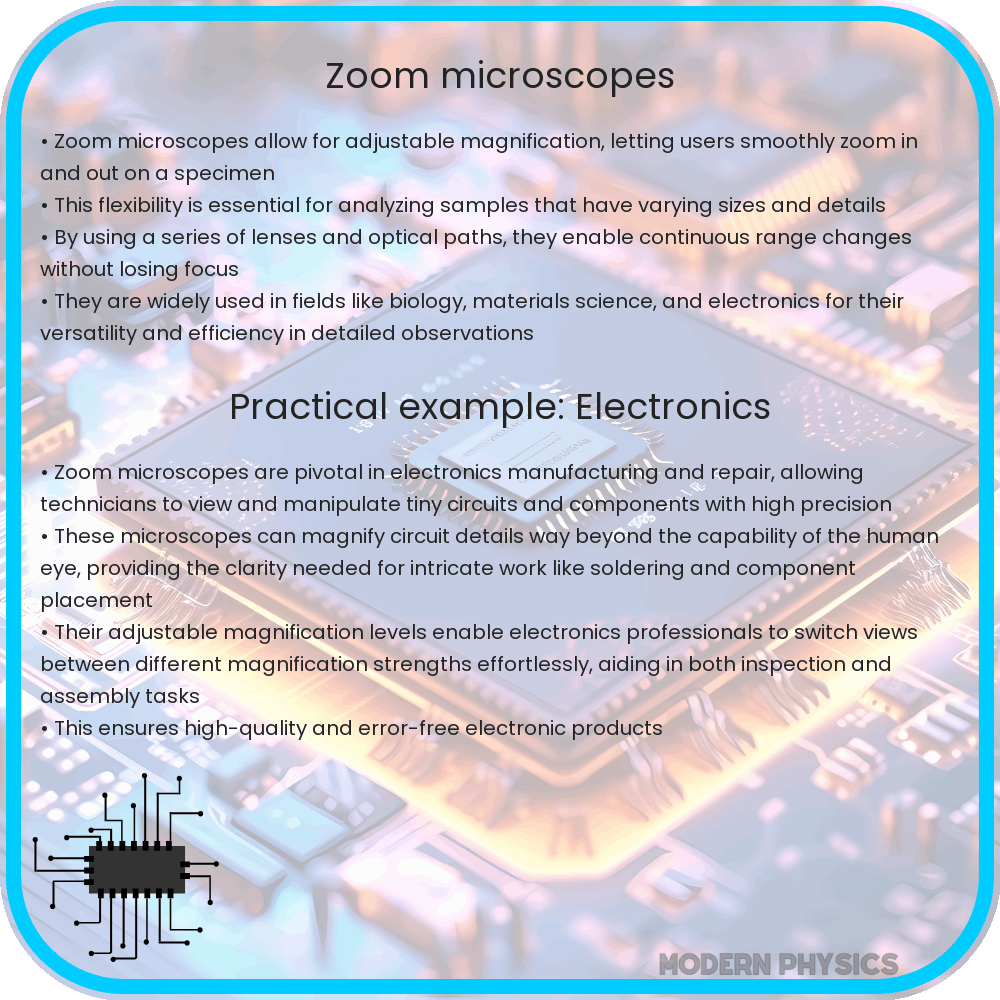
Zoom Microscopes: Unveiling the Microscopic World
Zoom microscopes, also known as stereo or dissecting microscopes, stand at the forefront of scientific exploration, offering unparalleled precision, clarity, and versatility. These optical marvels are indispensable tools in a wide range of fields, from biology and materials science to electronics and forensics. Their unique ability to provide variable magnification without the need to change lenses or objectives sets them apart, allowing for seamless transitions between magnification levels to observe specimens in exquisite detail.
Core Features and Advantages
At the heart of zoom microscopes’ effectiveness is their dual optical paths, which present a three-dimensional view of the subject, enhancing depth perception and offering a more comprehensive understanding of the specimen’s structure. This feature is crucial for applications requiring intricate manipulation or assembly under magnification, such as in microsurgery or the inspection of electronic components.
Moreover, the versatility of zoom microscopes is unmatched. They can be equipped with a variety of lighting options, including brightfield, darkfield, and polarized light, to illuminate the specimen in ways that best reveal its characteristics. Additionally, modern zoom microscopes often incorporate digital cameras and advanced imaging software, enabling the capture and analysis of images with high precision and ease.
Applications Across Disciplines
Zoom microscopes have found their place in an array of scientific disciplines. In biology, they are used for dissecting specimens, observing living organisms, and studying plant and animal tissues. Their application extends to the field of geology, where they assist in examining mineral compositions and rock textures. In industrial settings, they are pivotal for quality control, allowing for the detailed inspection of products to ensure they meet stringent standards.
Furthermore, the adaptability of zoom microscopes to various specimens and their ability to provide high-resolution images make them invaluable in educational settings. They offer students a vivid and interactive experience, bringing the microscopic world to life and fostering a deeper understanding of the natural world.
Zoom Microscopes: Precision, Clarity & Versatility in Optics
Zoom microscopes have revolutionized the field of microscopy by providing unparalleled precision, clarity, and versatility. These advanced optical instruments are designed to offer a continuous range of magnifications, allowing researchers, scientists, and hobbyists to observe specimens with exceptional detail. The key feature that sets zoom microscopes apart from traditional models is their ability to seamlessly adjust magnification without the need to change objectives. This capability ensures a smooth transition between different magnification levels, enabling a comprehensive analysis of the microscopic world.
One of the most significant advantages of zoom microscopes is their precision. Equipped with high-resolution optics, these microscopes produce sharp, clear images that reveal the intricate details of specimens. Whether it’s the complex structure of a cell, the delicate wings of an insect, or the fine grains of a mineral, zoom microscopes capture every aspect with impeccable clarity. This precision is crucial for research and analysis, where accurate visualization can lead to groundbreaking discoveries.
Versatility is another hallmark of zoom microscopes. They are used in a wide range of applications, from biological research and medical diagnostics to materials science and industrial quality control. Thanks to their adjustable magnification, these microscopes can be tailored to suit the specific needs of any observation, making them indispensable tools in both scientific and industrial settings. Moreover, zoom microscopes often come with a variety of accessories and attachments, such as cameras and measurement software, further enhancing their functionality.
The Future of Zoom Microscopy
The future of zoom microscopy promises even greater advancements in optics technology. With ongoing research and development, we can expect to see improvements in optical resolution, magnification range, and image processing capabilities. Innovations such as digital zoom microscopy and 3D imaging techniques are set to push the boundaries of what is currently possible, offering deeper insights into the microscopic world.
Moreover, the integration of artificial intelligence and machine learning algorithms will revolutionize the way we analyze microscopic images. These technologies will enable automatic detection and classification of specimens, significantly speeding up research processes and improving diagnostic accuracy in medical applications.
In conclusion, zoom microscopes represent a pinnacle in optical engineering, providing precision, clarity, and versatility that are essential for modern scientific and industrial applications. As technology continues to evolve, the capabilities of these instruments will only expand, opening new horizons in microscopy and furthering our understanding of the microcosm. The future of zoom microscopy is bright, promising to unveil even more about the microscopic world that remains unseen to the naked eye.