
Afocal zoom systems provide variable magnification without refocusing, ideal for fast, adaptable visual applications.
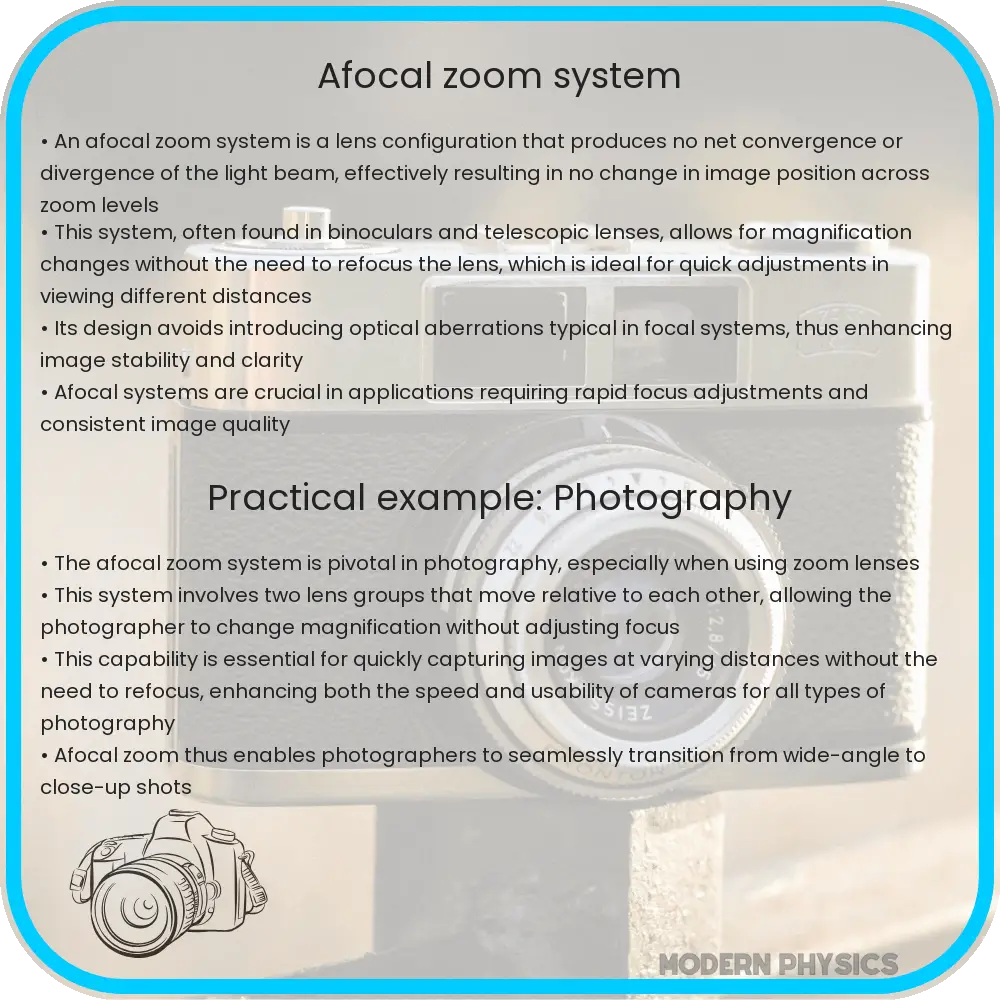
Understanding Afocal Zoom Systems
Afocal zoom systems are a fascinating area of optical engineering that cater to a variety of practical applications, from photography to intricate scientific instruments. These systems are defined by their ability to provide variable magnification without requiring the user to adjust the focus to maintain clarity. This capability makes them particularly useful in situations where speed and adaptability are essential.
Clarity and Image Integrity in Afocal Systems
One of the primary advantages of afocal zoom systems is their ability to maintain image clarity across different magnifications. This is achieved through the use of an afocal system, which consists of two or more lenses that are set such that the focal point of one lens coincides with the focal point of the other. In simple terms, instead of focusing light to a point, an afocal lens system sends out parallel rays, ensuring that the system as a whole does not alter the focus of the image.
In practical applications, this means that an observer can change the magnification of an object being viewed without needing to refocus the lens. This is particularly advantageous in scenarios like bird watching or sports photography, where the subject may move rapidly and unpredictably.
Magnification Mechanics
The mechanics of magnification in an afocal system can be explained through the concepts of angular magnification. Angular magnification, \(M\), is a measure of how much larger or smaller an object appears when viewed through a lens compared to the naked eye. It is defined as:
\[ M = -\frac{f_{o}}{f_{e}} \]
Here, \(f_{o}\) is the focal length of the objective lens (the lens closest to the object being viewed), and \(f_{e}\) is the focal length of the eyepiece lens. The negative sign indicates that the image is inverted.
In an afocal setup, when zooming in or out, the relationship between the objective and the eyepiece lenses is adjusted to change the overall angular magnification without refocusing. This adjustment is often facilitated by additional lens elements or groups that move relative to each other, altering the effective focal lengths \(f_{o}\) and \(f_{e}\).
Versatility and Applications
Afocal zoom systems are not just limited to visual devices like binoculars or cameras; they are also crucial in applications requiring precise magnification control under varied observational conditions. For instance, they are used in optical instrument design, where consistent image quality across varying magnifications is paramount.
- Astronomy: Telescopes with afocal zoom capabilities allow astronomers to switch between different magnifications quickly to observe celestial objects with varying sizes and at different distances.
- Medical Instruments: Devices like endoscopes and surgical microscopes benefit from afocal technology as it allows doctors to adjust magnification rapidly during delicate procedures without losing focus on the subject.
- Photography: Afocal zoom lenses in cameras provide photographers the flexibility to capture images at multiple magnifications swiftly, a crucial factor in dynamic environments like wildlife or sports photography.
The combination of clarity, magnification flexibility, and application versatility makes afocal zoom systems a cornerstone in modern optical design, providing tools that enhance both our vision and capability to record and study the world around us.
Technological Integration and Challenges
Afocal zoom systems, while highly versatile, are not without their technological challenges. Integrating these systems into devices requires precise engineering to maintain image quality across all zoom levels. This accuracy ensures that all optical elements are perfectly aligned and move synchronously during zooming. Typical challenges involve ensuring mechanical stability and minimizing optical aberrations like chromatic aberration (color fringing) and spherical aberration (a blur occurring at the lens edge).
Modern solutions often incorporate computer-aided design and digital processing to optimize the performance of afocal zoom systems. For instance, software corrections can be applied to images to mitigate some unavoidable aberrations, enhancing the final image quality captured by digital cameras or observed through electronic viewfinders in various instruments.
Future Prospects of Afocal Zoom Systems
The future of afocal zoom systems looks promising as advancements in materials science and optical engineering continue to evolve. Innovations such as new lens materials or adaptive optics, which can adjust their shape in real time to counteract optical distortions, may redefine the capabilities of afocal zoom systems. Additionally, the integration of artificial intelligence for controlling zoom and focus could lead to even more responsive and user-friendly optical devices.
Research is also being driven by the demand for smaller, lighter devices across various fields. This necessitates the development of compact afocal systems that do not compromise on performance, ensuring that technology can meet the needs of mobile and highly active users, such as explorers, military personnel, or emergency responders.
Conclusion
Afocal zoom systems represent a remarkable blend of optical precision and practical versatility. These systems enable users to maintain focus while adjusting magnification, crucial in many scientific, medical, and recreational applications. The ongoing advancements in technology promise to enhance these systems further, making them more compact, efficient, and user-friendly. By overcoming challenges related to optical aberrations and system integration, afocal zoom systems continue to play a pivotal role in the evolution of optical devices. Enhancing our ability to observe and interact with the world at multiple scales, they provide a window not just into the minute details of our environment but also into the vastness of outer space. As such, these systems are not only tools for today but also the building blocks for the next generation of optical technology.