
Explore the world of optical switchers, the cornerstone of high-speed, accurate, and reliable optical communications, in this comprehensive guide.
Understanding Optical Switchers: The Gateway to High-Speed, Accurate, and Reliable Optics
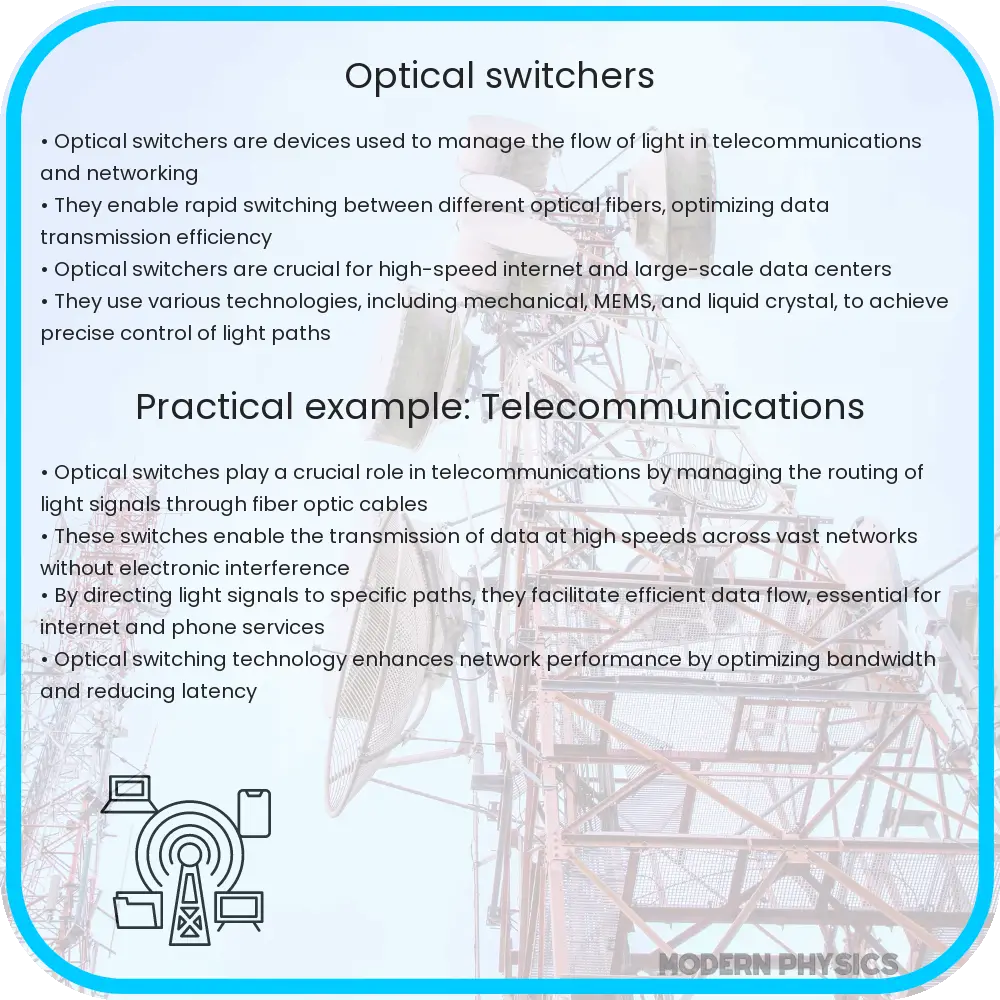
Optical switchers stand at the forefront of telecommunications and data networking, offering unparalleled efficiency and performance in optical signal routing. These devices are essential for managing light paths in various applications, from data centers to telecommunication networks, ensuring that optical signals are directed to their intended destinations without compromising speed or integrity.
The Mechanics of Optical Switching
At the heart of optical switchers lies the principle of directing light paths through controlled mechanisms. Unlike traditional electronic switches, optical switchers manipulate light directly, using physical displacement, electro-optic effects, or other methods to achieve switching. This direct handling of light enables the transmission of data at the speed of light, minimizing latency and maximizing throughput.
Key Features of High-Quality Optical Switchers
- High-Speed Performance: Optical switchers facilitate data transmission at speeds unattainable by electronic counterparts, making them ideal for high-bandwidth applications.
- Accuracy and Precision: Precision engineering allows for the accurate routing of optical signals, ensuring that data reaches its intended destination without loss or interference.
- Reliability: Designed for durability and long-term operation, these switchers operate under a wide range of environmental conditions without degradation in performance.
Applications of Optical Switchers
Optical switchers find their place in a myriad of settings, each leveraging the unique advantages of optical technology. In data centers, they manage the colossal amount of data traffic, ensuring efficient and reliable communication between servers. Telecommunication networks rely on optical switchers for the seamless distribution of data, voice, and video signals across vast distances. Additionally, in advanced research and development labs, optical switchers play a crucial role in experiments requiring precise control over light paths, such as in quantum computing and photonics research.
Technological Innovations in Optical Switching
The continuous evolution of optical switch technology has led to the development of more sophisticated and efficient devices. Innovations such as MEMS (Micro-Electro-Mechanical Systems) and liquid crystal optical switchers have revolutionized the field, offering improved performance, lower power consumption, and enhanced scalability. These advancements ensure that optical switchers remain at the cutting edge of technology, ready to meet the demands of future optical networks.
Is this conversation helpful so far?
Understanding Optical Switchers
Optical switchers are pivotal in the modern telecommunications landscape, providing the backbone for high-speed data transmission. These devices enable the routing of optical signals without the need for converting them into electrical signals, thereby preserving the integrity and speed of the data being transmitted. Their application spans from data centers to network operations centers, illustrating their versatility and importance in ensuring seamless communication across various platforms.
Types of Optical Switchers
There are several types of optical switchers, each with its unique attributes and applications. The most common types include Mechanical Optical Switches, MEMS (Micro-Electro-Mechanical Systems) Switches, and Liquid Crystal and Semiconductor Optical Amplifiers. Mechanical switches are known for their reliability and are typically used in environments where durability is paramount. MEMS switches, on the other hand, offer superior speed and flexibility, making them ideal for high-performance computing environments. Liquid Crystal and Semiconductor Optical Amplifiers, while less common, provide unique benefits in specific applications, such as variable optical attenuation and signal amplification.
Advantages of Optical Switching
Optical switching technology offers numerous advantages over traditional electronic switching, including higher speed, greater bandwidth, and lower power consumption. These benefits are critical in today’s data-driven world, where the demand for rapid and efficient data transmission is ever-increasing. Additionally, optical switchers are less susceptible to electromagnetic interference, ensuring more reliable communication in environments prone to such disturbances.
Applications of Optical Switchers
The versatility of optical switchers allows for their use in a wide range of applications. In telecommunications, they facilitate the efficient routing of voice, video, and data traffic. In data centers, they enable high-speed data transmission between servers, improving overall network performance. Optical switchers are also used in optical signal processing, including the generation, modulation, and amplification of optical signals.
Conclusion
Optical switchers stand at the forefront of telecommunications technology, offering unparalleled speed, reliability, and efficiency in data transmission. As the digital landscape continues to evolve, the importance of these devices is only set to increase. Whether in data centers, telecommunications, or advanced computing applications, optical switchers play a critical role in keeping the world connected. With ongoing advancements in optical technology, the future of optical switching looks promising, heralding new possibilities for faster, more efficient communication networks.