
Explore the world of compound lenses and their role in enhancing clarity, precision, and magnification in optics, from microscopes to cameras.
Understanding Compound Lenses: Enhancing Clarity, Precision, and Magnification
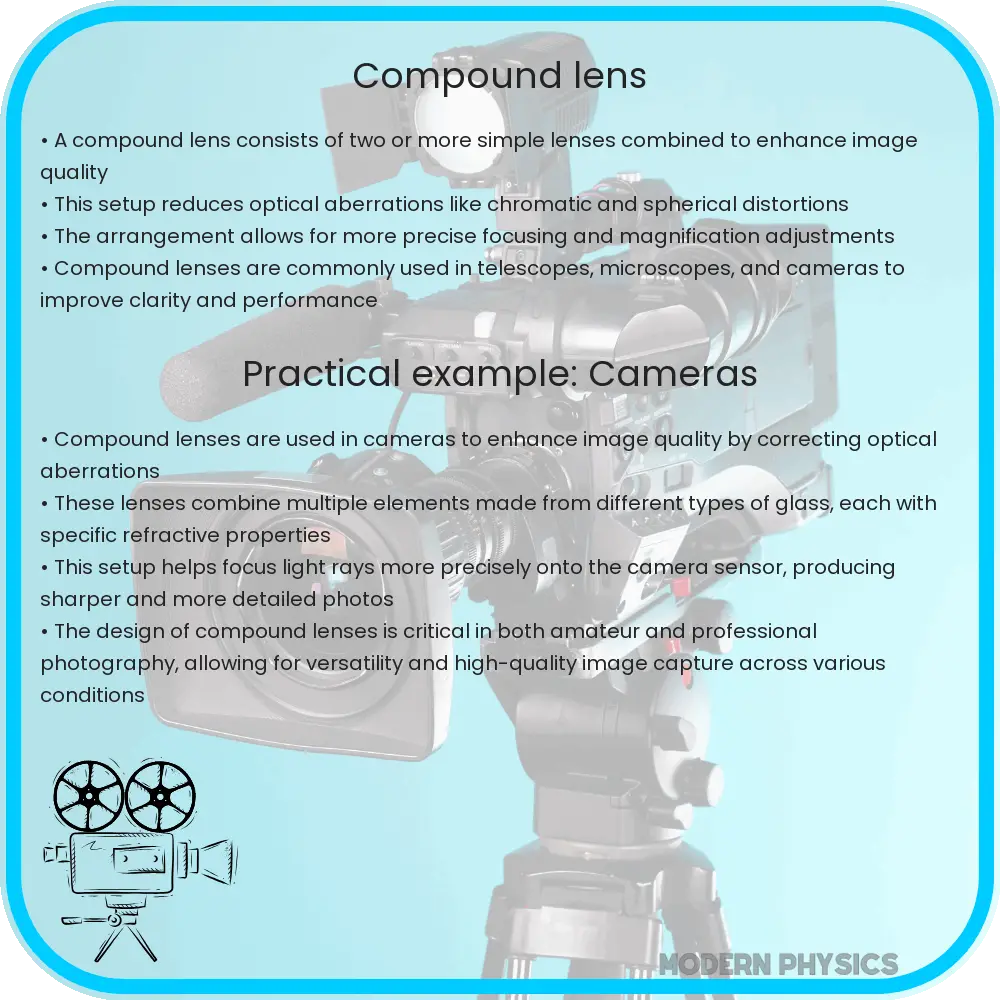
In the realm of optics, compound lenses stand as pivotal components in a myriad of devices, from microscopes to cameras. These lenses are assemblies of multiple simple lenses or elements, designed to work cohesively in reducing aberrations and enhancing image quality. This article delves into the intricacies of compound lenses, exploring their role in achieving greater clarity, precision, and magnification.
Composition of Compound Lenses
At their core, compound lenses are composed of several simple lenses, each with its unique curvature and refractive index. These individual elements can be either converging (convex) or diverging (concave), and are meticulously arranged to correct optical errors such as chromatic and spherical aberrations. The precise alignment and combination of these lenses are crucial in producing a clear and sharp image.
Clarity and Aberration Correction
One of the primary benefits of using compound lenses is their ability to enhance clarity. By strategically combining different lenses, manufacturers can effectively minimize optical imperfections. Chromatic aberration, caused by the dispersion of light into its constituent colors, is significantly reduced in compound lenses. This is achieved by using a combination of lenses made from different types of glass, each compensating for the dispersion caused by the other.
Enhanced Precision and Focus
Compound lenses also contribute to improved precision and focus in optical instruments. Spherical aberration, another common optical issue where light rays refract at different angles due to the lens’s spherical shape, is addressed through the use of aspherical lens elements. These elements are designed to focus light rays more accurately, thereby sharpening the image.
Magnification Capabilities
The magnification power of compound lenses is another key aspect. In instruments like microscopes, the combination of multiple lenses allows for high levels of magnification while maintaining image clarity. This is particularly important in scientific and medical applications where detailed observation is crucial.
In summary, the use of compound lenses in optical devices is a testament to the advancements in lens technology. Their ability to correct aberrations, enhance clarity and precision, and provide significant magnification makes them indispensable in modern optics.
Applications of Compound Lenses
Compound lenses find extensive applications in various fields. In photography, they are used in camera lenses to produce sharp images with minimal distortion. In astronomy, telescopes equipped with compound lenses enable the detailed observation of distant celestial bodies. Microscopes, another domain heavily reliant on these lenses, benefit from their magnification and clarity, allowing scientists to study microscopic entities in great detail.
Technological Advancements and Future Trends
The continual evolution of lens-making technologies has led to the development of more sophisticated compound lenses. Advancements in materials science have introduced new types of glass and synthetic materials, further reducing aberrations and enhancing image quality. Additionally, computational photography, where software plays a crucial role in image processing, is increasingly used alongside compound lenses to produce high-quality images in devices like smartphones.
Choosing the Right Compound Lens
Selecting an appropriate compound lens for a specific application requires consideration of several factors. These include the intended use (e.g., magnification, image quality), the specific type of aberrations to be corrected, and the physical constraints of the device. In many cases, custom-designed lenses are developed to meet unique requirements of specialized optical systems.
Conclusion
Compound lenses represent a significant leap in optical technology, transcending the limitations of simple lenses. Their ability to reduce aberrations, coupled with their versatility in various applications, makes them an indispensable component in the field of optics. As technology continues to advance, we can expect further enhancements in compound lens design, leading to even greater clarity, precision, and magnification capabilities. Whether it’s in capturing a photographer’s perfect shot, enabling astronomers to explore the cosmos, or assisting scientists in groundbreaking research, compound lenses continue to play a crucial role in our quest to see the world more clearly.