
Understand the fundamentals of zoom optics, including focal length, magnification, and lens design, that ensure clarity and precision in cameras and microscopy.
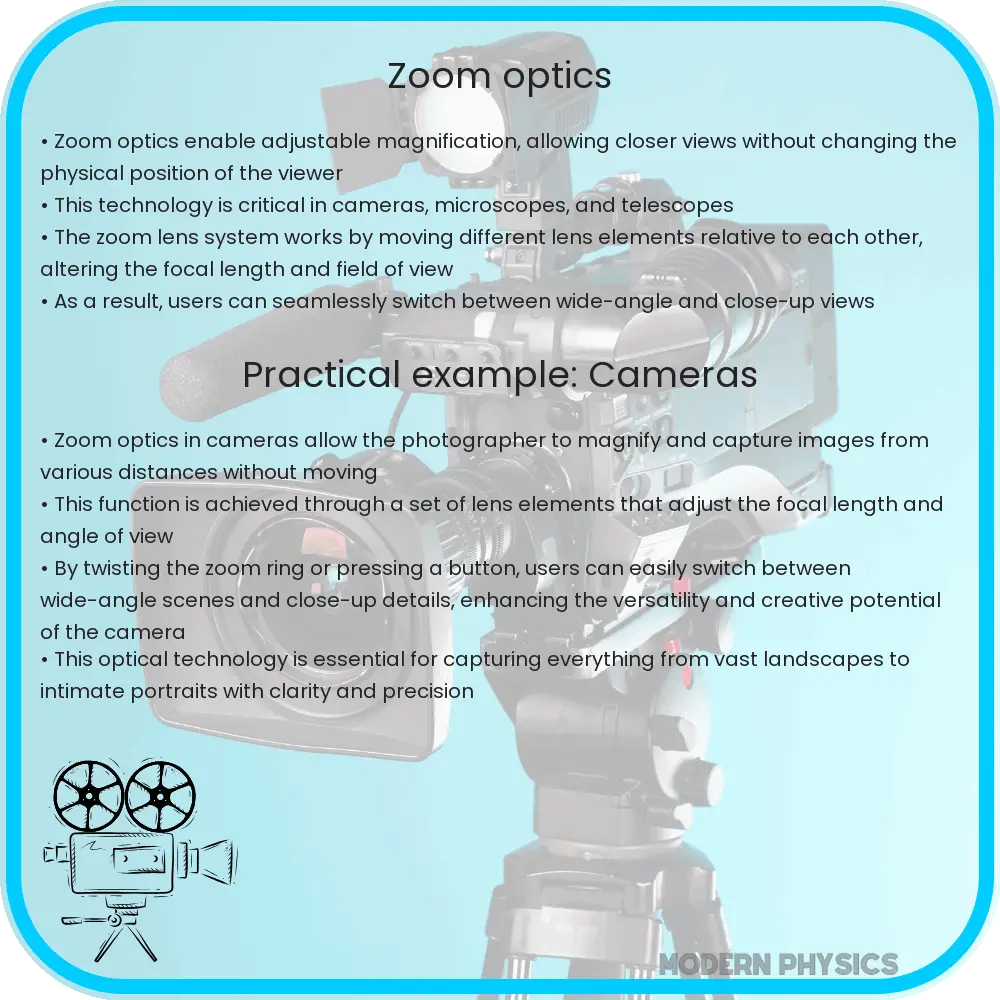
Zoom Optics: Clarity, Precision & Design Fundamentals
In the realm of photography, microscopy, and even smartphone cameras, the ability to zoom in and out while maintaining clarity and precision is crucial. This capability arises from sophisticated zoom optics, a marvel of modern engineering and physics. Understanding the principles behind zoom optics reveals how they provide magnified views without sacrificing image quality.
Basics of Zoom Optics
Zoom optics involve a set of lenses arranged to change the focal length, allowing the user to zoom in (telephoto) or zoom out (wide-angle). The heart of this system relies on lens designs that can provide variable focal lengths without moving the entire lens system significantly.
Optical vs. Digital Zoom
It’s important to understand the distinction between optical and digital zoom:
- Optical Zoom: Achieved by physically adjusting the lens elements, thereby changing the focal length. This type of zoom maintains image clarity and resolution because it modifies the way light is captured.
- Digital Zoom: Uses software to crop and enlarge the image post-capture. It often results in a loss of resolution and clarity since it relies on pixel interpolation.
Principles of Lens Design for Zoom Optics
To design a lens for zoom optics, several principles must be considered. Engineers and physicists deploy a combination of refraction and dispersion to achieve variable focal lengths while maintaining image sharpness.
1/f = 1/u + 1/v
To be continued…
Design Complexities and Engineering Challenges
Designing a reliable zoom lens involves overcoming numerous engineering challenges:
- Precision in Manufacturing: Producing high-quality lenses requires precision manufacturing techniques to ensure that each lens element perfectly aligns with the rest.
- Compactness: Modern devices, especially smartphones, demand compact lenses. Engineers must innovate ways to house these zoom optics in limited spaces without compromising on performance.
- Reducing Aberrations: While designing lenses, reducing optical imperfections like chromatic and spherical aberrations is crucial. This requires meticulous design and the use of advanced materials and coatings.
- Environmental Durability: Zoom lenses must perform consistently in various environmental conditions, from extreme temperatures to humidity. Materials and mechanical designs are tested rigorously to ensure durability.
Applications of Zoom Optics
Zoom optics have revolutionized various domains by enhancing visualization capabilities:
- Photography: Both professional and amateur photographers benefit from zoom lenses, allowing them to capture detailed images from a distance or fit wide scenes into one frame.
- Microscopy: Zoom optics in microscopes enable researchers to observe specimens at varying magnifications, aiding in detailed analysis and discoveries.
- Consumer Electronics: Smartphones and cameras with advanced zoom functionalities have made high-quality imaging accessible to the general public.
Future Innovations in Zoom Optics
The field of zoom optics is continuously evolving with advancements in technology:
- Adaptive Optics: Future lenses may incorporate adaptive optics technology, initially developed for astronomy, to correct for real-time image distortions caused by atmospheric conditions or rapid movements.
- Electronically Tuned Lenses: Innovations are being explored in electronically tunable lenses, which can change their shape and focal length using electrical signals, promising more compact and versatile zoom systems.
- Integration with AI: Artificial Intelligence (AI) enhancements could further improve zoom capabilities by optimizing image processing algorithms for clarity, even in challenging lighting conditions.
Conclusion
Zoom optics are a testament to the marvelous integration of physics and engineering, enabling us to see the world in ways previously unimaginable. From capturing breathtaking photographs to making groundbreaking scientific discoveries, the technology behind zoom lenses continues to advance, bringing more precision and versatility. Understanding the principles and engineering challenges behind zoom optics not only demystifies this technology but also enhances our appreciation for the innovation and effort that go into creating these intricate devices. The future holds exciting possibilities, promising even more sophisticated and accessible zooming capabilities for diverse applications.