
Learn about supercapacitors, advanced energy storage devices that bridge the gap between conventional capacitors and batteries, offering rapid charging and robust cycle life.
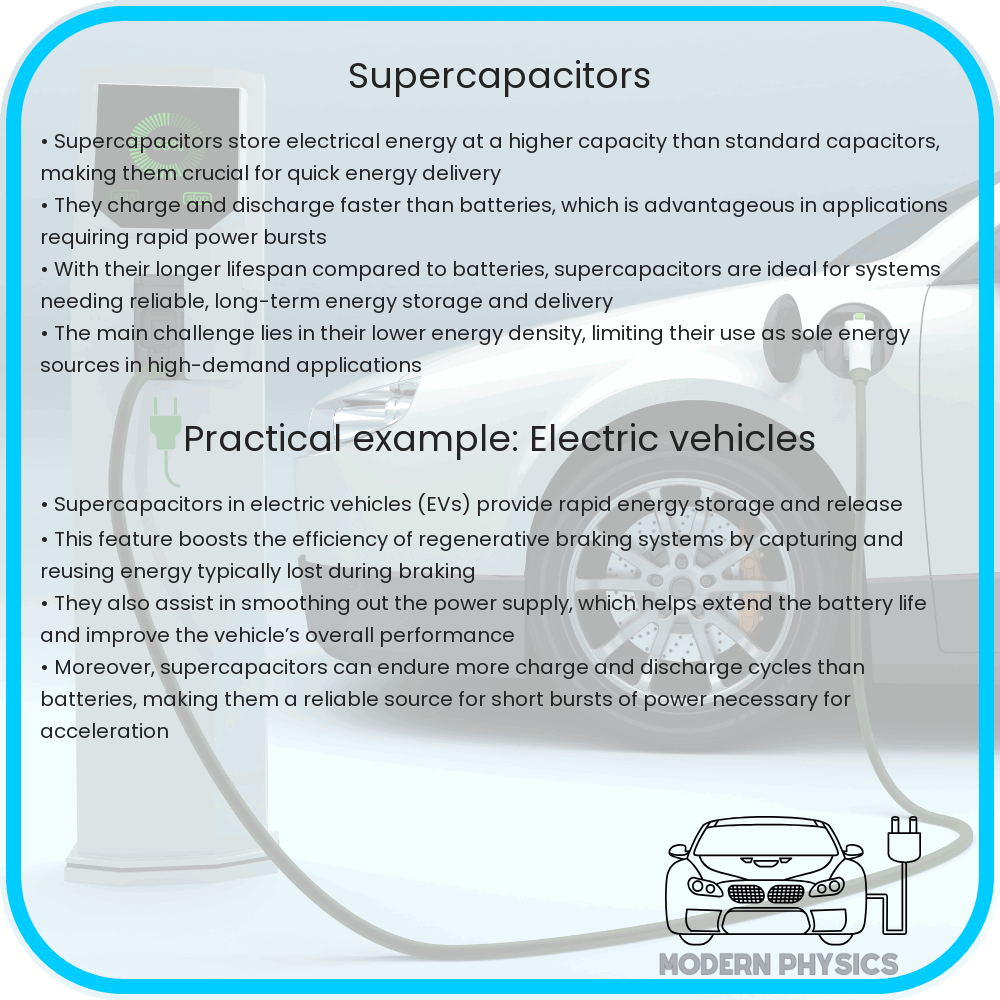
Understanding Supercapacitors: Enhanced Storage, Efficiency, and Durability
Supercapacitors, also known as ultracapacitors, represent a pivotal advancement in the field of energy storage systems. Straddling the line between conventional capacitors and batteries, supercapacitors offer significant improvements in terms of storage capacity, charging rates, and lifecycle durability. Their unique ability to release energy quickly and their tolerance for frequent charging and discharging cycles make them ideal for applications where rapid bursts of power are more crucial than long-term energy storage.
How Supercapacitors Work
At their core, supercapacitors operate on principles similar to traditional capacitors; they store energy via an electrostatic mechanism. Unlike batteries, which rely on chemical reactions to store and release energy, supercapacitors accumulate energy at the interface between a double layer of ions in an electrolyte solution and a conductive electrode. This fundamental difference allows supercapacitors to charge and discharge in a matter of seconds.
Components of a Supercapacitor
The main components of a supercapacitor include electrodes, separator, electrolyte, and current collectors:
- Electrodes: Made from materials with high surface area such as activated carbon, electrodes in supercapacitors facilitate the storage of electrical charges.
- Separator: This non-conductive membrane prevents physical contact between the two electrodes while allowing the flow of ionic charge carriers in the electrolyte.
- Electrolyte: It contains a mixture of positive and negative ions dissolved in a solvent, playing a crucial role in the movement of ions that generate electrical double layers at the electrodes.
- Current Collectors: Typically made from a conductive material, they connect to the external circuit, helping in the efficient distribution of electrons in and out of the supercapacitor.
Energy Storage Mechanism
Supercapacitors store energy through a process known as electrostatic double-layer capacitance (EDLC). In EDLC, energy is stored by means of static charge rather than through a chemical reaction, leading to a much faster charge and discharge process. The amount of energy stored can be expressed by the equation:
\[ E = \frac{1}{2}CV^{2} \]
where:
- E is the energy in joules,
- C is the capacitance in farads,
- V is the voltage across the capacitor in volts.
However, some supercapacitors also exhibit what is known as pseudocapacitance, which involves a faradaic charge transfer contributed by electrode materials such as metal oxides or conducting polymers. This phenomenon can enhance the capacitance value by adding an additional layer of charge storage mechanism to the existing EDLC effects.
Advantages of Supercapacitors
The superior characteristics of supercapacitors include rapid charging and discharging capabilities, high power density, and longevity. Their fast charge/discharge rate makes them suitable for applications requiring instant power surges, such as in regenerative braking systems in vehicles or in power backup systems. Moreover, they can endure hundreds of thousands of charge/discharge cycles without significant degradation, far exceeding the lifecycle of typical batteries.
Furthermore, supercapacitors operate effectively across a broader temperature range compared to batteries, which suffer from reduced performance in extreme conditions. This robustness enhances their viability for use in a wide array of environments and applications, pushing the boundaries of what is achievable with traditional energy storage devices.
In the subsequent section, we will delve deeper into the challenges facing supercapacitors, including energy density limitations and current technological innovations aimed at overcoming these challenges to widen the application spectrum of supercapacitors.
Challenges and Innovations in Supercapacitor Technology
Despite their numerous advantages, supercapacitors face certain limitations that affect their widespread adoption. One primary challenge is their lower energy density compared to conventional batteries. Energy density defines how much energy a storage device can hold relative to its size or mass. While supercapacitors excel in power density, providing quick bursts of energy, they lag behind batteries in terms of long-term energy storage capacity.
Addressing this, researchers are continuously exploring new materials and technologies to enhance the energy density of supercapacitors without compromising their inherent strengths. Advances in nanotechnology have led to the development of novel electrode materials, such as graphene and carbon nanotubes, which offer higher surface areas and electrical conductivity. These materials potentially increase the capacitance and, consequently, the overall energy density of the supercapacitors.
In addition to material innovations, integration techniques such as the development of hybrid supercapacitors are being pursued. These hybrids combine the rapid charge-discharge capabilities of supercapacitors with the higher energy density of batteries, aiming to create a compromise that harnesses the strengths of both technologies.
Future Prospects and Applications
The ongoing improvements in supercapacitor technology hold promising prospects for future applications. As energy density increases and costs decrease, supercapacitors could play a crucial role in the expansion of renewable energy systems by efficiently storing intermittent solar and wind energy.
Moreover, the automotive industry continues to benefit from supercapacitor integration, particularly in electric vehicles (EVs) where they can enhance performance and lifespan by supporting quick energy transfers during acceleration and regenerative braking. Other potential applications include power grid stabilization, portable electronics, and emergency power supply systems, where quick energy delivery is essential.
Conclusion
Supercapacitors represent a dynamic and evolving technology in the field of energy storage, sitting at a fascinating intersection between batteries and conventional capacitors. With their ability to charge and discharge rapidly, endure numerous cycles, and perform under a wide range of temperatures, supercapacitors are already enhancing the capabilities of various electronic and mechanical systems. As challenges like energy density are progressively overcome through innovative research and material science, supercapacitors are poised to become even more integral to modern technological solutions, driving forward the efficiency and effectiveness of energy utilization in countless applications.
In this age of high-demand, high-performance technologies, understanding and leveraging the capabilities of supercapacitors is crucial. They not only offer immediate benefits in terms of power management and sustainability but also open up new avenues for future advancements in energy storage technology.