
Explore the revolutionary world of Quantum Capacitors, their enhanced efficiency, stability, and speed, and their impact on future technology.
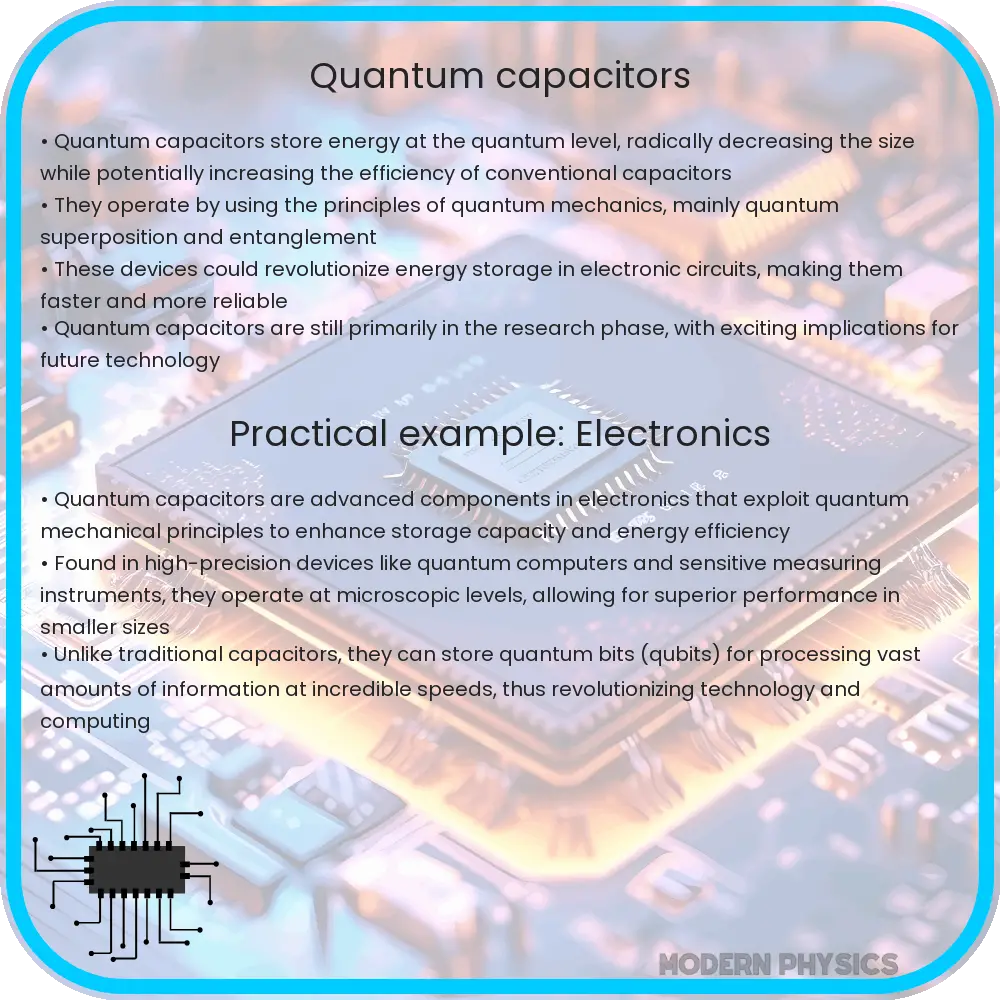
Quantum Capacitors: Revolutionizing Energy Storage
Quantum capacitors represent a groundbreaking advancement in the field of energy storage technology. Leveraging the principles of quantum mechanics, these capacitors offer enhanced efficiency, stability, and speed, setting a new benchmark in the industry. This article delves into the intricate workings of quantum capacitors, their benefits, and their potential applications.
Understanding Quantum Capacitors
At the core of quantum capacitors is the exploitation of quantum states of electrons to store energy. Unlike traditional capacitors that store energy in an electric field, quantum capacitors use the discrete energy levels of electrons in quantum dots or other nanostructured materials. This approach significantly increases the energy density and efficiency of the capacitor.
Enhanced Efficiency and Energy Density
The efficiency of quantum capacitors stems from their ability to harness quantum tunnelling and electron correlation effects. These mechanisms allow for a more compact and efficient energy storage system. Furthermore, the use of nanostructured materials like graphene or transition metal dichalcogenides (TMDs) enhances the energy density, allowing these capacitors to store more energy in a smaller volume.
Improved Stability and Longevity
One of the notable advantages of quantum capacitors is their enhanced stability. The quantum mechanical nature of these devices minimizes the degradation processes that typically affect conventional capacitors. This results in a longer lifespan and consistent performance over time, making them more reliable for long-term applications.
Accelerated Charge and Discharge Rates
Quantum capacitors are not only efficient and stable but also boast rapid charge and discharge rates. This is due to the fast electron transfer processes at the nanostructured interfaces, which enable quick energy release and absorption. Such speed is crucial in applications requiring immediate power bursts, like in electric vehicles or high-speed computing systems.
Potential Applications
The unique properties of quantum capacitors open up a myriad of potential applications. In renewable energy systems, they can provide efficient energy storage, complementing intermittent energy sources like solar and wind. In electronics, their fast charge and discharge rates can revolutionize the performance of portable devices and electric vehicles. Additionally, their stability and efficiency hold promise for advancing technologies in fields like aerospace and military applications.
In conclusion, quantum capacitors are not just a theoretical concept but a tangible innovation with far-reaching implications. As research progresses, we can expect these capacitors to play a pivotal role in various industries, pushing the boundaries of what’s possible in energy storage and utilization.
Challenges and Future Directions
Despite their numerous advantages, quantum capacitors face certain challenges that need addressing. One of the primary concerns is the cost and complexity of manufacturing these advanced materials at a commercial scale. Additionally, ensuring uniformity and stability in the nanostructured materials is crucial for the consistent performance of these capacitors. Researchers are actively working to overcome these hurdles, aiming to make quantum capacitors a viable option for widespread use.
Integration with Existing Technologies
An exciting aspect of quantum capacitors is their potential integration with existing technologies. For instance, in electric grids, these capacitors could be combined with traditional energy storage systems to enhance efficiency and reliability. In consumer electronics, their integration could lead to lighter, more efficient, and longer-lasting devices. Such synergy between new and existing technologies could accelerate the adoption of quantum capacitors in various sectors.
Environmental Impact
Quantum capacitors also hold significant promise in terms of environmental impact. Their enhanced efficiency and longevity could lead to reduced waste and lower energy consumption in many applications. This aligns with global efforts to reduce carbon footprints and move towards more sustainable energy solutions. As such, the development of quantum capacitors is not only a technological advancement but also a step towards environmental sustainability.
Conclusion
In summary, quantum capacitors mark a significant leap forward in energy storage technology. With their unparalleled efficiency, stability, and speed, they are poised to revolutionize various industries, from renewable energy to consumer electronics. While challenges remain in terms of production scalability and integration, the ongoing research and development are promising. The potential environmental benefits further enhance the appeal of these advanced energy storage devices. As technology continues to evolve, quantum capacitors are likely to become a key component in our pursuit of efficient, sustainable, and high-performance energy solutions.