
Uncover the potential of graphene supercapacitors, which utilize graphene’s extraordinary properties to enhance energy storage with high efficiency and durability.
Understanding Graphene Supercapacitors: The Future of Energy Storage
Graphene supercapacitors represent a transformative advancement in the field of energy storage technology. By leveraging the exceptional electrical, thermal, and mechanical properties of graphene, these supercapacitors are leading a shift towards more efficient, high-capacity, and durable ways to store and utilize energy.
What is Graphene?
Graphene is a single layer of carbon atoms arranged in a two-dimensional honeycomb lattice. It exhibits remarkable properties, including high electrical conductivity, supreme mechanical strength, and excellent thermal conductivity. These characteristics make graphene an ideal material for various applications, including in the realm of supercapacitors.
Supercapacitors vs. Traditional Capacitors and Batteries
Supercapacitors, also known as ultracapacitors, store energy through a mechanism that is different from traditional capacitors and batteries. While capacitors store energy in an electric field created between two conductive plates separated by an insulating material, and batteries store energy chemically within their electrodes and electrolyte, supercapacitors combine traits from both:
- Capacitance value generally higher than traditional capacitors
- Charge and discharge much faster than batteries
- Higher energy density than conventional capacitors
Crucially, supercapacitors can endure hundreds of thousands more charge and discharge cycles than batteries.
Role of Graphene in Supercapacitors
Graphene’s incorporation into supercapacitors significantly enhances their performance. The large surface area of graphene provides an astonishing capacitance, which is the ability of a system to store an electric charge. Theoretically, graphene has a surface area of up to 2630 m2/g, which can lead to the development of supercapacitors with very high capacitance values. Additionally, graphene’s high conductive properties facilitate quick charge and discharge cycles.
In the standard architecture of a graphene supercapacitor, graphene acts as the electrode material. Two layers of graphene, separated by an electrolyte, work together to store energy electrostatically. The use of graphene reduces the internal resistance and allows the supercapacitor to perform efficiently at high currents and over extensive periods. This property particularly is what gives graphene supercapacitors a significant edge in terms of durability and lifespan compared to other types of supercapacitors.
Moreover, the mechanical stability of graphene ensures that the supercapacitors are more robust, capable of operating under various mechanical stresses and temperatures, making them suitable for a wide range of applications from electronic devices to industrial scale power management systems.
Applications of Graphene Supercapacitors
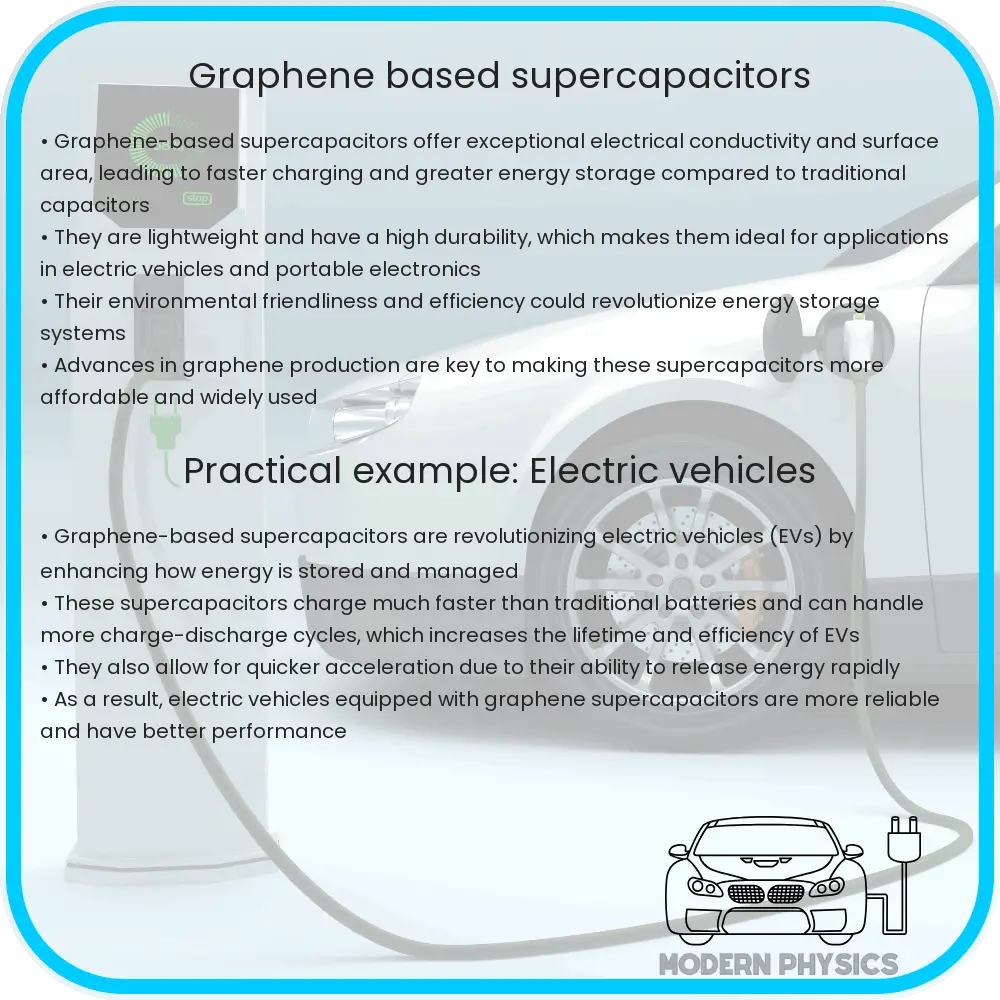
Graphene supercapacitors have the potential to revolutionize many industries due to their enhanced capabilities. In personal electronics, they can significantly reduce charging times while extending battery life. In electric vehicles, supercapacitors could replace conventional batteries, leading to lighter vehicles and longer travel distances per charge. Additionally, in renewable energy systems, graphene supercapacitors offer a solution for storing intermittent power, such as from wind or solar sources, thus stabilizing the electricity supply.
Challenges and Future Perspectives
Despite their many advantages, graphene supercapacitors face several challenges. One of the primary obstacles is cost—graphene is still expensive to produce on an industrial scale. Techniques for manufacturing high-quality graphene cheaply and in bulk are crucial for widespread adoption. Another challenge is integrating this new technology into existing systems and financial models, which are often designed around traditional energy storage methods like lithium-ion batteries.
Looking forward, researchers are focused on overcoming these challenges through innovation in synthesis methods and better integration techniques. As the technology matures and the cost decreases, graphene supercapacitors are expected to become more prevalent in energy systems around the world.
Conclusion
Graphene supercapacitors represent an exciting frontier in energy storage technology, providing a blend of high capacity, rapid charging, and durability that far surpasses existing solutions. By advancing the development and integration of graphene supercapacitors, we can look forward to more efficient electronic devices, sustainable transportation options, and a reliable renewable energy sector. As research and technology continue to break barriers, the potential applications of graphene supercapacitors will expand, opening up new possibilities for a world increasingly dependent on efficient and sustainable energy solutions.