
Explore the fundamentals of optical couplers, their types, mechanics, and diverse applications in telecommunications and beyond for efficient signal processing.
Understanding Optical Couplers: The Path to Efficiency and Versatility
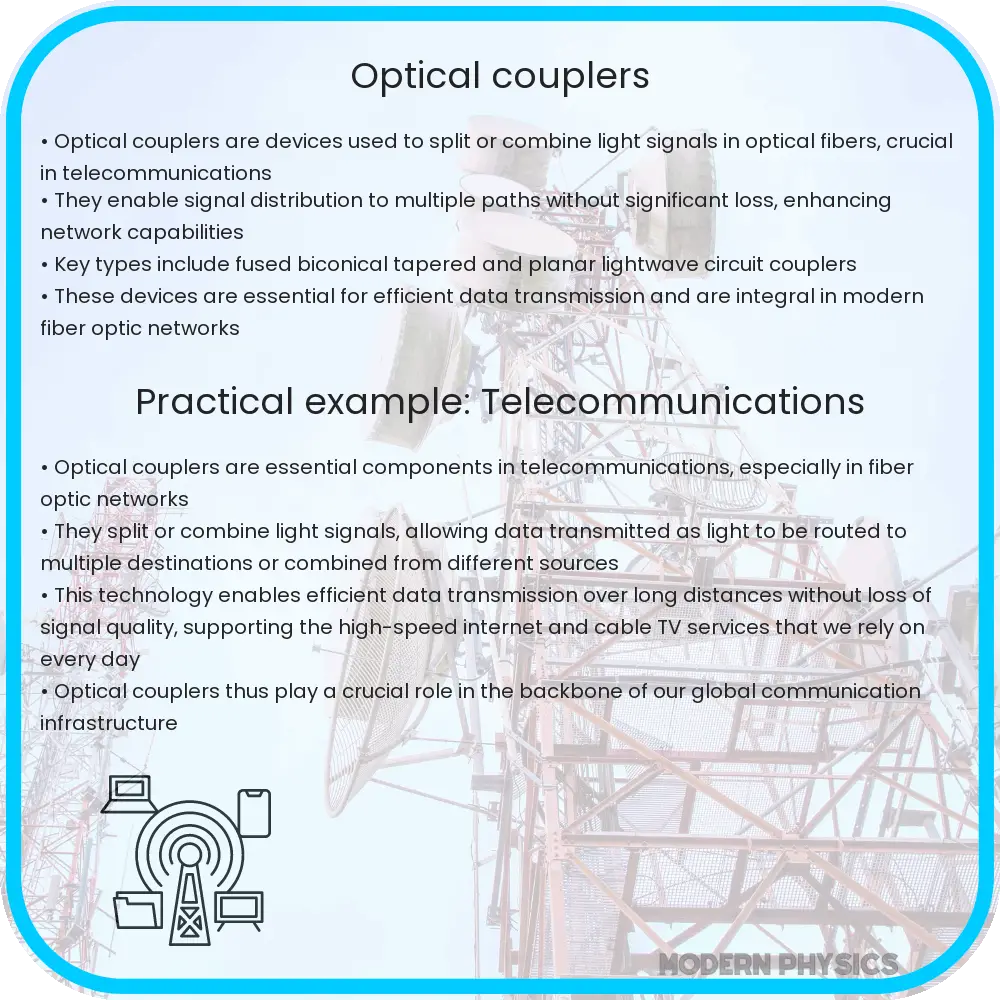
Optical couplers, essential components in the realm of fiber optics and telecommunications, stand at the forefront of enabling efficient, versatile, and reliable optical signal processing. These devices, pivotal for the management of light signals, play a crucial role in splitting or combining light waves without compromising the integrity of the information they carry. This initial exploration delves into the mechanics, types, and applications of optical couplers, underscoring their significance in modern communication systems.
Mechanics of Optical Couplers
At their core, optical couplers operate on the principle of optical interference and waveguide technology to distribute light between two or more fiber ends. By harnessing the phenomena of lightwave coupling, these devices can either split a single light input into multiple outputs or combine several inputs into a single output. The efficiency of an optical coupler is measured by its ability to minimize loss while ensuring maximum signal integrity and uniformity across outputs.
Types of Optical Couplers
- Fused Biconical Taper (FBT) Couplers: Created by fusing and tapering two or more fibers together, FBT couplers are renowned for their customizability and cost-effectiveness, suitable for various splitting ratios.
- Planar Lightwave Circuit (PLC) Couplers: PLC couplers utilize semiconductor fabrication techniques to integrate optical circuits on a chip, offering superior performance and consistency for complex splitting requirements.
- Wavelength Division Multiplexing (WDM) Couplers: These couplers separate or combine signals based on wavelength, critical for bandwidth expansion in communication networks.
Applications of Optical Couplers
Optical couplers find their application across a broad spectrum of fields, from telecommunication to medical imaging. In telecommunications, they are indispensable for signal routing, monitoring, and distribution in fiber optic networks. Furthermore, optical couplers contribute to the advancement of sensor technology, enabling precise measurements in environmental monitoring and biomedical devices. Their versatility also extends to laser systems, where they are used for beam combining and splitting, enhancing the performance and efficiency of laser operations.
Through their efficiency, versatility, and reliability, optical couplers have become foundational to the advancement of optical communication technology. As we delve deeper into their technical intricacies and innovative applications, it becomes evident that optical couplers are not just components but catalysts for a new era of optical networking.
Technical Intricacies and Innovations
The evolution of optical couplers is marked by significant advancements in material science and fabrication techniques, leading to enhanced performance and reduced costs. Innovations such as micro-opto-electro-mechanical systems (MOEMS) and silicon photonics have paved the way for miniaturized, highly integrated optical devices capable of complex functionalities. These technological strides have not only improved the efficiency and reliability of optical couplers but have also expanded their application domains.
Challenges and Future Directions
Despite their numerous advantages, optical couplers face challenges such as insertion loss, wavelength dependency, and polarization sensitivity. Ongoing research focuses on overcoming these limitations through innovative designs and materials, such as photonic crystal fibers and waveguides. Furthermore, the integration of artificial intelligence and machine learning offers promising prospects for adaptive and intelligent optical networks, with couplers that can dynamically adjust to changing conditions and requirements.
Environmental Impact and Sustainability
The environmental impact of optical couplers, while generally lower than electronic counterparts, is an area of growing concern. The push towards greener technologies has led to the development of eco-friendly materials and energy-efficient fabrication processes. Sustainable practices in the production and disposal of optical couplers are crucial for minimizing the carbon footprint of optical communication systems.
Conclusion
Optical couplers stand as a testament to the remarkable progress in the field of optical communications, embodying the principles of efficiency, versatility, and reliability. Their evolution reflects the continuous quest for innovation, driven by the challenges of modern communication needs and environmental considerations. As we look towards the future, the role of optical couplers in enabling advanced, sustainable, and intelligent optical networks is indisputable. Their ongoing development and adaptation will undoubtedly continue to shape the landscape of telecommunications, sensing technologies, and beyond, highlighting the enduring importance of these pivotal devices in the digital age.
With their broad range of applications and potential for future advancements, optical couplers not only facilitate today’s communication demands but also inspire tomorrow’s technological breakthroughs. The journey of optical couplers from fundamental components to enablers of cutting-edge technologies showcases the dynamic interplay between innovation and practicality, urging us forward in the exploration of optical science and engineering.