
Explore how fiber optic transmitters revolutionize communication with high-speed, reliable data transfer, shaping the future of digital connectivity.
Understanding Fiber Optic Transmitters
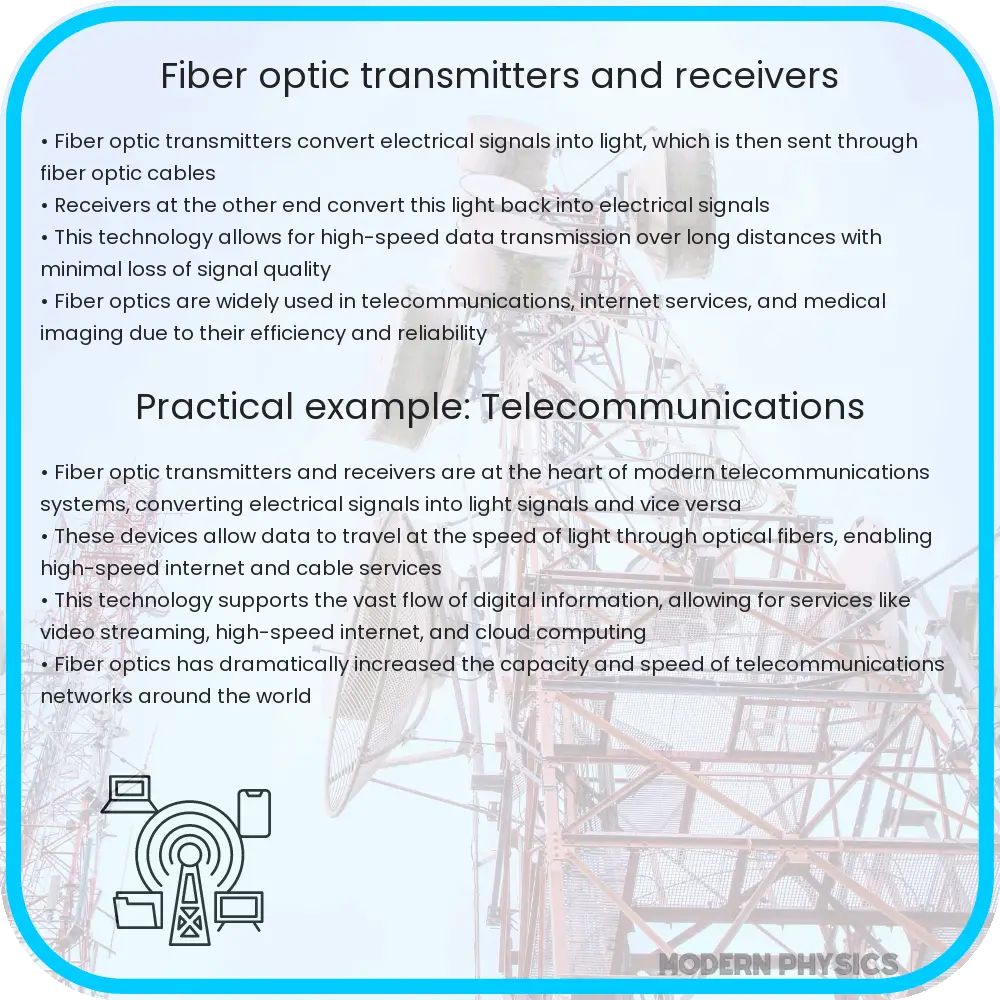
Fiber optic transmitters are pivotal in modern telecommunications, converting electrical signals into optical signals that can travel through fiber optic cables. These devices are crucial for high-speed, reliable, and efficient data transmission over long distances, making them indispensable in internet backbones, telecommunication networks, and data center connections.
Key Components and How They Work
At the heart of a fiber optic transmitter is a light source, typically a laser diode or a light-emitting diode (LED). The choice between a laser diode and an LED depends on the application’s requirements for speed, distance, and budget. Laser diodes are preferred for their ability to transmit data over longer distances and at higher speeds, thanks to their coherent light, which minimizes signal loss and dispersion.
The transmitter also includes a driver circuit that modulates the light source, encoding the electrical signal into a light signal. This modulation can be either analog or digital, with digital modulation being the most common in telecommunications due to its higher efficiency and capacity for high-speed data transmission.
Advantages of Fiber Optic Transmitters
- High-Speed Transmission: Fiber optic transmitters enable data transmission at speeds of up to several terabits per second, far surpassing traditional copper cable capabilities.
- Reliability: Optical fibers are immune to electromagnetic interference, ensuring that the data transmitted is less susceptible to corruption or loss.
- Efficiency: Optical signals suffer from less attenuation compared to electrical signals, allowing for data transmission over longer distances without the need for signal boosters.
The efficiency and reliability of fiber optic transmitters are further enhanced by advancements in technology, such as Dense Wavelength Division Multiplexing (DWDM). DWDM increases the bandwidth of fiber optic cables by transmitting multiple light beams, each at a different wavelength, through the same fiber. This technology multiplies the data transmission capacity, making fiber optic systems even more efficient.
In summary, fiber optic transmitters play a critical role in the backbone of modern telecommunications infrastructure, providing the speed, efficiency, and reliability required for today’s high-demand network environments.
Fiber Optic Transmitters: Pioneers of Modern Communication
In the realm of digital communication, fiber optic transmitters stand as a cornerstone for transmitting information at speeds that were once deemed impossible. These devices convert electrical signals into optical signals, enabling data to traverse vast distances with minimal loss. The efficiency, speed, and reliability they offer have revolutionized how we connect, paving the way for advancements in internet technology, telecommunications, and beyond.
How Fiber Optic Transmitters Work
Fiber optic transmitters begin their process by receiving electronic data from a source, such as a computer or a network switch. This data is then converted into light by a laser or a light-emitting diode (LED). The light generated carries the data through optical fibers, which are remarkably thin strands of glass or plastic, to its destination. The core principle behind this technology is the use of light, a medium that can carry more information over longer distances faster than any electrical signal through copper wire.
Advantages of Fiber Optic Transmitters
- High-Speed Data Transmission: One of the most significant advantages of fiber optic transmitters is their ability to transmit data at speeds reaching into the gigabits per second (Gbps) or even terabits per second (Tbps), far surpassing traditional copper cables.
- Reliability and Low Signal Loss: Optical fiber is immune to electromagnetic interference, meaning that fiber optic transmitters can send data over long distances without the signal degradation common in copper cables.
- Enhanced Security: Data transmitted through fiber optics is less susceptible to being intercepted, making it a more secure medium for sensitive information.
Applications of Fiber Optic Transmitters
Fiber optic transmitters are instrumental in various applications, from high-speed internet connections and telecommunications to medical imaging and military communications. Their ability to transmit large volumes of data at high speeds makes them invaluable in sectors where efficiency and reliability are paramount. In the internet backbone, fiber optic cables carry the bulk of the world’s data, underpinning the global digital infrastructure and enabling the rapid exchange of information across continents.
Conclusion
The advent of fiber optic transmitters has ushered in a new era of communication, characterized by unprecedented speeds, reliability, and efficiency. As technology continues to evolve, these transmitters play a critical role in shaping the future of our digital world. Their wide-ranging applications and advantages underscore their importance in our increasingly interconnected society. As we push the boundaries of what’s possible, fiber optic transmitters will continue to be at the heart of innovations, driving progress in countless fields and enhancing the way we live, work, and connect.