
Explore how fiber couplers and splitters enhance data transmission speed and precision in telecommunications, driving future network performance.
Fiber Couplers & Splitters: Enhancing Data Transmission Precision and Speed
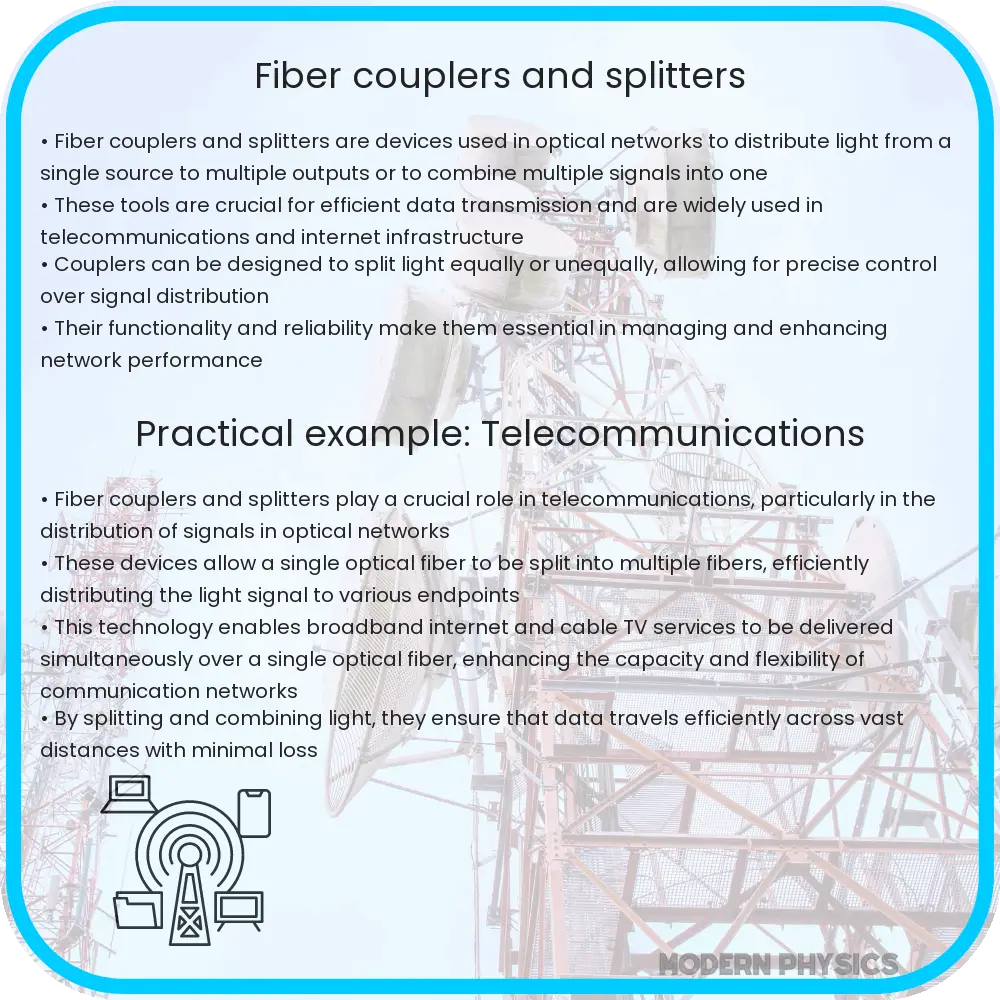
In the realm of optical communications, fiber couplers and splitters play pivotal roles in directing the flow of light signals, thereby significantly enhancing data transmission’s precision and speed. These devices are essential components of modern telecommunication systems, data center networks, and optical fiber sensors, offering a blend of technical sophistication and practical utility.
Understanding Fiber Couplers
Fiber couplers are devices designed to distribute or combine light from multiple fibers. They are integral in managing the directionality of signal transmission, enabling the splitting of light from a single fiber into two or more fibers, or vice versa. This capability is crucial for creating network branches or integrating signals in telecommunication infrastructure, ensuring seamless data flow across various network segments.
The Role of Fiber Splitters
Similarly, fiber splitters are specialized types of couplers designed explicitly for dividing light from one fiber into multiple fibers. They are pivotal in applications that require signal distribution to multiple locations without signal degradation. Splitters are commonly used in passive optical networks (PONs), facilitating internet, cable TV, and telephone services in telecommunications systems.
Advancements in Technology
Recent advancements in fiber optic technology have led to the development of more efficient and precise couplers and splitters. These enhancements include the use of waveguide technology and micro-optics to achieve better control over light propagation, minimizing loss and maximizing signal fidelity. The introduction of wavelength-selective splitters and couplers also allows for the simultaneous transmission of multiple signals at different wavelengths, significantly increasing the data capacity of optical fibers.
Impact on Data Transmission
The utilization of advanced fiber couplers and splitters has a profound impact on data transmission, enabling higher speeds, greater bandwidth, and improved reliability. By efficiently managing the distribution and combination of optical signals, these devices facilitate the rapid transmission of vast amounts of data over long distances, supporting the ever-growing demand for high-speed internet and telecommunications services.
The evolution of fiber optic components, such as couplers and splitters, continues to drive the telecommunications industry forward, promising even greater levels of data transmission precision and speed in the future.
Enhancing Network Performance with Fiber Couplers and Splitters
The technical evolution of fiber couplers and splitters is directly linked to the enhancement of network performance. With the capability to support multiple data channels over a single optical fiber, these devices contribute to the densification of network infrastructure. This not only reduces the physical space required for cables but also significantly cuts down on the overall cost of network deployment and maintenance.
Application in Diverse Sectors
Beyond telecommunications, the application of fiber couplers and splitters spans various sectors including medical imaging, aerospace, and defense. In medical imaging, for instance, splitters are used in endoscopic procedures for better light management, enhancing the quality of images. Similarly, in aerospace and defense, these components are crucial for data communication systems, where precision, reliability, and speed are non-negotiable.
Future Prospects
The future of fiber couplers and splitters looks promising with ongoing research focused on enhancing their performance and functionality. Innovations such as tunable splitters and couplers, which allow for the dynamic adjustment of splitting ratios, are on the horizon. This flexibility could revolutionize network management, allowing for real-time adjustments based on bandwidth demand.
Moreover, the integration of smart technologies with fiber optic components, enabling predictive maintenance and network optimization, is another area of potential growth. Such advancements could further bolster the efficiency and reliability of optical networks, catering to the exponential increase in data traffic and the expanding needs of the digital world.
Conclusion
The role of fiber couplers and splitters in the modern telecommunications landscape cannot be overstated. These devices are the backbone of optical networks, ensuring the precise and efficient transmission of data across the globe. With technological advancements enhancing their functionality, fiber couplers and splitters are set to play an even more crucial role in meeting the world’s ever-increasing demand for high-speed, reliable data transmission. As we look toward a future marked by further digital transformation, the continued evolution of these components will be paramount in shaping the next generation of telecommunications infrastructure, making our world more connected than ever before.