
Explore how nanoscale light confinement revolutionizes quantum tech, boosts efficiency, and spurs innovation in computing, healthcare, and beyond.
Nanoscale Light Confinement: Pioneering Quantum Efficiency and Technological Innovation
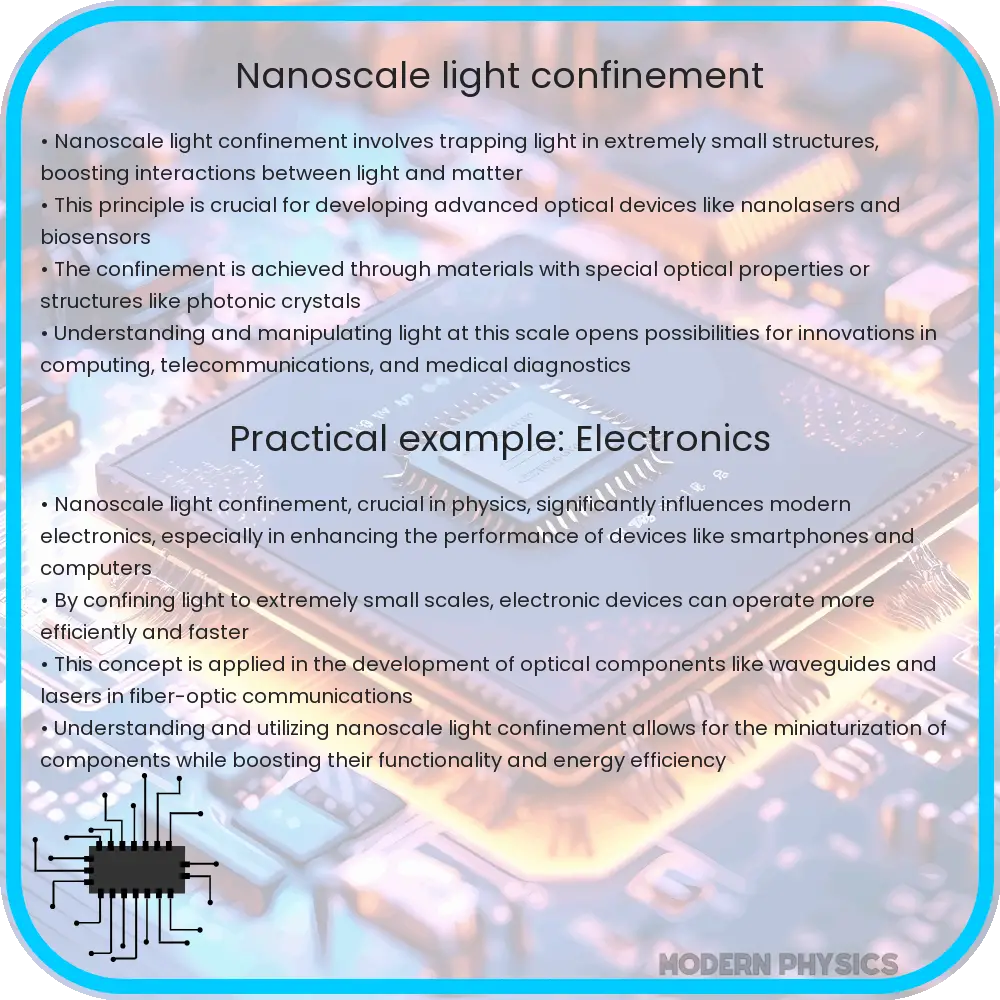
The realm of nanotechnology has brought forth the marvel of nanoscale light confinement, a groundbreaking advancement poised to revolutionize quantum technology, enhance efficiency, and foster innovation across various sectors. This cutting-edge technique manipulates light at the nanoscale, enabling unprecedented control over light-matter interactions. Through the precise engineering of materials at the nanometer scale—often smaller than the wavelength of light—scientists and engineers can confine light within incredibly small volumes, unlocking new possibilities for photonic devices.
Quantum Tech: The Frontier of Miniaturization and Efficiency
At the heart of nanoscale light confinement lies its potential to propel quantum technology forward. Quantum technologies, which leverage the principles of quantum mechanics, stand to benefit immensely from the enhanced control and manipulation of photons at the nanoscale. This not only paves the way for the development of ultra-compact, efficient quantum computers, sensors, and communication devices but also significantly improves their performance and reliability. The ability to confine light within nanoscale dimensions enhances the interaction between light and matter, a critical aspect for quantum computing and entangled photon generation, essential for quantum encryption and communication.
Boosting Efficiency with Nanophotonics
Nanophotonics, the study of light behavior on the nanometer scale, is a key area that exploits nanoscale light confinement to boost efficiency. By confining light in nanostructured materials, devices achieve greater control over light propagation and emission. This enhanced control leads to more efficient light absorption and emission processes, crucial for solar cells, LEDs, and photodetectors. The manipulation of light at this scale allows for the development of more compact, energy-efficient devices that can outperform their conventional counterparts.
Spurring Innovation in Multiple Domains
The implications of nanoscale light confinement extend far beyond quantum technology and photonic efficiency. This technique is instrumental in advancing research and development in fields such as biomedical imaging, environmental monitoring, and energy harvesting. By enabling the precise detection and manipulation of biomolecules, for instance, nanoscale light confinement technologies can lead to breakthroughs in medical diagnostics and treatment. Similarly, the ability to precisely control light at the nanoscale can improve the sensitivity and specificity of sensors used in environmental monitoring, offering new tools to tackle global challenges.
Enabling Advanced Materials with Unique Optical Properties
The exploration of nanoscale light confinement has also led to the discovery and synthesis of advanced materials with unique optical properties. Metamaterials and photonic crystals, designed with nano-precision, exhibit exceptional control over light propagation, including negative refraction, superlensing, and cloaking. These materials open new avenues for manipulating light in ways that were once thought to be impossible, enabling the development of super-resolution imaging systems and invisibility cloaks, thus broadening the horizons of optical engineering and applied physics.
Challenges and Future Prospects
Despite its impressive potential, the path to integrating nanoscale light confinement into practical applications faces several challenges. Fabricating nanostructures with the required precision and stability is complex and costly. Moreover, managing heat dissipation at such small scales and ensuring compatibility with existing technologies remain significant hurdles. However, ongoing research and technological advancements are gradually overcoming these obstacles, promising a future where nanoscale light confinement technologies become central to numerous applications.
The relentless pursuit of innovation in nanoscale light confinement is also fostering interdisciplinary collaboration among physicists, chemists, material scientists, and engineers. This collaborative effort is essential for addressing the multifaceted challenges of designing, fabricating, and implementing nanoscale devices and systems. As we advance, the continued miniaturization of technology and the quest for higher efficiency and functionality will keep nanoscale light confinement at the forefront of scientific and technological progress.
Conclusion
Nanoscale light confinement stands as a beacon of innovation, driving advancements in quantum technology, nanophotonics, and a multitude of other fields. By harnessing the power to manipulate light at the nanoscale, scientists and engineers are unlocking new possibilities for efficient, compact, and highly functional devices. Despite the challenges that lie ahead, the potential of nanoscale light confinement to revolutionize communication, computing, healthcare, and environmental monitoring is immense. As research and technology continue to evolve, the future of nanoscale light confinement shines brightly, promising to reshape our world in ways we are just beginning to imagine.