
Explore the capabilities of Optical Coherence Elastography (OCE) in detecting tissue stiffness with high accuracy, speed, and resolution for improved diagnostics.
Introduction to Optical Coherence Elastography
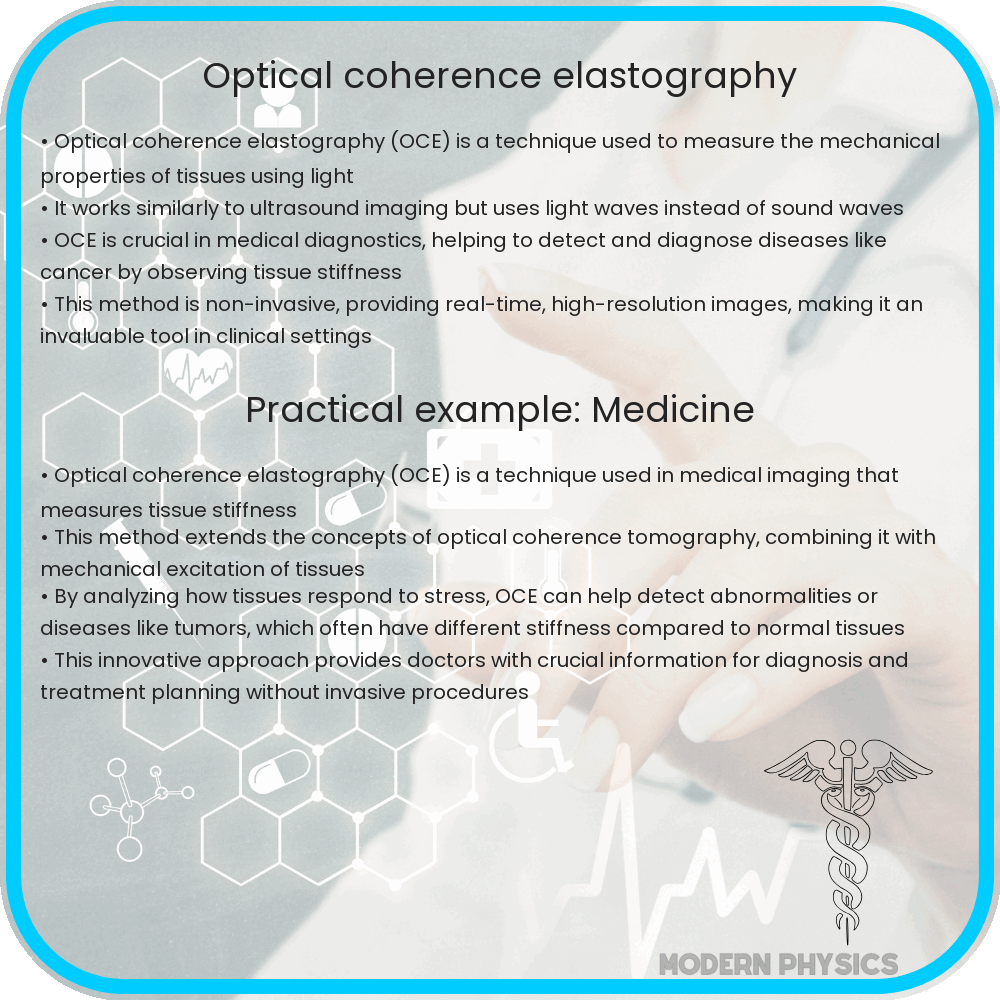
Optical Coherence Elastography (OCE) represents a groundbreaking advancement in biomedical imaging, offering a non-invasive technique for measuring the mechanical properties of tissues. This innovative approach extends the capabilities of traditional Optical Coherence Tomography (OCT) by not only imaging tissue structures but also assessing their elasticity or stiffness. The clinical relevance of OCE is profound, with applications ranging from oncology to ophthalmology, where the mechanical properties of tissues can provide critical diagnostic information.
Accuracy of Optical Coherence Elastography
The accuracy of OCE is paramount for its effectiveness in clinical applications. OCE leverages the principle of elastography, where an external stimulus is applied to tissues, and the resulting deformation is measured. By combining this with the high-resolution imaging of OCT, OCE achieves remarkable accuracy in detecting minute changes in tissue stiffness. This accuracy is especially crucial in the early detection of malignant tumors, as cancerous tissues typically exhibit different mechanical properties compared to healthy tissues. The precise measurement of tissue elasticity allows for the differentiation between benign and malignant lesions, enhancing diagnostic accuracy and potentially reducing the need for invasive biopsy procedures.
Speed and Resolution of OCE
The speed and resolution of OCE are critical factors that determine its utility in clinical settings. OCE systems are designed to provide rapid imaging capabilities, enabling real-time visualization of tissue elasticity. This speed is essential for practical clinical use, where time constraints are often critical. Furthermore, the resolution of OCE is on the micron scale, which allows for the detailed imaging of microstructural changes in tissues. This high resolution is crucial for identifying early-stage diseases, where subtle changes in tissue composition and structure can be indicative of pathology.
Moreover, ongoing advancements in OCE technology continue to improve both the speed and resolution of imaging. These improvements are achieved through the development of more sophisticated OCT systems, innovative elastography techniques, and advanced computational algorithms for data analysis. As a result, OCE is becoming an increasingly valuable tool in the medical imaging field, providing detailed insights into tissue mechanics that were previously unattainable.
Challenges and Future Directions in Optical Coherence Elastography
Despite its significant advantages, OCE faces certain challenges that need to be addressed to enhance its applicability and effectiveness. One of the primary challenges is the standardization of OCE methodologies and protocols across different devices and applications. The variability in techniques for applying mechanical stimuli and measuring tissue response can affect the comparability of results across studies and devices. Furthermore, the interpretation of OCE data requires sophisticated analysis and an understanding of tissue biomechanics, which can vary significantly between different types of tissues and pathological conditions.
Another area for development is the integration of OCE with other imaging modalities. Combining OCE with technologies such as magnetic resonance imaging (MRI) or ultrasound could provide complementary information, enriching the diagnostic capabilities and offering a more comprehensive view of tissue health. Such multimodal imaging approaches could enhance the accuracy of diagnoses and the monitoring of disease progression and response to treatment.
Future advancements in OCE are likely to focus on improving the technology’s sensitivity and specificity, enabling the detection of even subtler changes in tissue mechanics. Additionally, efforts to miniaturize OCE systems could facilitate its application in endoscopic procedures or in vivo measurements, opening new avenues for diagnostic imaging in internal organs and hard-to-reach areas. The ongoing research and development in photonics, signal processing, and machine learning algorithms also promise to extend the capabilities of OCE, making it a more versatile and powerful tool in the medical field.
Conclusion
Optical Coherence Elastography stands at the forefront of biomedical imaging technology, offering unparalleled insights into the mechanical properties of tissues. Its accuracy, speed, and resolution make OCE a powerful tool for early disease detection, diagnosis, and treatment planning. Despite facing challenges such as standardization and the need for advanced analysis techniques, the future of OCE is bright with potential for further advancements and broader clinical applications. As technology progresses, OCE is set to revolutionize the field of medical imaging, providing a non-invasive, high-resolution window into the physical characteristics of tissues that correlate closely with their health and pathology. By continuing to refine and develop OCE technology, researchers and clinicians will unlock new potentials for diagnosing and treating diseases with precision and efficacy previously unimagined.