
Explore the intersection of quantum optics and photonic crystals, unlocking advancements in computing, communication, and sensing through light manipulation.
Exploring Quantum Optics in Photonic Crystals: A New Frontier
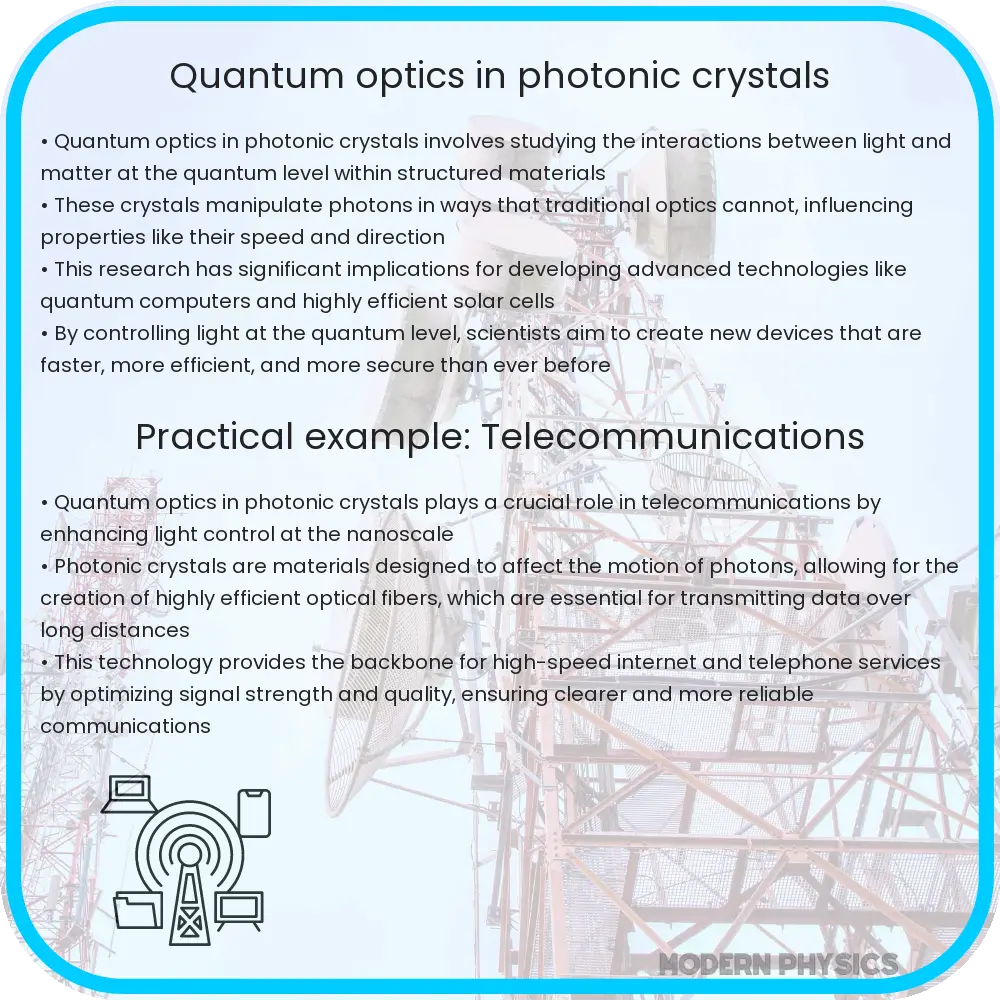
Quantum optics, a field at the intersection of quantum mechanics and optical sciences, delves into the behavior of light and its interaction with matter at the quantum level. An exciting advancement in this domain is the utilization of photonic crystals, materials engineered to have a periodic optical nanostructure that affects the motion of photons. This manipulation of light within photonic crystals opens up unprecedented opportunities in waveguide design, bandgap engineering, and the broader realm of light manipulation, heralding a new era in optical technologies.
Understanding Photonic Crystals and Their Unique Properties
Photonic crystals are characterized by their ability to control the flow of light, a property derived from their unique structure which creates a photonic bandgap. This bandgap prevents photons of certain energy levels from propagating through the crystal, similar to the way electronic bandgaps work in semiconductors. By adjusting the size and arrangement of the nanostructures within photonic crystals, engineers can tailor the bandgap to specific frequencies of light, enabling precise control over the propagation of photons.
The Role of Waveguides in Photonic Crystals
Waveguides in photonic crystals play a crucial role in directing the flow of light. By introducing defects into the otherwise perfect periodic structure of a photonic crystal, localized modes can be created where light is allowed to propagate. These engineered defects act as waveguides, channels that can guide light through the crystal with minimal loss. This capability is instrumental in developing highly efficient optical circuits, which are vital for optical computing and communication systems.
Exploiting the Photonic Bandgap for Light Manipulation
The photonic bandgap phenomenon is at the heart of light manipulation strategies in photonic crystals. By carefully designing the photonic crystal’s structure, it is possible to achieve selective transmission, reflection, or absorption of light at specific wavelengths. This selective control over light-matter interaction paves the way for a myriad of applications, from creating highly sensitive sensors to developing new platforms for quantum computing and secure communication networks that leverage the principles of quantum optics.
As we delve deeper into the capabilities of photonic crystals, their potential to revolutionize the field of quantum optics becomes increasingly apparent. The ability to manipulate light at such a fundamental level promises not only advancements in technology but also a deeper understanding of the quantum world.
Advancing Quantum Computing and Secure Communication
The integration of quantum optics with photonic crystals holds particular promise for quantum computing and secure communication. Quantum computing relies on the principles of quantum mechanics to process information in ways that traditional computers cannot match. Photonic crystals, with their precise control over light, offer a promising pathway to realizing photonic quantum bits (qubits) for quantum computing. These qubits can exist in multiple states simultaneously, enabling unprecedented processing power and efficiency.
Innovations in Sensing and Metrology
Beyond computing and communication, the unique properties of photonic crystals are driving innovations in sensing and metrology. The sensitivity of photonic crystals to changes in their environment makes them ideal for developing new types of sensors that can detect minute changes in chemical compositions, temperature, or pressure. Furthermore, their ability to manipulate light at the quantum level enhances precision in measurements, opening new frontiers in scientific research and industrial monitoring.
Challenges and Future Directions
Despite the promising advancements, the field of quantum optics in photonic crystals faces challenges. Fabricating photonic crystals with the required precision at a large scale remains a technical hurdle. Moreover, integrating these materials into existing technology infrastructures requires overcoming significant engineering challenges. However, ongoing research and technological advancements are paving the way for overcoming these obstacles, with scientists and engineers making steady progress towards practical applications.
Conclusion
The exploration of quantum optics within the framework of photonic crystals represents a frontier of both theoretical and applied physics. The ability to control and manipulate light at the quantum level offers a wealth of opportunities for advancing technology and expanding our understanding of the quantum world. From revolutionizing computing and communication to pushing the boundaries of sensing and metrology, the potential applications of this research are vast and varied. As we continue to tackle the challenges inherent in this field, the future of quantum optics in photonic crystals looks bright, promising a new era of technological innovation and scientific discovery.