
Explore the groundbreaking world of photonic lattices, their key patterns, applications across industries, and the future of light manipulation technology.
Exploring the Fascinating World of Photonic Lattices
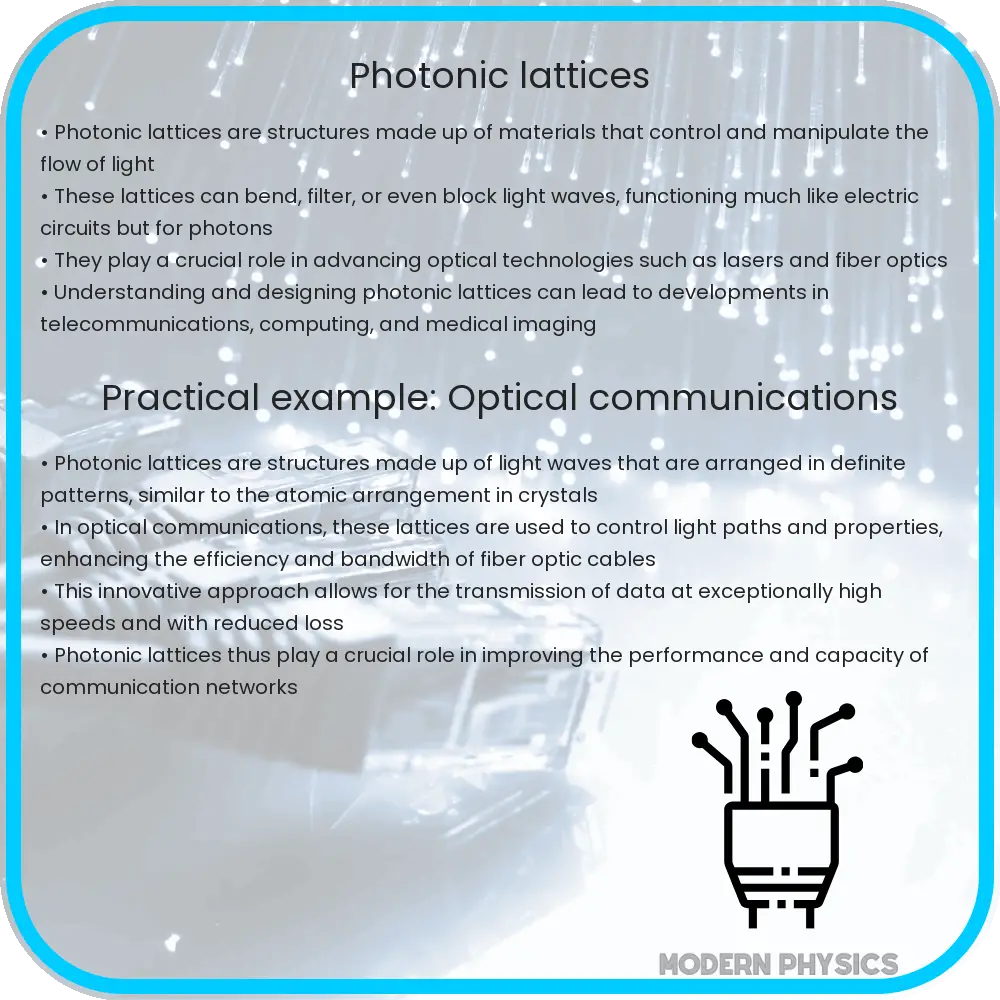
Photonic lattices, a groundbreaking field of physics and engineering, have captivated the scientific community with their intricate patterns and the vast potential they hold for technological advancement. These structures, designed to control and manipulate the flow of light, are at the forefront of optical research, offering new pathways for the development of photonic devices.
Key Patterns and Their Significance
At the heart of photonic lattices lies a variety of key patterns, each with its unique characteristics and implications. One fundamental pattern is the periodic arrangement of dielectric materials, which creates a photonic bandgap. This bandgap acts as a barrier for certain light frequencies, enabling precise control over light propagation. Such patterns are essential for developing efficient waveguides, filters, and light sources.
Applications Across Industries
The applications of photonic lattices are as diverse as they are impactful. In telecommunications, they are used to enhance signal transmission by minimizing loss and dispersion. The healthcare industry benefits from their application in biomedical imaging and diagnostics, where high-resolution, non-invasive techniques are paramount. Furthermore, photonic lattices are integral to the development of quantum computing, providing a platform for creating and manipulating quantum states of light.
Theoretical Foundations and Future Directions
Underpinning the development of photonic lattices is a rich theoretical framework that merges concepts from optics, materials science, and quantum physics. The theory of photonic bandgap materials, for instance, has been instrumental in designing lattices that can control light with unprecedented precision. Researchers continue to explore the quantum properties of light within these structures, pushing the boundaries of what’s possible in optical computing and beyond.
The future of photonic lattices is undoubtedly promising, with ongoing research aimed at unlocking even more sophisticated applications. From enhancing solar energy conversion to pioneering new forms of light-based computing, the potential of these structures is only beginning to be tapped. As the field evolves, it will continue to challenge our understanding of light and its capabilities, paving the way for a future where the manipulation of light at the nanoscale can lead to revolutionary technological advancements.
Advancements in Fabrication Techniques
The progress in photonic lattice applications is closely tied to advancements in fabrication techniques. Cutting-edge methods such as direct laser writing, electron beam lithography, and self-assembly processes have enabled the creation of increasingly complex and precise photonic structures. These techniques allow for the manipulation of materials on the nanoscale, resulting in lattices with finely tuned optical properties. The ability to craft such intricate patterns is crucial for the practical implementation of photonic devices in real-world applications.
Challenges and Opportunities
Despite the significant advancements, the field of photonic lattices faces several challenges. One of the primary hurdles is the integration of these lattices into existing optical systems and technologies, which requires overcoming compatibility and scalability issues. Additionally, there is a continuous need for materials with better optical properties to enhance the performance of photonic lattice-based devices. However, these challenges also present opportunities for innovation and collaboration across disciplines, driving further research and development in this exciting field.
Interdisciplinary Collaboration and Future Research
The advancement of photonic lattices is inherently interdisciplinary, requiring collaboration among physicists, engineers, material scientists, and technologists. The synergy between these fields can accelerate the discovery of new materials, fabrication techniques, and theoretical models, pushing the boundaries of what is possible with photonic technologies. Future research is likely to focus on achieving greater control over light-matter interactions, developing more efficient manufacturing processes, and exploring the integration of photonic lattices with other technological platforms.
Conclusion
Photonic lattices represent a frontier in the manipulation of light, offering unprecedented opportunities for innovation in multiple industries. From revolutionizing telecommunications and healthcare to opening new avenues in quantum computing and solar energy conversion, the potential applications of these structures are vast and varied. As we continue to unravel the complexities of light-matter interactions and overcome current fabrication and integration challenges, photonic lattices stand poised to play a central role in the next generation of technological advancements. The future of this field is bright, with ongoing research set to unlock further potentials of light, ultimately shaping the technological landscape of tomorrow.