
Nanocrystal solar cells are innovative PV technologies enhancing solar energy efficiency, durability, and eco-friendliness through nanometer-sized crystals.
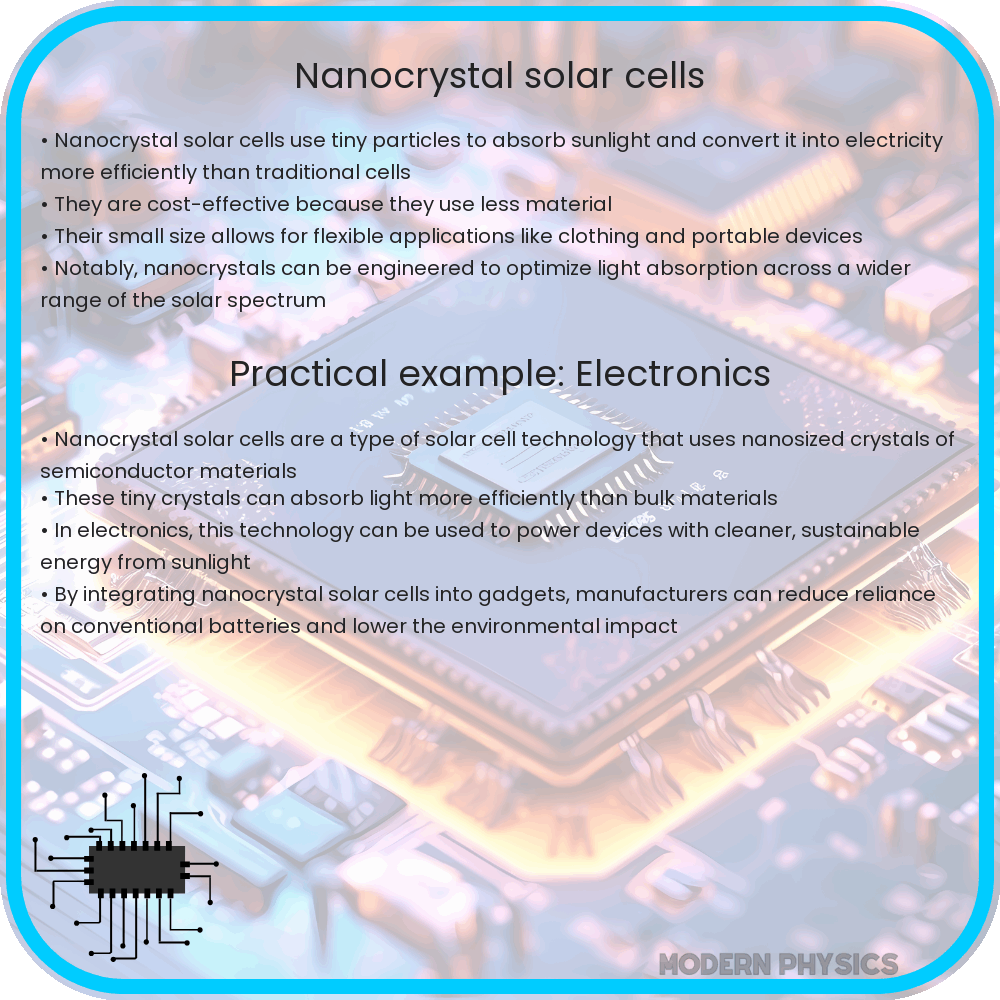
Nanocrystal Solar Cells: Pioneering Efficient, Durable, and Eco-Friendly Energy
Solar energy, harnessed through solar panels, stands as one of the most promising renewable energy sources in the world today. Among the various technologies available for converting sunlight into electricity, nanocrystal solar cells have emerged as a groundbreaking innovation. These solar cells are key players in addressing the challenges of efficiency, durability, and environmental impact that common photovoltaic (PV) technologies face. Below, we delve into how nanocrystal technology works and why it offers such promise.
Understanding Nanocrystal Solar Cells
Nanocrystal solar cells incorporate nanometer-sized crystals – extraordinarily small particles that can exhibit exceptional electrical and optical properties. Typically made from semiconducting materials like cadmium telluride (CdTe) or copper indium gallium selenide (CIGS), these nanoparticles are adept at absorbing sunlight and converting it into electricity. What sets nanocrystal cells apart is their size; the tiny nanoparticles have a high surface area relative to their volume, which enhances their ability to capture and convert sunlight more efficiently than larger particles.
Advantages Over Traditional Solar Cells
- Increased Efficiency: Nanocrystal solar cells operate with a quantum dot structure that allows them to absorb a wider range of the solar spectrum compared to traditional silicon cells. This ability to capture more wavelengths of light directly translates into higher efficiency rates.
- Flexible Applications: Unlike the rigid structure of traditional panels, nanocrystal solar cells can be manufactured into flexible layers. This versatility allows for integration into various surfaces like building facades, vehicles, or even clothing.
- Lowered Manufacturing Costs: Generally, the production of nanocrystal solar cells involves simpler and less energy-intensive processes, which can potentially lower the costs of manufacture as compared to silicon-based cells.
- Durability: The robustness of the materials used in nanocrystals can lead to longer lifespans for the solar cells under different environmental conditions.
Eco-friendly Manufacturing
Significantly, nanocrystal solar cells offer an advantage when it comes to environmental impact. Their production does not require the same high temperatures, or toxic chemicals typically needed for creating traditional solar cells. Moreover, the energy-intensive steps are fewer, meaning that the overall carbon footprint during manufacture can be reduced. These factors make nanocrystal solar cells a more sustainable choice in the realm of solar technology.
As research continues to advance, there is an ongoing improvement in the techniques for producing and utilizing these cells, which may lead to even lower environmental impacts and broader applications. This continual development is not only promising for making solar energy more accessible but also for pushing the boundaries on how efficiently and sustainably we can harness the sun’s power.
Future Prospects and Challenges
The journey of nanocrystal solar cells is not without its hurdles. One of the prominent challenges lies in the scalability of production. While nanocrystal solar cells offer numerous benefits, scaling up their manufacturing processes to meet global demands is still a work in progress. Researchers are actively working to find cost-effective and efficient ways to produce these cells on a larger scale without compromising on quality and performance. Additionally, there are issues related to the long-term stability of the nanomaterials used, which must be addressed to guarantee the longevity that consumers expect from solar technologies.
Collaborative Efforts and Innovations
To overcome these challenges, collaboration among scientists, engineers, and industry leaders is crucial. Innovations in nanotechnology, material science, and engineering are continuously being integrated to enhance the performance and durability of nanocrystal solar cells. These collaborative efforts not only help in improving the technology but also in establishing standards and protocols for their integration into the existing energy systems.
Conclusion
Nanocrystal solar cells represent a significant leap forward in solar technology, offering increased efficiency, flexibility, and environmental sustainability. As we continue to confront global energy challenges, innovations like nanocrystal solar cells play a pivotal role in advancing renewable energy solutions. Despite the challenges in scalability and stability, the potential for these cells to revolutionize the energy landscape remains immense. With ongoing research, collaborative efforts, and technological advancements, the future of nanocrystal solar cells looks bright, promising a cleaner, more sustainable future powered by the sun.