
Learn about Organic Photodetectors (OPDs), flexible, eco-friendly devices that convert light into electrical signals, enhancing applications in digital imaging and sensors.
Introduction to Organic Photodetectors
Organic photodetectors (OPDs) represent a significant advancement in optical sensor technology, combining the benefits of lightweight, flexible materials with the principles of sustainability. Widely used in applications ranging from digital cameras to medical sensors, OPDs harness light to convert it into electrical signals, differentiating them from traditional photodetectors by their composition and versatility.
Understanding Organic Photodetectors
At their core, OPDs are composed of organic semiconductor materials. These materials are carbon-based, making them distinct from the inorganic compounds like silicon commonly used in traditional photodetectors. The organic nature of these materials provides unique properties such as flexibility, tunable absorption spectra, and the potential for easier and less energy-intensive manufacturing processes.
Organic photodetectors operate based on the photoelectric effect. When photons strike the active layer of an OPD, they excite electrons, raising them from the valence band to the conduction band, thereby creating electron-hole pairs known as excitons. The separation of these charges across the device generates an electrical signal corresponding to the intensity and wavelength of the incident light.
The Benefits of Organic Photodetectors
- Flexibility: The use of organic materials allows OPDs to be manufactured on flexible substrates. This attribute enables the development of bendable and wearable devices, opening up new avenues for applications in flexible electronics and smart textiles.
- Sensitivity and Selectivity: OPDs can be engineered to be highly sensitive and selective to specific wavelengths of light. This makes them ideal for specialized sensing applications, such as in biomedical imaging or environmental monitoring, where precise detection of specific light wavelengths is crucial.
- Low-cost Manufacturing: The synthesis and processing of organic materials can often be done at lower temperatures and with less stringent environmental controls compared to inorganic materials. This translates to lower production costs and reduced energy consumption during manufacturing.
- Eco-Friendly: As organic materials are primarily carbon-based, they are potentially more environmentally friendly compared to their inorganic counterparts. They can be designed to be more easily degradable, reducing their impact on the environment post-use.
Advancements in Organic Photodetector Technology
Recent progress in materials science has greatly enhanced the performance of OPDs. Innovations such as the development of new organic semiconductor materials and the refinement of device architectures have led to improvements in efficiency, durability, and response times of these devices. Additionally, advanced techniques like nanostructuring and hybridization with inorganic materials have been used to further enhance the capabilities of OPDs.
These technological advancements extend the potential applications of OPDs, making them suitable for more demanding environments and tasks, such as high-resolution imaging in security systems or precise light detection in automotive sensors.
Moreover, ongoing research is focused on overcoming some of the traditional limitations of OPDs, including their sensitivity to oxygen and moisture, which can degrade the organic materials over time. Solutions such as better encapsulation techniques and the development of more robust organic materials are currently being investigated to extend the lifespan and reliability of these devices.
Current and Future Trends in OPD Application
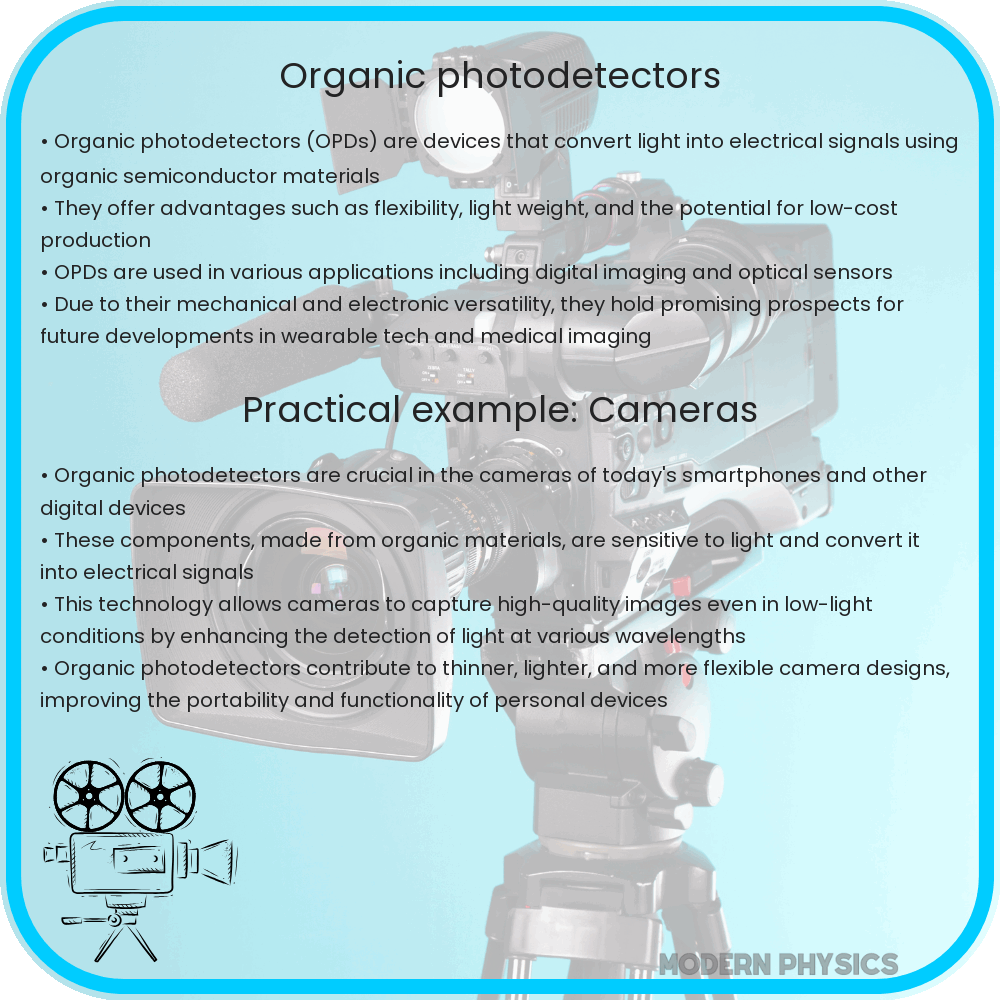
As organic photodetector technology matures, its integration into daily technology and industrial applications is steadily increasing. Smartphones and other consumer electronics that require advanced imaging capabilities are starting to adopt OPDs due to their thinner, lighter, and more flexible properties. Furthermore, the medical field is exploring OPDs for new types of non-invasive diagnostic tools, which utilize the technology’s ability to detect a wide spectrum of light with high precision.
Looking towards the future, the potential for OPDs to contribute to sustainable technologies is immense. Their application in solar power harvesting, for example, could revolutionize how solar energy is collected and utilized, making solar panels more efficient and less obtrusive. Researchers are also exploring the possibility of integrating OPDs with artificial intelligence to create smart sensing systems that are more adaptive and responsive to their environment.
Conclusion
Organic photodetectors represent a fascinating and rapidly advancing field in optical sensor technology. Their unique composition of organic materials not only provides distinct benefits such as flexibility and eco-friendliness but also opens up a myriad of applications across various industries. From high-stakes fields like security and healthcare to consumer electronics and environmental monitoring, OPDs are set to become a cornerstone technology that bridges the gap between digital innovations and organic material science.
As this technology continues to evolve and overcome its current limitations, we may soon see more widespread adoption of OPDs in even more diverse applications. The ongoing enhancements in material science, device architecture, and integration capabilities suggest a bright future for OPDs, highlighting the potential of organic electronics in contributing to a more sustainable and technologically advanced society.