
Explore the intriguing concept of Wigner Rotation in special relativity, its mathematical basis, implications in physics, and practical applications.
Understanding Wigner Rotation in Special Relativity Dynamics
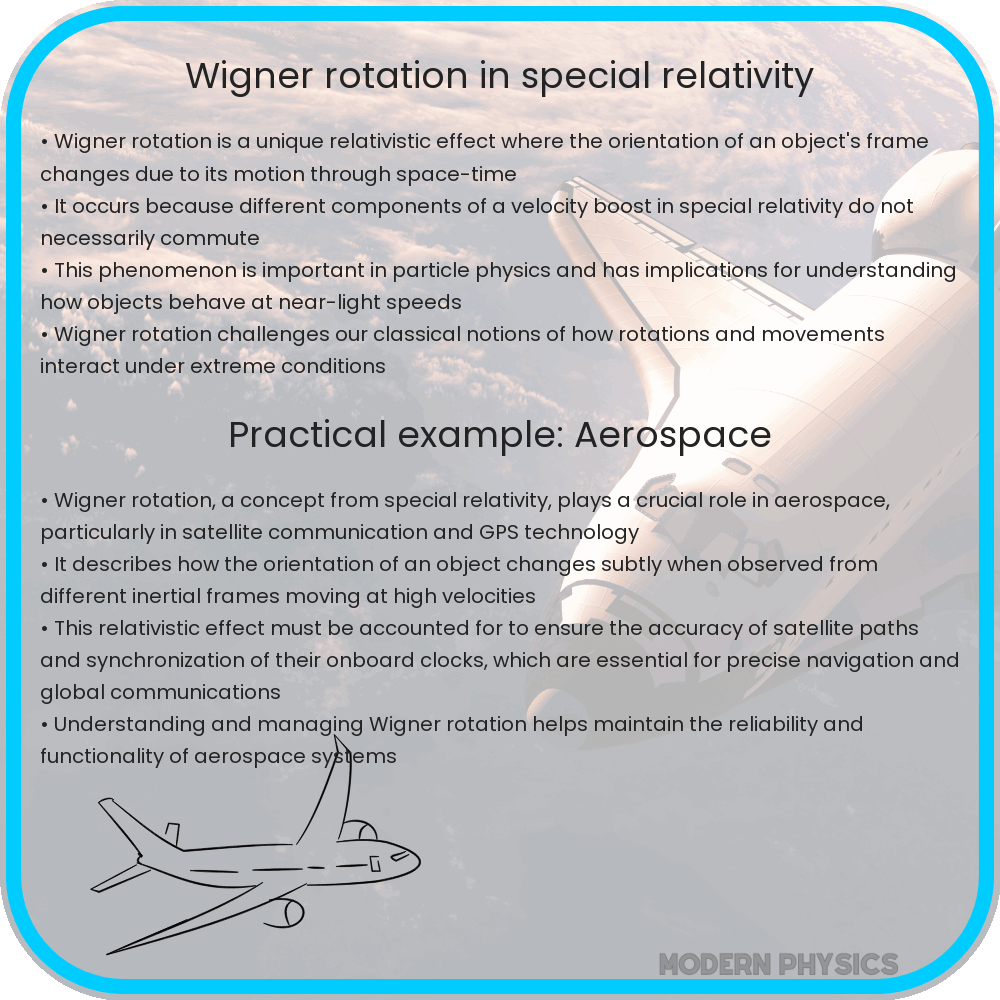
Wigner rotation, a fascinating phenomenon in the realm of special relativity, emerges from the intricate interplay of relativity and rotational transformations. It is named after Eugene Wigner, a prominent physicist who contributed significantly to the field of quantum mechanics and relativity. This article aims to elucidate the concept of Wigner rotation and its implications in the framework of special relativity.
The Basis of Wigner Rotation
The core principle of Wigner rotation lies in the transformation of reference frames. In classical mechanics, when an object moves from one inertial frame to another, its velocity and position change, but its orientation remains unaltered. However, in the realm of special relativity, this is not the case. When transitioning between different inertial frames moving at relativistic speeds, not only do the velocity and position of an object change, but its orientation also undergoes a subtle rotation, known as the Wigner rotation.
Special Relativity and Lorentz Transformation
To understand Wigner rotation, one must first grasp the concept of Lorentz transformation. Lorentz transformations are the mathematical operations that describe how the measurements of time and space coordinates of events change in different inertial frames in special relativity. These transformations ensure the constancy of the speed of light (c ≈ 3.00 × 10⁸ m/s) in all inertial frames, a cornerstone principle of Einstein’s theory of relativity.
Wigner Rotation: A Deeper Dive
Imagine two inertial frames, A and B, moving relative to each other. If an observer in frame A analyzes a spinning object in frame B, they would notice that the object’s spin axis undergoes a rotation as the frame B moves. This rotation, which is not present in classical physics, is the Wigner rotation. The intriguing aspect of Wigner rotation is that it becomes significant only at velocities close to the speed of light. This phenomenon is a direct consequence of the relativistic effects on space-time as described by Lorentz transformations.
Interestingly, Wigner rotation has profound implications in the field of particle physics, particularly in understanding the behavior of particles like electrons and photons that travel at relativistic speeds. It provides insights into the spin and angular momentum of particles, key aspects in quantum mechanics.
As we delve deeper into the realms of special relativity and quantum mechanics, Wigner rotation stands as a testament to the non-intuitive yet fundamental nature of our universe at high velocities. In the next section, we will explore the mathematical formulation of Wigner rotation and its practical applications in modern physics.
Mathematical Formulation of Wigner Rotation
The mathematical essence of Wigner rotation can be understood through the Lorentz transformation matrices. When combining two Lorentz transformations, the resulting transformation includes not only a translational component but also a rotational one. This rotation is the Wigner rotation. Mathematically, it is represented by a group of transformations known as the Lorentz Group. The angle of Wigner rotation, θW, can be calculated using the formula:
�
�
=
arccos
(
Trace
(
�
)
−
1
2
)
θ
W
=arccos(
2
Trace(L)−1
)
where L is the Lorentz transformation matrix and Trace(L) represents the sum of the diagonal elements of this matrix.
Practical Applications and Implications
Wigner rotation has significant implications in the realm of high-energy physics and quantum field theory. One of the most notable applications is in the understanding of spinor fields. Spinors, which describe particles like electrons and neutrinos, transform under Lorentz transformations in a way that involves Wigner rotation. This aspect is crucial for correctly describing the behavior of these particles in relativistic quantum mechanics.
Additionally, Wigner rotation plays a role in the synchronization of clocks in orbiting satellites. For global positioning systems (GPS), which rely on precise time measurement, the effects of relativity, including Wigner rotation, must be accounted for to ensure accuracy.
Conclusion: The Significance of Wigner Rotation
In summary, Wigner rotation is a subtle yet profound phenomenon in special relativity. It challenges our classical intuitions about the behavior of objects in different inertial frames, especially at relativistic speeds. While the rotation itself might be minuscule and unnoticeable at everyday speeds, its implications become significant in the realm of particle physics and high-velocity astrophysical objects.
The concept not only deepens our understanding of the universe at a fundamental level but also has practical applications in modern technology, such as in GPS and communications satellites. The study of Wigner rotation thus represents a perfect blend of theoretical intrigue and practical utility, a testament to the ever-evolving nature of our understanding of the physical world. As we continue to explore the universe, concepts like Wigner rotation will undoubtedly play a pivotal role in shaping our comprehension of the complex interplay between relativity, quantum mechanics, and the fabric of spacetime.