
Explore Wigner Rotation’s role in quantum mechanics and Lorentz transformations, bridging the gap between quantum states and relativity.
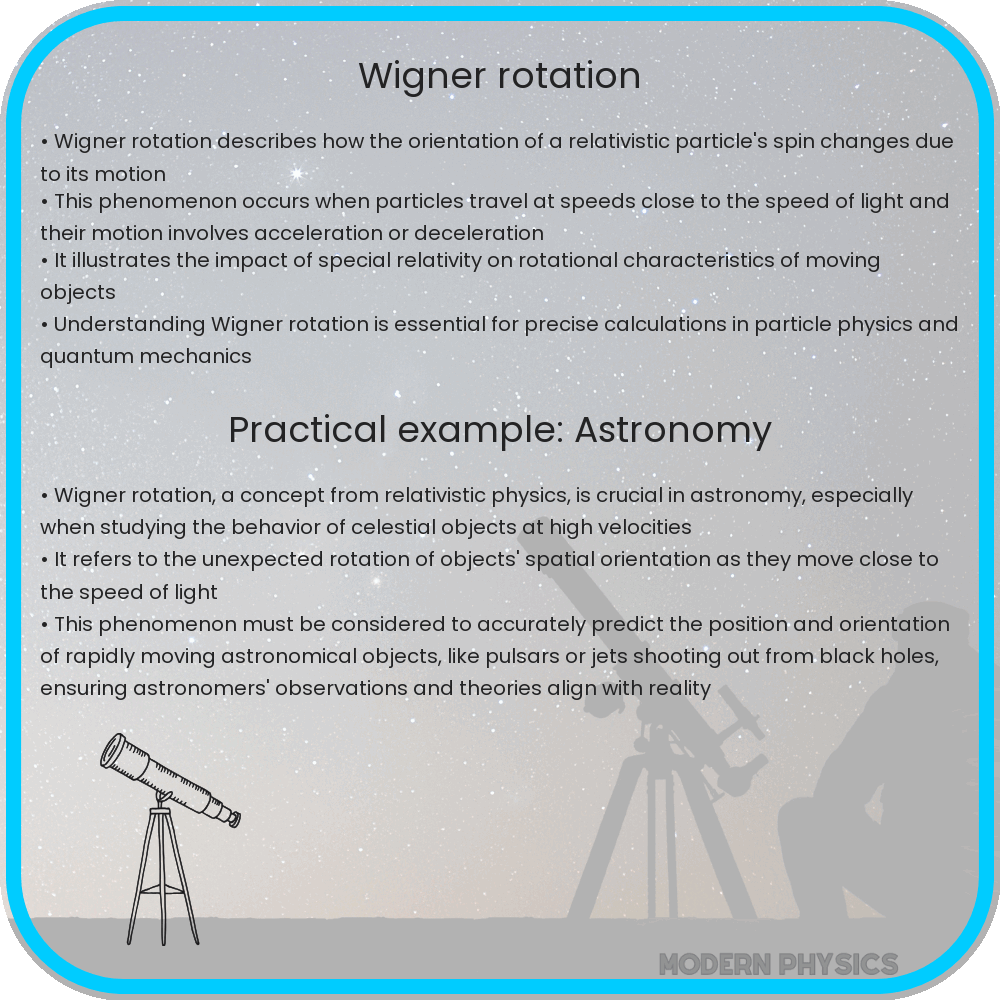
Understanding Wigner Rotation in Quantum Mechanics and Lorentz Transformations
Wigner rotation, named after physicist Eugene Wigner, is a fascinating phenomenon at the intersection of quantum mechanics and the theory of relativity. It manifests in the context of Lorentz transformations, which are fundamental to Einstein’s theory of relativity, highlighting the intricate relationship between quantum states and observers moving at relativistic speeds.
The Lorentz Transformation: A Prelude to Wigner Rotation
Lorentz transformations form the core of special relativity, providing the mathematical framework for understanding how measurements of space and time differ for observers in relative motion. Crucially, these transformations preserve the speed of light as a constant in all inertial frames, a cornerstone of modern physics. The equations involve c, the speed of light, and v, the relative velocity of the observer, and are defined as:
- Time dilation: t’ = γ(t – vx/c2)
- Length contraction: l’ = l/γ
- Velocity Transformation: u’ = (u – v)/(1 – uv/c2)
Here, γ (gamma) is the Lorentz factor, defined as γ = 1/√(1 – v2/c2). These transformations have profound implications for our understanding of space, time, and motion, especially at velocities close to the speed of light.
Quantum Mechanics and Lorentz Transformations
In quantum mechanics, particles are described by wave functions, which encapsulate their probabilistic nature. The wave function provides information about the likelihood of finding a particle in a particular state or position. However, when considering relativistic speeds, Lorentz transformations play a crucial role in how these wave functions transform between different observers. This interaction leads to the Wigner rotation.
Wigner rotation emerges when considering the transformation of quantum states under Lorentz transformations. In essence, it describes a rotation in the spin of a particle when observed from two different inertial frames moving relative to each other. This rotation is not a physical movement in space but a change in the orientation of the spinor, the mathematical object representing the particle’s spin state in quantum mechanics.
The significance of Wigner rotation lies in its ability to reconcile the principles of quantum mechanics with the theory of relativity, two pillars of modern physics. It ensures that the laws of quantum mechanics remain consistent for observers in different inertial frames, adhering to the principle of relativity. This phenomenon has implications in understanding fundamental particles and their interactions, especially in high-energy physics where relativistic effects are prominent.
In the next section, we will delve deeper into the mathematical formulation of Wigner rotation and explore its implications in theoretical and experimental physics.
Mathematical Formulation of Wigner Rotation
The mathematical description of Wigner rotation is deeply rooted in the theory of group representations, particularly the representations of the Lorentz group. The Lorentz group encompasses all Lorentz transformations and includes rotations and boosts (transformations to moving frames). In quantum mechanics, particles with spin, such as electrons, are described by spinors. Under a Lorentz transformation, these spinors transform according to the representation of the Lorentz group, leading to Wigner rotation.
Consider a particle with spin moving from one inertial frame to another. The change in the observer’s frame of reference induces a Lorentz transformation, which can be decomposed into a boost (change in velocity) followed by a rotation. This rotation is the Wigner rotation. Its angle, often denoted as θW, depends on both the velocity of the frame transformation and the intrinsic spin of the particle. The Wigner rotation angle is given by:
θW = arctan[(v/c)sin(θ)/(1 + (v/c)cos(θ))]
where v is the relative velocity, c is the speed of light, and θ is the angle of the Lorentz boost.
Implications and Applications
Wigner rotation has profound implications in various fields of physics. In particle physics, it plays a crucial role in understanding the behavior of elementary particles at high energies, where relativistic effects are significant. In quantum field theory, it aids in constructing quantum states that are consistent with the principles of relativity. Additionally, it has practical implications in areas like nuclear magnetic resonance (NMR) and the study of polarized light in astrophysics.
One intriguing aspect of Wigner rotation is its potential role in quantum information theory. Since it can alter the spin state of a particle, it may affect quantum entanglement in systems involving relativistic particles. This has led to research into the relativistic effects on quantum computing and information transmission.
Conclusion
Wigner rotation is a subtle yet powerful concept bridging quantum mechanics and relativity. It highlights the intricate interplay between the spin of particles and their relativistic motion. Beyond its theoretical elegance, Wigner rotation offers practical insights in high-energy physics, astrophysics, and the burgeoning field of quantum information science. As our understanding of the universe delves deeper into the quantum realm, phenomena like Wigner rotation not only enrich our knowledge but also challenge us to rethink the fundamental principles that govern the microscopic and macroscopic worlds.