
Explore the Wigner-Weyl Transform in Quantum Field Theory: Insights, Integration, and Applications in Quantum Mechanics and Beyond.
Understanding the Wigner-Weyl Transform in Quantum Field Theory
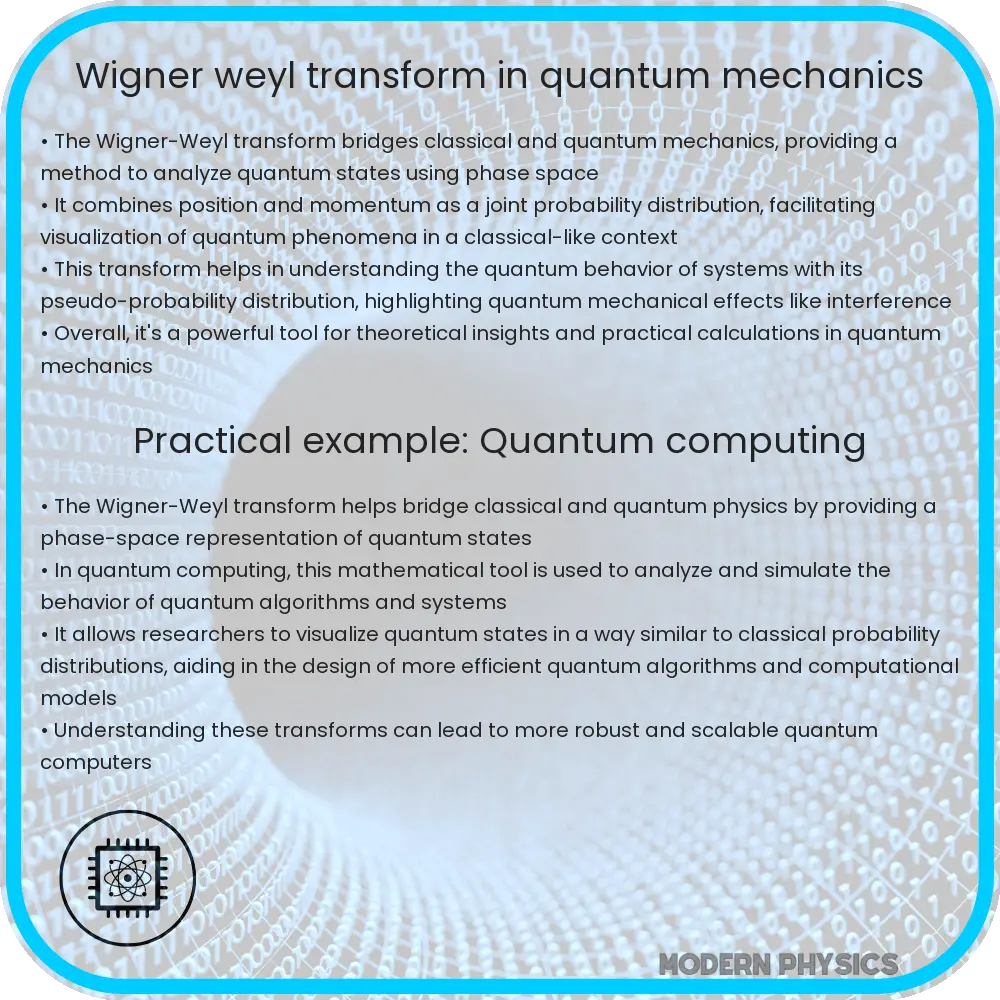
The Wigner-Weyl transform is a mathematical tool of significant importance in Quantum Field Theory (QFT), offering a unique approach to the analysis and understanding of quantum systems. It serves as a bridge between the classical and quantum worlds, providing insights into the quantum behavior of systems while maintaining a connection to classical mechanics. This transform finds its use in various areas of physics, including statistical mechanics and quantum optics.
Integration in Quantum Field Theory
In QFT, the Wigner-Weyl transform plays a critical role in integrating quantum mechanics with field theory. It allows for the representation of quantum states in phase space, a concept deeply rooted in classical mechanics. This phase space representation enables physicists to visualize quantum phenomena in a more intuitive manner, akin to classical trajectories. This integration is pivotal for studying complex systems where the traditional approach of wave functions becomes cumbersome.
Insight into Quantum Phenomena
One of the most significant advantages of the Wigner-Weyl transform is its ability to provide deep insights into quantum phenomena. For instance, it facilitates the understanding of quantum coherence and entanglement, foundational aspects of quantum mechanics. By bridging the gap between classical and quantum descriptions, it offers a powerful framework for interpreting quantum mechanical behavior in terms of classical probability distributions, albeit with certain quantum corrections.
Applications in Quantum Field Theory
The applications of the Wigner-Weyl transform in QFT are manifold. It aids in the calculation of correlation functions, a fundamental aspect of QFT that describes how particles interact and influence each other over space and time. Additionally, it provides a framework for analyzing the thermal properties of quantum fields, an essential aspect in understanding the behavior of systems at high temperatures.
In conclusion, the Wigner-Weyl transform is an invaluable tool in the realm of Quantum Field Theory. It not only offers a deeper understanding of quantum mechanics but also bridges the gap between quantum and classical descriptions. Its applications extend to various aspects of physics, making it a cornerstone in the study of quantum phenomena.
Further Readings and References
- Wigner, E. P. (1932). On the quantum correction for thermodynamic equilibrium. Physical Review, 40(5), 749.
- Hillery, M., O’Connell, R. F., Scully, M. O., & Wigner, E. P. (1984). Distribution functions in physics: Fundamentals. Physics Reports, 106(3), 121-167.
- Zachos, C. K., Fairlie, D. B., & Curtright, T. L. (2005). Quantum Mechanics in Phase Space: An Overview with Selected Papers. World Scientific.
Advanced Insights and Challenges
The Wigner-Weyl transform, while powerful, also presents certain challenges and advanced insights in Quantum Field Theory (QFT). One of the complexities arises in dealing with the non-positive definiteness of the Wigner function, which can lead to probabilities that are not physically interpretable. This necessitates careful analysis and interpretation, especially when dealing with quantum phenomena where classical analogies break down.
Quantum Computing and Information
In the rapidly evolving field of quantum computing and information, the Wigner-Weyl transform offers substantial benefits. It provides a framework for visualizing and understanding the state of qubits in quantum computers, aiding in the design and analysis of quantum algorithms and error correction techniques. The transform’s ability to represent quantum states in phase space is particularly advantageous for simulating quantum systems and for developing intuition about their behavior.
Numerical Simulations and Theoretical Advances
Numerical simulations in QFT often leverage the Wigner-Weyl transform for its efficiency and clarity. The transform simplifies the computation of path integrals, a cornerstone of QFT, by translating them into a phase space framework. This not only makes calculations more manageable but also opens up new avenues for theoretical advancements, particularly in non-perturbative regimes of QFT where traditional methods struggle.
Implications in Other Fields of Physics
The implications of the Wigner-Weyl transform extend beyond the confines of QFT. In fields like condensed matter physics, it aids in understanding phenomena such as superconductivity and quantum Hall effects. Its versatility also finds applications in gravitational physics, especially in the context of quantum cosmology and the early universe, where quantum field effects play a pivotal role.
Conclusion
The Wigner-Weyl transform is more than just a mathematical tool in Quantum Field Theory; it’s a bridge connecting quantum mechanics with classical physics, enhancing our understanding of the quantum world. While it presents certain challenges, its benefits in providing insights, aiding in numerical simulations, and applications in diverse fields of physics, from quantum computing to cosmology, are invaluable. As we continue to unravel the mysteries of the quantum realm, the Wigner-Weyl transform remains a key asset, guiding researchers and theorists in their quest for deeper understanding and novel discoveries.
Additional References
- Case, W. B. (2008). Wigner functions and Weyl transforms for pedestrians. American Journal of Physics, 76(10), 937-946.
- Polkovnikov, A. (2010). Phase space representation of quantum dynamics. Annals of Physics, 325(8), 1790-1852.
- Curtright, T. L., & Zachos, C. K. (2012). Quantum mechanics in phase space. Asia Pacific Physics Newsletter, 1(01), 37-46.