
Explore the Unruh Effect, a key concept linking quantum theory and relativity, and its impact on understanding the universe and black hole physics.
Exploring the Unruh Effect: Bridging Quantum Theory and Relativity
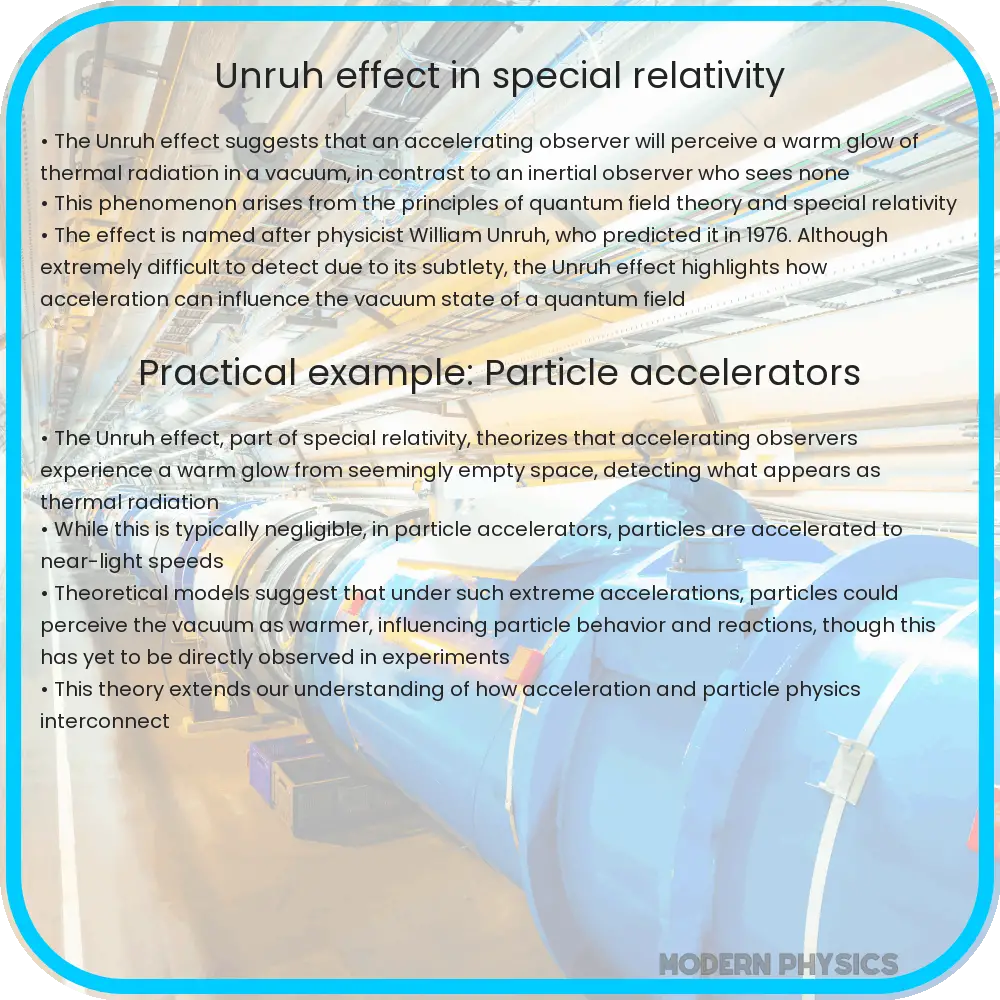
The Unruh effect, a fascinating phenomenon at the intersection of quantum field theory and general relativity, proposes that an observer in constant acceleration will perceive a warm glow of thermal radiation in an otherwise empty space. This seemingly counterintuitive concept, first theorized by physicist William Unruh in 1976, challenges our fundamental understanding of vacuum states and thermal radiation, linking the realms of the very small (quantum) and the very large (relativity).
Understanding the Basics of the Unruh Effect
At the heart of the Unruh effect is the notion that the perception of what constitutes a vacuum is relative. In quantum field theory, a vacuum is typically viewed as a state with no particles. However, for an accelerating observer, this ’empty’ space appears filled with particles, an observation grounded in the principles of relativity. This phenomenon arises from the Rindler horizon, a conceptual boundary experienced by an accelerating observer, beyond which events are unobservable, leading to the appearance of thermal radiation.
Quantum Field Theory and Acceleration
Quantum field theory (QFT) posits that fields, rather than particles, are the fundamental constituents of the universe. In QFT, particles are excitations of these fields. The Unruh effect illustrates that the excitation state of a field is not absolute but depends on the observer’s acceleration. For an inertial (non-accelerating) observer, a quantum field in its ground state is perceived as a vacuum. In contrast, an accelerating observer perceives this same state as containing particles, indicating a profound link between acceleration and particle detection.
Thermal Radiation and the Unruh Temperature
The Unruh effect predicts that the perceived thermal radiation has a specific temperature, known as the Unruh temperature. This temperature is proportional to the observer’s acceleration, expressed mathematically as \( T = \frac{\hbar a}{2\pi ck} \), where \( \hbar \) is the reduced Planck constant, \( a \) is the acceleration, \( c \) is the speed of light, and \( k \) is the Boltzmann constant. The Unruh temperature is exceedingly small for practical accelerations, making experimental verification challenging.
Despite its elusive nature, the Unruh effect has significant implications in theoretical physics, offering insights into the elusive relationship between quantum mechanics and general relativity. It provides a unique lens through which the concepts of observer-dependence and the nature of the vacuum can be explored, deepening our understanding of the universe.
The Role of the Unruh Effect in Black Hole Physics
The Unruh effect has profound implications in the study of black holes, particularly in understanding Hawking radiation. Stephen Hawking’s groundbreaking work suggested that black holes are not completely black but emit radiation due to quantum effects near their event horizon. This radiation, akin to the Unruh effect, results from the extreme gravitational acceleration at the event horizon. The parallel between Hawking radiation and the Unruh effect underlines the deep connection between quantum phenomena and gravitational fields.
Challenges in Experimental Verification
Experimentally observing the Unruh effect remains a formidable challenge due to the minuscule scale of the predicted temperature increase. The accelerations required to produce a measurable Unruh temperature are far beyond current technological capabilities. However, advances in particle accelerators, space-based experiments, and precision measurement tools continue to edge us closer to potential verification, which would be a monumental achievement in confirming this theoretical prediction.
Future Prospects and Theoretical Significance
The Unruh effect continues to be a topic of significant interest in theoretical physics, particularly in the quest to unify quantum mechanics and general relativity. It serves as a crucial testing ground for theories attempting to bridge these two pillars of modern physics. Additionally, the concept has spurred interest in analog systems, where similar phenomena might be observed under laboratory conditions, offering indirect but valuable insights into the nature of accelerated frames in quantum field theory.
Conclusion: The Unruh Effect’s Pivotal Role in Modern Physics
In conclusion, the Unruh effect stands as a cornerstone concept in modern theoretical physics, intertwining the principles of quantum mechanics and general relativity. While its direct observation remains elusive, the theoretical implications continue to fuel advancements in our understanding of the universe. It underscores the observer-dependent nature of reality as predicted by quantum theory and relativity, challenging conventional notions of a vacuum and redefining our understanding of space-time. As research progresses, the Unruh effect could provide pivotal insights into the uncharted territory of quantum gravity, potentially unlocking secrets of the cosmos that have baffled scientists for decades.