
Explore the enigma of Unruh Radiation, its ties to quantum theory and general relativity, and its potential impact on physics and cosmology.
Unraveling the Enigma of Unruh Radiation
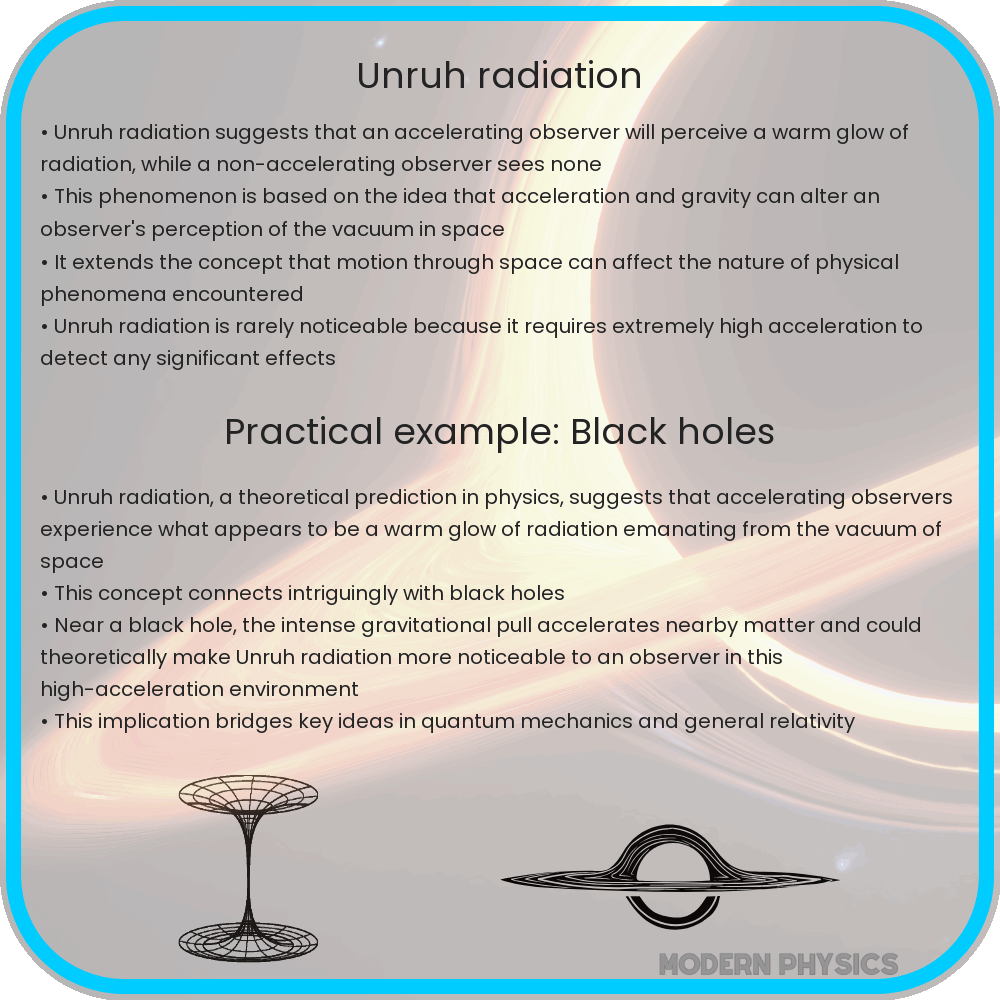
Unruh radiation, a phenomenon predicted by physicist William Unruh in 1976, stands at the crossroads of quantum theory and general relativity, presenting a fascinating quantum mystery. This theoretical concept suggests that an observer accelerating through a vacuum would detect particles, akin to thermal radiation, where an inertial observer would perceive none. This phenomenon is not just a theoretical curiosity; it provides profound insights into the nature of vacuums, particle physics, and the unification of quantum mechanics with gravity.
Theoretical Foundations of Unruh Radiation
At its core, Unruh radiation stems from the principles of quantum field theory (QFT) and the equivalence principle of general relativity. According to QFT, vacuums are not empty but teem with virtual particles that constantly form and annihilate. In the context of Unruh radiation, an accelerating observer experiences these virtual particles as real, observable particles. This effect is mathematically described using the Rindler coordinates, a framework that models the perspective of a uniformly accelerating observer.
The temperature of this perceived radiation, known as the Unruh temperature, is given by the equation \( T = \frac{\hbar a}{2\pi k_B c} \), where \( \hbar \) is the reduced Planck’s constant, \( a \) the acceleration, \( k_B \) the Boltzmann constant, and \( c \) the speed of light. Notably, the Unruh effect implies that the concept of a particle is observer-dependent, challenging conventional notions in physics.
Unruh Radiation and the Quantum Mystery
The Unruh effect is deeply intertwined with quantum mysteries, particularly the nature of vacuums and particle physics. It underscores the quantum principle that ’emptiness’ is not truly empty but a dynamic, fluctuating state. This insight has profound implications for understanding the vacuum energy problem and the cosmological constant, two pivotal issues in modern physics.
Moreover, the observer-dependent nature of Unruh radiation dovetails with the concept of relativity in general relativity, proposing a fascinating interplay between the two foundational theories of physics. This duality suggests that the traditional separation between quantum mechanics and general relativity might be more permeable than previously thought, offering a potential pathway towards a unified theory of quantum gravity.
Stay tuned for further insights into the applications and implications of Unruh radiation in the next section of this article.
Practical Applications and Future Prospects of Unruh Radiation
While primarily theoretical, Unruh radiation has potential applications and implications in various fields of physics. One significant area is in the study of black holes, particularly in the context of Hawking radiation. The parallels between Unruh and Hawking radiation provide a unique window into understanding black hole thermodynamics and the information paradox. By studying Unruh radiation, physicists hope to gain insights into the mechanisms of particle emission from black holes.
Another intriguing application lies in the field of particle acceleration. The Unruh effect suggests that extreme acceleration can lead to the creation of real particles from the vacuum, an idea that could potentially inspire new methods of particle generation in accelerators. Additionally, this effect might have implications in cosmology, particularly in understanding the early stages of the universe’s expansion and the behavior of particles during this period.
Challenges and Future Research Directions
Despite its theoretical elegance, direct experimental verification of Unruh radiation remains elusive. The primary challenge is the immense acceleration required to detect the Unruh effect, which is currently beyond the reach of modern technology. However, advancements in high-energy physics and experimental techniques may eventually make such observations feasible. Researchers are also exploring analog systems, such as fluid dynamics and optical analogs, to simulate and study aspects of Unruh radiation in a controlled environment.
Future research in this area promises to deepen our understanding of quantum field theory and the interplay between quantum mechanics and general relativity. Unruh radiation stands as a tantalizing concept that bridges these two pillars of modern physics, potentially guiding us towards a unified theory of quantum gravity.
Conclusion
In conclusion, Unruh radiation represents a captivating intersection of quantum mechanics and general relativity, offering profound theoretical insights into the nature of vacuums, particle physics, and the quest for a unified theory. While direct experimental evidence remains a challenge, the implications and applications of this concept in areas like black hole physics and particle acceleration are substantial. As we advance in our experimental capabilities and theoretical understanding, Unruh radiation continues to be a key topic in the quest to unravel the mysteries of the universe. It epitomizes the beauty and complexity of theoretical physics, serving as a beacon for future explorations in the enigmatic world of quantum gravity.