
Explore the Unruh-Davies Effect in QED: Understanding quantum vacuum, particle dynamics, and radiation in accelerated frames of reference.
Exploring the Unruh-Davies Effect in Quantum Electrodynamics
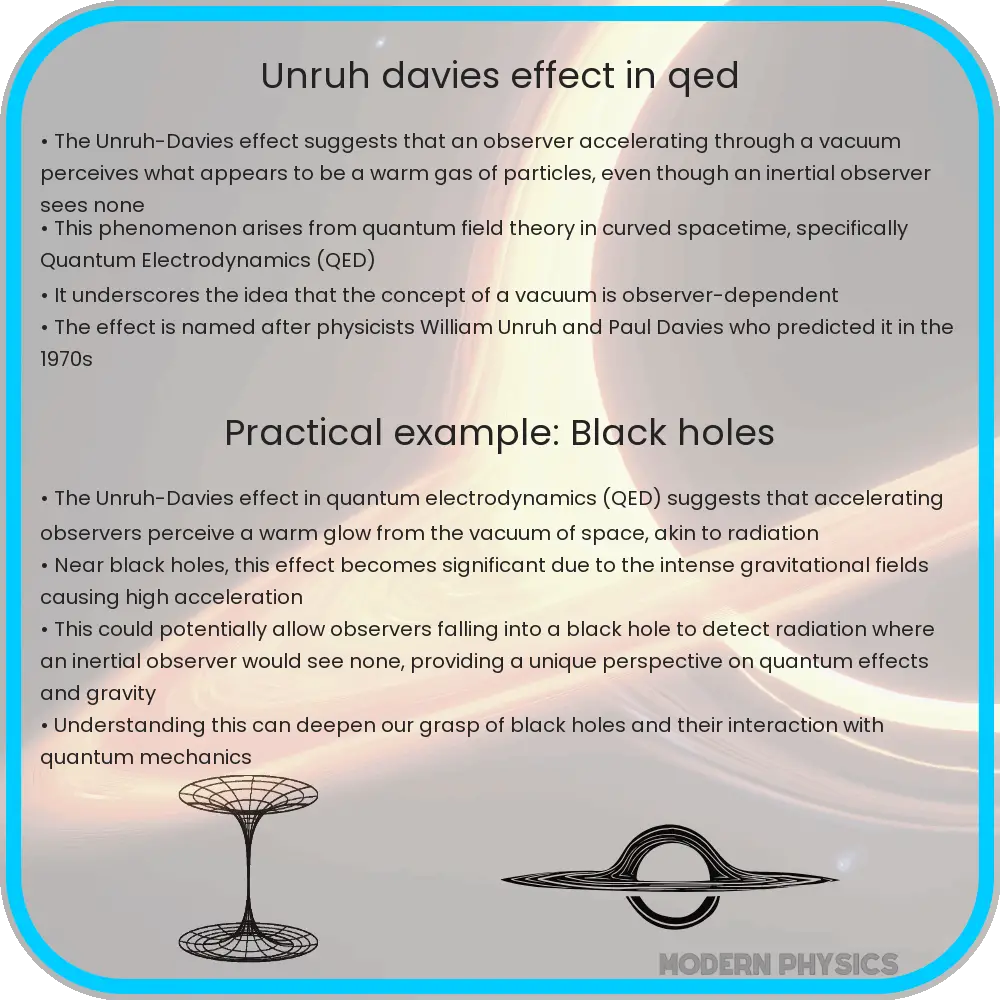
Quantum Electrodynamics (QED) is a cornerstone of modern physics, providing a quantum theory framework for understanding the interactions of light and matter. An intriguing phenomenon within this realm is the Unruh-Davies Effect, a theoretical prediction deeply rooted in the principles of QED and the study of particle dynamics and radiation. This effect, proposed independently by William Unruh and Paul Davies, suggests that an observer in uniform acceleration perceives a warm bath of radiation even in a vacuum, a scenario radically different from that experienced by an inertial observer.
The Unruh-Davies Effect is grounded in the concept of the quantum vacuum, which, contrary to classical expectations, is not empty but a seething ocean of virtual particles and antiparticles. These particles, governed by the uncertainty principle, briefly appear and annihilate each other. In the framework of QED, this vacuum state is a fundamental aspect of the field theory, shaping our understanding of particle dynamics and interactions.
To comprehend the effect, it is crucial to consider the role of acceleration. According to the principles of Relativity, there is no absolute distinction between gravitational and inertial forces. Thus, an observer in an accelerated frame of reference could theoretically interpret their experience as being in a gravitational field. This leads to a fascinating implication: the perception of vacuum state radiation depends on the observer’s state of motion.
For an accelerating observer, the vacuum appears as a warm bath of radiation due to the Doppler shift and the horizon effect. The Doppler shift, well-known in sound and light, refers to the change in frequency of a wave in relation to an observer moving relative to the wave source. In the context of the Unruh-Davies Effect, the observer’s acceleration causes a frequency shift in the virtual particles of the vacuum, making them detectable as real particles. The horizon effect is akin to the event horizon of a black hole, where the observer’s acceleration creates a horizon, beyond which events cannot influence the observer. This horizon alters the state of the quantum field around the observer, resulting in the perception of thermal radiation.
At the heart of the Unruh-Davies Effect is a profound insight into the nature of reality in the quantum realm. It challenges our conventional understanding of empty space and demonstrates how the fabric of the universe is altered by the motion and acceleration of observers. This effect not only deepens our understanding of QED but also has implications for fields like cosmology and black hole physics.
The Implications and Challenges of the Unruh-Davies Effect
The Unruh-Davies Effect, while primarily a theoretical construct, has significant implications for various fields of physics. In cosmology, it offers insights into the nature of Hawking radiation emitted by black holes. Stephen Hawking’s theory postulates that black holes emit radiation due to quantum effects near their event horizons, a process conceptually similar to the horizon effect in the Unruh-Davies scenario. This parallelism enhances our understanding of black hole thermodynamics and the fundamental links between gravity, quantum mechanics, and thermodynamics.
In the realm of particle physics, the Unruh-Davies Effect provides a deeper understanding of the vacuum’s role in particle creation and annihilation. It illustrates how the vacuum’s properties are not universal but depend on the observer’s frame of reference. This insight is pivotal in understanding the vacuum fluctuations that contribute to phenomena like the Casimir effect and the Lamb shift, subtle effects observable in quantum field experiments.
Furthermore, the Unruh-Davies Effect has intriguing implications in the study of quantum information and quantum computing. The idea that an observer’s acceleration can alter their perception of a quantum state suggests new ways to manipulate quantum information. This could potentially lead to novel methods of encoding and processing information at the quantum level, leveraging the relativistic effects of acceleration.
Despite its profound implications, direct experimental observation of the Unruh-Davies Effect remains a challenge. The accelerations required to detect this effect are extraordinarily high, beyond current technological capabilities. However, advancements in high-energy particle accelerators and space-based experiments may eventually make it possible to test these predictions. Such experiments would not only validate a fundamental aspect of QED but also open new frontiers in our understanding of the universe.
Conclusion
The Unruh-Davies Effect, a fascinating prediction of Quantum Electrodynamics, underscores the complex interplay between acceleration, radiation, and the nature of the vacuum. While it challenges our traditional perceptions of space and radiation, it simultaneously offers a richer, more nuanced understanding of the universe. As theoretical exploration continues and experimental capabilities advance, the Unruh-Davies Effect stands as a testament to the endless quest for knowledge in the quantum realm, offering a gateway to unraveling deeper mysteries of the cosmos.