
Explore the revolutionary potential of Thermochemical Batteries in renewable energy storage, their advantages, challenges, and future prospects.
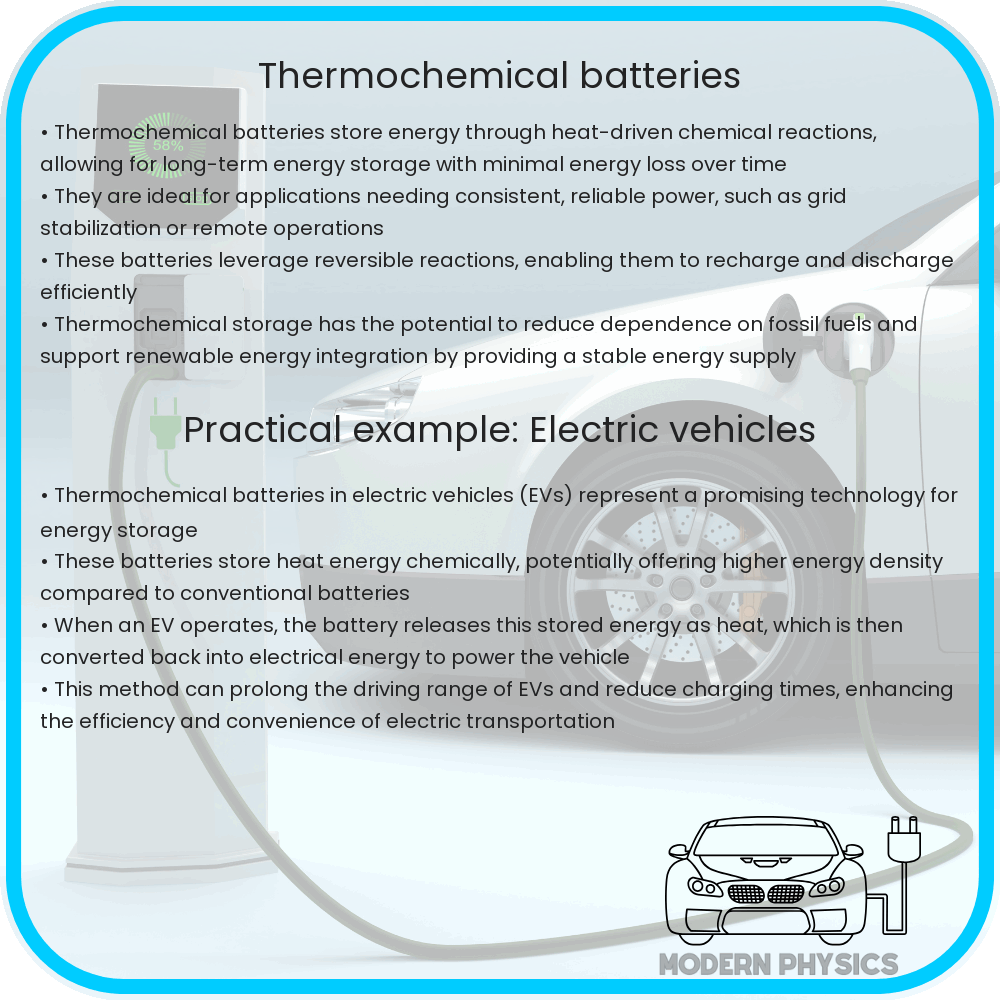
Thermochemical Batteries: Revolutionizing Renewable Energy Storage
As the world shifts towards sustainable energy solutions, the importance of efficient and reliable energy storage systems has never been greater. Thermochemical batteries (TCBs) are emerging as a groundbreaking technology in this arena, offering an innovative approach to storing and releasing energy. This article delves into the science behind TCBs, their advantages, and their potential in reshaping the future of renewable energy.
Understanding Thermochemical Batteries
At its core, a thermochemical battery is a type of energy storage device that uses thermochemical reactions to store and release energy. These reactions involve the transformation of chemical energy into thermal energy and vice versa. Unlike conventional batteries that rely on electrochemical processes, TCBs utilize heat to drive the chemical reactions, making them particularly suitable for integrating with solar thermal and industrial waste heat applications.
The Science Behind TCBs
The working principle of a thermochemical battery is based on reversible chemical reactions. When heat is supplied to the system, it triggers a chemical reaction that stores energy. This process is known as ‘charging’ the battery. The chemical reaction typically involves compounds like metal oxides or hydrates. For example, a common reaction involves the breakdown of metal hydrides like MgH2 to magnesium (Mg) and hydrogen (H2), with the reaction written as MgH2 → Mg + H2. During discharge, the reverse reaction occurs, releasing the stored energy as heat.
Advantages of Thermochemical Batteries
TCBs offer several key advantages over traditional energy storage systems. Firstly, they have the potential for higher energy density, meaning they can store more energy in a smaller space. This aspect is crucial for applications where space is a premium. Secondly, they are capable of storing energy for longer durations without significant losses, addressing one of the main challenges faced by renewable energy sources like solar and wind, which are intermittent by nature.
Another significant advantage of TCBs is their environmental friendliness. They do not rely on rare or toxic materials, reducing the environmental impact associated with their production and disposal. This factor aligns well with the global push for greener technologies.
Moreover, the integration of TCBs with renewable energy sources can lead to more efficient and sustainable energy systems. For instance, excess heat from solar thermal plants can be stored in TCBs and released during periods of low sunlight, ensuring a continuous energy supply.
In conclusion, thermochemical batteries represent a promising and innovative approach to energy storage. Their efficiency, coupled with their environmental benefits, positions them as a key player in the future of renewable energy systems.
Challenges and Future Potential of Thermochemical Batteries
While thermochemical batteries offer immense potential, they also face several challenges that need to be addressed. One of the primary challenges is the development of materials that can efficiently and reliably perform the necessary thermochemical reactions. Research is ongoing to identify materials that can withstand repeated cycling of charging and discharging without significant degradation. Additionally, optimizing the system design to efficiently capture, store, and release heat is crucial for maximizing the effectiveness of TCBs.
Another challenge lies in scaling up the technology for commercial use. Thermochemical batteries are still primarily in the research and development stage, with few practical implementations to date. Scaling up involves not just technological advancements but also overcoming economic barriers, such as the high initial investment costs and the need for integration with existing energy infrastructures.
Innovations and Research in Thermochemical Batteries
Despite these challenges, there are significant innovations and research underway in the field of thermochemical batteries. Researchers are exploring a variety of chemical reactions and materials, including advanced metal hydrides and salt hydrates, to improve the efficiency and durability of TCBs. Furthermore, pilot projects and partnerships between academia, industry, and government agencies are essential in advancing this technology from the laboratory to real-world applications.
Conclusion
In conclusion, thermochemical batteries represent a transformative technology in the field of energy storage. Their ability to efficiently store and release energy, combined with their environmental benefits, positions them as a crucial component in the transition to renewable energy. While challenges exist in terms of material development, system design, and economic feasibility, the ongoing research and innovations in this field are promising. As the world continues to seek sustainable and efficient energy solutions, thermochemical batteries could play a pivotal role in providing a reliable energy storage solution, thereby supporting the broader adoption of renewable energy sources. The future of energy storage, with its focus on sustainability, efficiency, and innovation, is bright, and thermochemical batteries are poised to be at the forefront of this exciting journey.