
Delve into the fundamentals of battery technology, focusing on efficiency, durability, and advanced materials in energy storage systems.
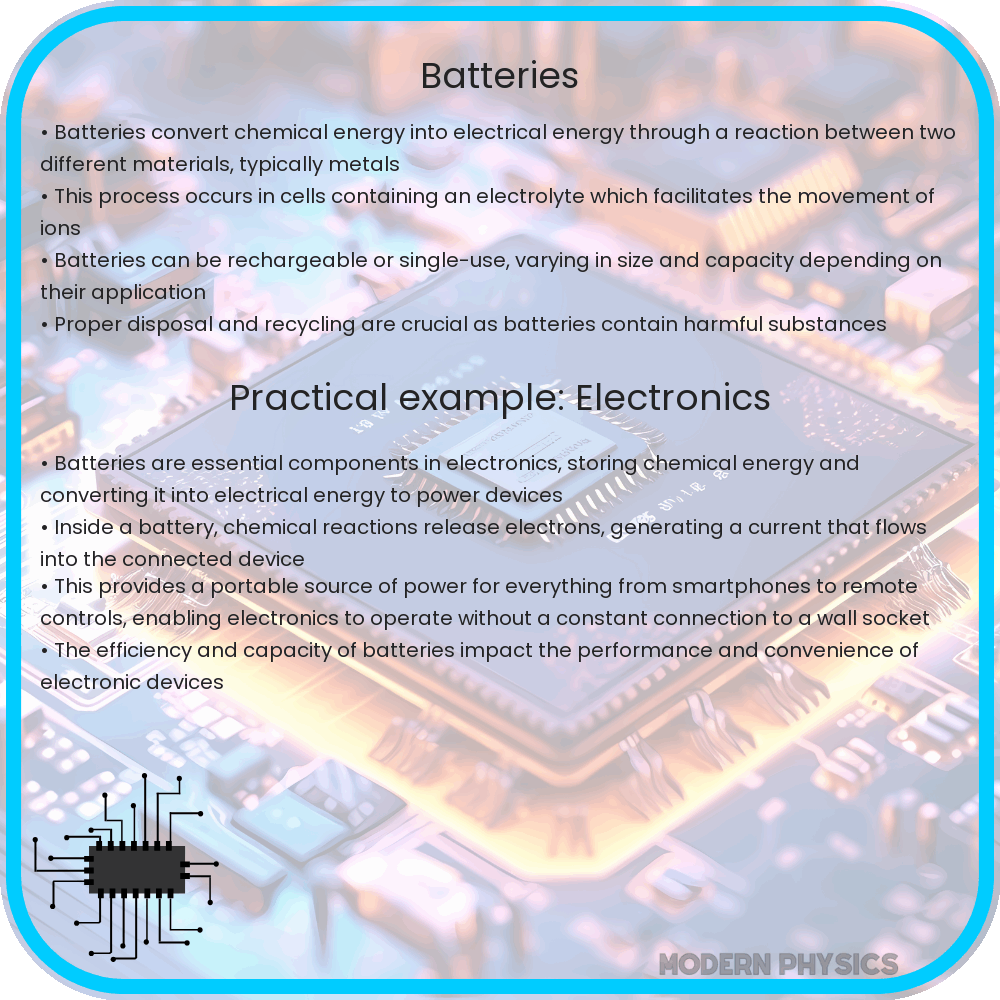
Understanding the Basics of Battery Technology
Batteries are essential to modern life, powering everything from smartphones to electric vehicles. At the heart of battery technology lies a combination of physics and materials science, which work together to store and release energy efficiently. This article will delve into the durability, efficiency, and innovations in battery materials that drive the functionality of these indispensable units.
The Core of Battery Efficiency
The efficiency of a battery is gauged by its ability to store and convert energy with minimal losses. A key factor influencing this is the battery’s electrochemical potential, which is the voltage difference between its two electrodes. This potential is driven by the properties of the materials used in the electrodes and the electrolyte. The efficiency can be represented by the equation:
Voltage Efficiency = (Discharge Voltage / Charge Voltage) * 100%
Battery durability, on the other hand, refers to a battery’s life span and its capability to sustain performance over time, often measured in charge cycles.
Advancements in Materials Science
Material innovation plays a pivotal role in enhancing both the durability and efficiency of batteries. Recent research in materials science has brought forward new substances and composites that could lead to longer-lasting and more efficient energy storage options. For instance, lithium-ion batteries have seen significant improvements through the development of solid-state electrolytes, which are more stable than their liquid counterparts.
Exploring New Battery Materials
Traditional batteries like lead-acid or nickel-cadmium are being slowly phased out or improved due to their environmental impact and inefficiency compared to newer technologies. Substantial research efforts have been centered around finding sustainable and high-performance alternatives, including:
- Lithium-Sulfur (Li-S): Promising higher energy density than lithium-ion, lithium-sulfur batteries face challenges like shorter cycle life due to polysulfide shuttle effects.
- Graphene: As an additive or a primary material, graphene’s exceptional conductivity and flexibility enhance both the energy capacity and the life span of batteries.
- Silicon Composite Anodes: Silicon offers a much higher capacity than carbon (the traditional material for lithium-ion anode), but tends to swell during charging, which poses a challenge for its practical application.
Each of these developments stands to potentially revolutionize how batteries are manufactured and used, pointing towards a future where energy storage is not only more efficient but also more attuned to the needs of advanced electronic devices and electric vehicles.
Impact of Battery Technology on the Environment
The rise in usage of batteries has significant environmental implications, primarily concerning the disposal and recycling of spent batteries. The materials used in batteries, such as heavy metals and chemicals, can be hazardous if not properly managed. Hence, the development of eco-friendly battery technologies and efficient recycling methods are critical to mitigating these environmental impacts. Innovations like biodegradable battery components and improvements in recycling processes are vital steps towards a more sustainable battery technology landscape.
Future Trends in Battery Technology
The future of battery technology is focused not only on enhancing performance but also on aligning with global sustainability goals. Upcoming trends include the development of ultra-fast charging batteries that significantly reduce downtime for devices and vehicles, and the integration of Artificial Intelligence to optimize battery life cycles and efficiency. Furthermore, the expansion of “smart” batteries equipped with integrated circuits that provide real-time data on battery health and usage is anticipated, which could reshape how we interact with these essential energy sources.
Conclusion
In summary, batteries are a cornerstone of modern technology, with their importance stretching across numerous domains from personal electronics to large-scale transport solutions. Understanding the basics of battery technology exposes the intricate balance between energy efficiency, material science, and environmental impact. As advancements continue, the focus shifts towards creating more durable, efficient, and environmentally friendly battery solutions. The continual evolution in battery technology promises to drive forward various technological and sustainable advancements in modern society, making our dependency on these power sources both feasible and beneficial.