
Explore the fascinating world of stellar granulation: understand the surface dynamics, energy transport, and impacts on astrophysics with advanced observations.
Understanding Stellar Granulation
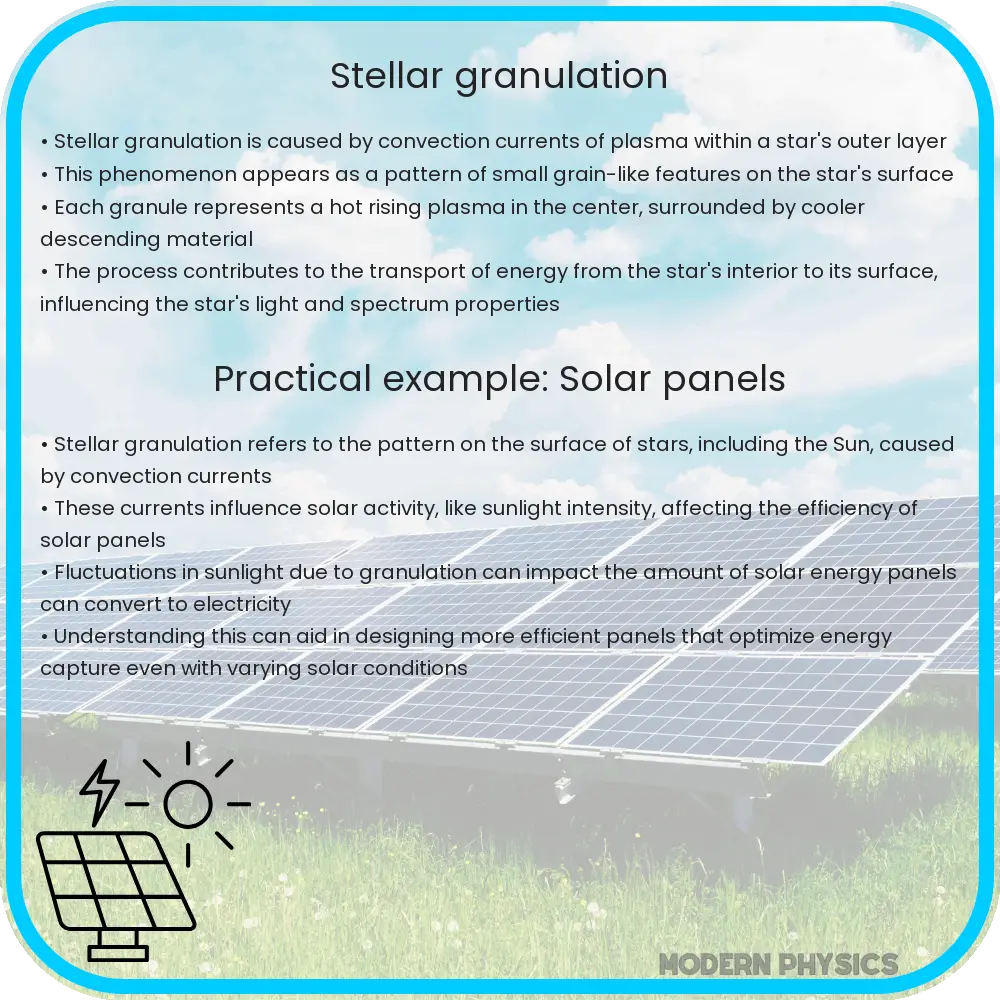
Stellar granulation is a prominent feature on the surface of stars, including our Sun. This phenomenon manifests as convective cells of plasma, resembling grains on the star’s surface. Each granule represents hot plasma rising from the stellar interior, cooling off as it reaches the surface, and then sinking back down, creating a pattern of bright (hot) and dark (cooler) areas. This process is crucial for understanding the dynamics and energy transport within a star.
Surface Mapping and Observations
Advancements in telescopic technologies have significantly improved our ability to observe and map stellar surfaces. Techniques such as spectroscopy and helioseismology allow astronomers to dissect the light from stars and probe their internal structures. Through these methods, scientists can study the granulation patterns, sizes, and life cycles, which vary from one star to another, primarily depending on the star’s size and temperature.
Granulation Dynamics
The dynamics of stellar granulation are governed by the star’s convection zone, where energy is transported outward from the core through the movement of plasma. This process is influenced by various factors, including the star’s magnetic field, rotation, and overall mass. The granules are typically seen to last from a few minutes to several hours, depending on the star’s characteristics, before dissipating and being replaced by new ones.
Effects of Stellar Granulation
- Energy Transport: Granulation is a primary mechanism through which energy is transferred from the interior of the star to its surface and then into space.
- Spectral Lines: The movement of plasma in granules can cause shifts in the spectral lines of a star, affecting measurements of its velocity, temperature, and magnetic fields.
- Stellar Activity: The interaction between granulation and magnetic fields can lead to various forms of stellar activity, such as sunspots, flares, and coronal mass ejections in the case of the Sun.
Understanding these granulation patterns not only sheds light on the surface dynamics of stars but also provides critical insights into their overall physical processes and life cycles.
Implications for Astrophysics
The study of stellar granulation has far-reaching implications in the field of astrophysics. By analyzing granulation patterns, astronomers can improve their models of stellar atmospheres, which are essential for understanding the life cycles of stars. Additionally, granulation affects the measurement of stellar oscillations and pulsations, which are used to probe the internal structures of stars in a field known as asteroseismology.
Challenges in Granulation Research
Despite advancements, there are still significant challenges in studying stellar granulation. One of the primary issues is the resolution of current telescopes, which limits the detail with which we can observe granulation patterns on distant stars. Moreover, the dynamic nature of granules, combined with the influence of stellar magnetic fields, makes modeling these phenomena complex and computationally demanding.
Future Prospects
The future of granulation research looks promising, with advancements in telescope technology and computational modeling. Upcoming missions and telescopes, such as the Extremely Large Telescope (ELT) and the James Webb Space Telescope (JWST), are expected to provide unprecedented views of stellar surfaces. These improvements will enable more detailed studies of granulation and its effects on stellar physics, further refining our understanding of stars and their life cycles.
Conclusion
Stellar granulation is a critical aspect of astrophysics, offering insights into the convective processes that transport energy within stars. Through the study of these granular patterns, scientists can gain a deeper understanding of stellar behavior, including energy transport, atmospheric dynamics, and magnetic field interactions. Despite the challenges posed by observational and modeling limitations, ongoing advancements hold the promise of unraveling the intricate dynamics of stellar surfaces. As we continue to enhance our observational capabilities and refine our theoretical models, the study of stellar granulation will remain at the forefront of unraveling the mysteries of the universe.