
Explore the mysteries of solar granulation patterns, their formation, and analysis. Learn how these features impact our understanding of the Sun’s dynamics.
Solar Granulation Patterns: Unveiling the Mysteries
Solar granulation patterns are a striking feature of the Sun’s photosphere, offering insights into the dynamic processes at play within our closest star. These patterns, resembling grains or cells, are the visible manifestations of convective motions in the solar plasma. Understanding these patterns is crucial for astronomers and solar physicists as they provide valuable information about solar convection, energy transfer, and magnetic field dynamics.
Formation of Solar Granulation
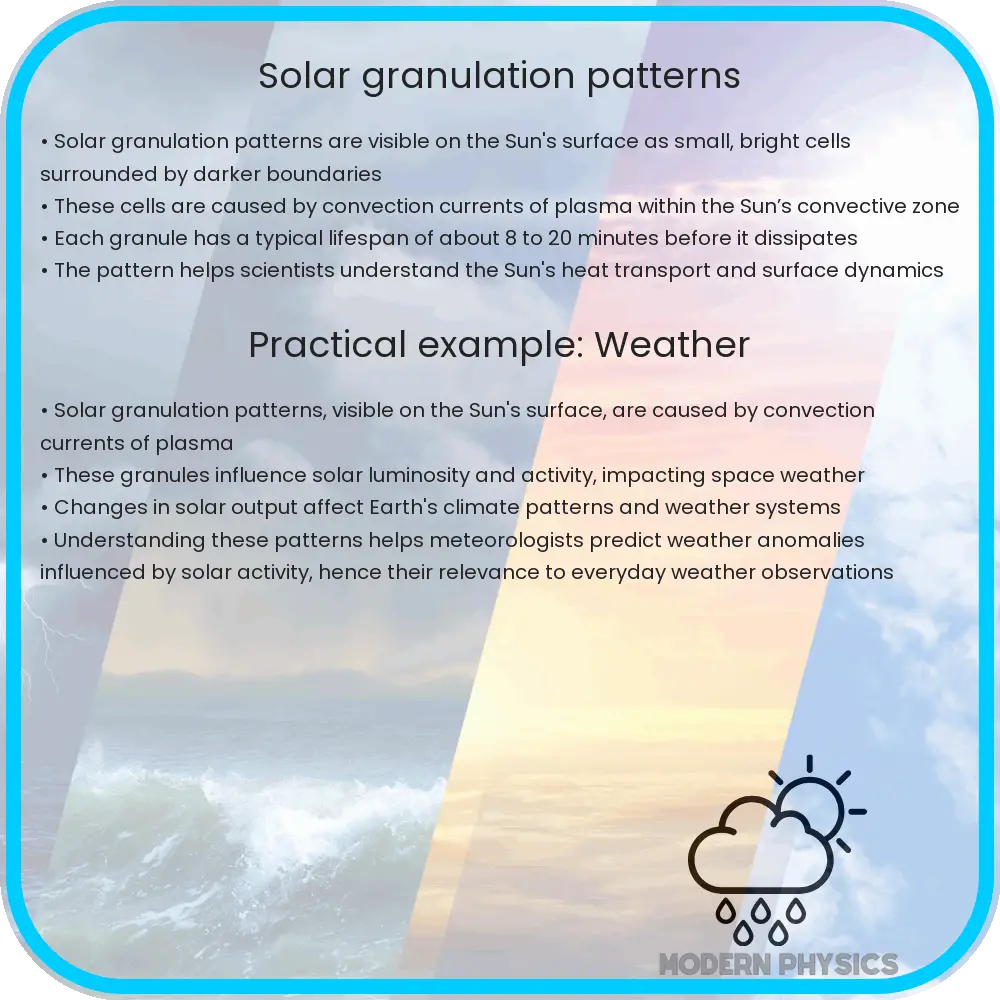
The formation of solar granulation is primarily attributed to the convection currents within the Sun’s convective zone. In this region, hot solar plasma rises towards the surface in columns due to the decrease in temperature and density. Upon reaching the surface, the plasma cools down, radiating energy into space and creating the bright areas known as granules. Subsequently, the cooled plasma descends back into the Sun along the darker lanes between granules, known as intergranular lanes, completing the convective cycle. This process results in the distinctive pattern of bright and dark patches observed on the solar surface.
Analysis of Granulation Patterns
Analyzing solar granulation patterns involves sophisticated techniques and instruments, such as high-resolution telescopes and spectrometers. Scientists study these patterns by measuring their size, shape, and lifespan, which typically ranges from a few minutes to several hours. Additionally, the analysis includes examining the velocity of the plasma flows within granules and intergranular lanes. By analyzing these characteristics, researchers can deduce the physical conditions in the Sun’s outer layers, including temperature, pressure, and magnetic field structures.
One significant aspect of solar granulation analysis is the study of the Sun’s magnetic fields. Granules can be affected by the Sun’s magnetic activity; areas with strong magnetic fields, such as sunspots, can suppress the formation of granulation patterns, leading to cooler, darker regions. By studying these interactions, scientists can gain insights into the complex relationship between solar convection and magnetic fields, enhancing our understanding of solar dynamics and activity.
Understanding Solar Granulation Patterns
Solar granulation is a feature visible on the surface of the Sun, consisting of small, convection cell-like structures known as granules. These granules are the tops of convection currents that bring hot plasma from the solar interior to the surface. The granulation pattern is a direct result of the convective motions within the solar plasma, akin to the boiling motion seen in a pot of water, but on a colossal scale and with plasma instead of water.
Mysteries of Solar Granulation
Despite years of observation, solar granulation harbors several mysteries. One of the most intriguing is the formation mechanism of supergranules, larger structures beyond the typical granules, with diameters of about 30,000 kilometers. Another mystery involves the precise interaction between granules and solar magnetic fields, especially how these fields influence granulation patterns and vice versa.
Formation of Granules
The Sun’s granules form as hot plasma rises in the solar convection zone. When this plasma reaches the surface, it cools down, loses buoyancy, and sinks back into the depths along the granules’ dark lanes, known as intergranular lanes. Each granule typically lasts about 8 to 20 minutes before dissipating. The constant motion contributes to the Sun’s magnetic field and impacts phenomena such as sunspots and solar flares.
Analysis Techniques
Scientists use various methods to study solar granulation, including high-resolution telescopes and satellites like the Solar Dynamics Observatory (SDO). Spectroscopy and helioseismology are also crucial for understanding the underlying processes and structures. These techniques help decipher the Sun’s chemical composition, movement patterns, and internal structures, offering insights into its convective motions and magnetic activity.
Conclusion
Solar granulation is a fundamental aspect of the Sun’s complex dynamics, representing the visible surface of deeper, convective processes. Although significant advancements have been made in understanding these patterns, mysteries still remain, particularly regarding their interaction with the Sun’s magnetic field and the formation of larger structures like supergranules. Ongoing research and technological advancements continue to shed light on these phenomena, contributing to our broader understanding of stellar physics and the behavior of our closest star. By unraveling the secrets of solar granulation, scientists move closer to comprehending the Sun’s influence on the solar system, including its impact on space weather and the Earth’s climate.