
Explore the dynamics of stellar convection, its role in heat transfer, and impact on star life cycles. Understand modeling techniques and chemical processes involved.
Understanding Stellar Convection
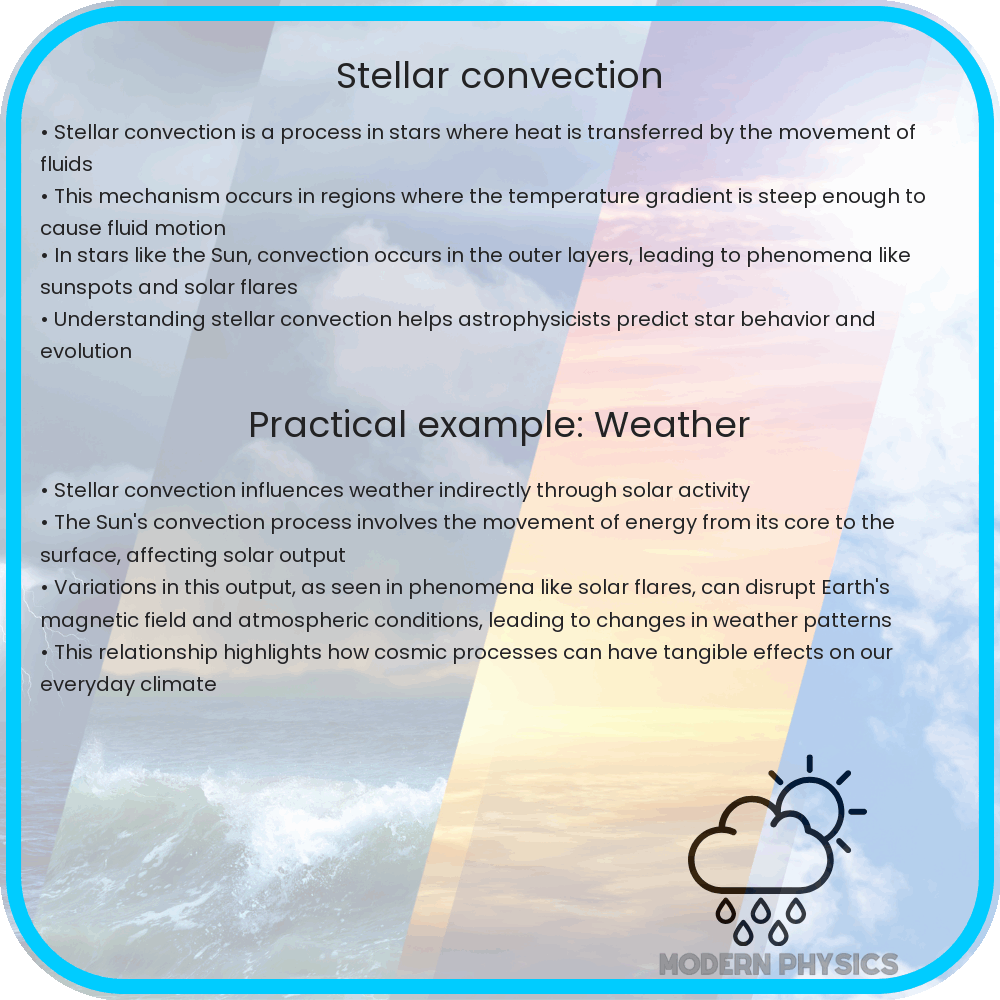
Stellar convection is a fundamental process that occurs in the outer layers of many stars, including our own Sun. This phenomenon is crucial for the transport of energy from the inner parts of a star to its surface. It involves the movement of plasma within the star, which carries heat outward as part of the star’s energy transfer mechanisms.
The Dynamics of Stellar Convection
The dynamics of stellar convection are governed by the principles of fluid dynamics and thermodynamics. In regions where the temperature gradient is steep enough, convection becomes more efficient than radiation in transporting energy. As a result, hot plasma rises towards the surface, cools down, and then sinks back, creating convection cells known as granules or supergranules in the case of the Sun.
Heat Transfer in Stellar Convection
In the convective zones of stars, heat transfer occurs mainly through the movement of mass, unlike in the radiative zones where energy is transferred through radiation. The efficiency of this heat transfer is influenced by several factors, including the star’s composition, temperature, and the presence of magnetic fields.
Modeling Stellar Convection
Modeling stellar convection is a complex task that requires advanced numerical simulations. Scientists use various parameters, such as the Rayleigh number, which indicates the system’s propensity to convection, and the Prandtl number, which relates the viscosity of the fluid to its thermal conductivity. These simulations help astrophysicists understand the convective processes within stars and predict their behavior.
Chemical Processes in Stellar Convection
Stellar convection also plays a vital role in the chemical mixing and nucleosynthesis within stars. Elements formed in the core of a star can be brought to the surface layers through convection currents, influencing the star’s chemical composition and evolution. For example, the carbon-nitrogen-oxygen (CNO) cycle, crucial for energy production in stars heavier than the Sun, involves the conversion of hydrogen into helium with the intermediate creation of carbon-12 (12C), nitrogen-14 (14N), and oxygen-16 (16O).
Implications of Stellar Convection on Star Life Cycle
Stellar convection impacts various stages of a star’s life cycle, from its formation to its eventual death. During the main sequence phase, convection contributes to the stellar equilibrium, balancing gravitational forces and nuclear fusion reactions. In later stages, such as the red giant phase, convection helps to transport energy from the core to the outer layers, leading to significant changes in the star’s size and brightness.
Observational Evidence and Research
Astronomers gather observational evidence of stellar convection through techniques such as spectroscopy and helioseismology. These methods allow scientists to infer the internal motion of stellar material and to study surface granulation patterns, providing critical insights into the convection processes within stars.
Future Prospects in Stellar Convection Research
Advancements in technology and computational methods continue to enhance our understanding of stellar convection. Future research aims to resolve existing challenges, such as accurately simulating the full spectrum of convective scales and understanding the interaction between convection and magnetic fields. These efforts will improve our knowledge of stellar physics, influencing theories on star formation, evolution, and the dynamic processes governing their behavior.
Conclusion
Stellar convection is a complex but essential process in the life cycle of stars. It not only facilitates the transfer of heat but also contributes to chemical mixing, impacting a star’s composition and evolution. Through ongoing research and technological advancements, our understanding of these convective processes continues to grow, shedding light on the dynamic nature of stars and their pivotal role in the cosmos. As we delve deeper into the mysteries of stellar convection, we inch closer to unraveling the fundamental principles that govern the universe.