
Explore the fascinating world of helioseismology, understanding solar waves and the Sun’s internal structure and dynamics, to unveil the mysteries of our closest star.
Understanding Helioseismology: Probing the Sun’s Interior
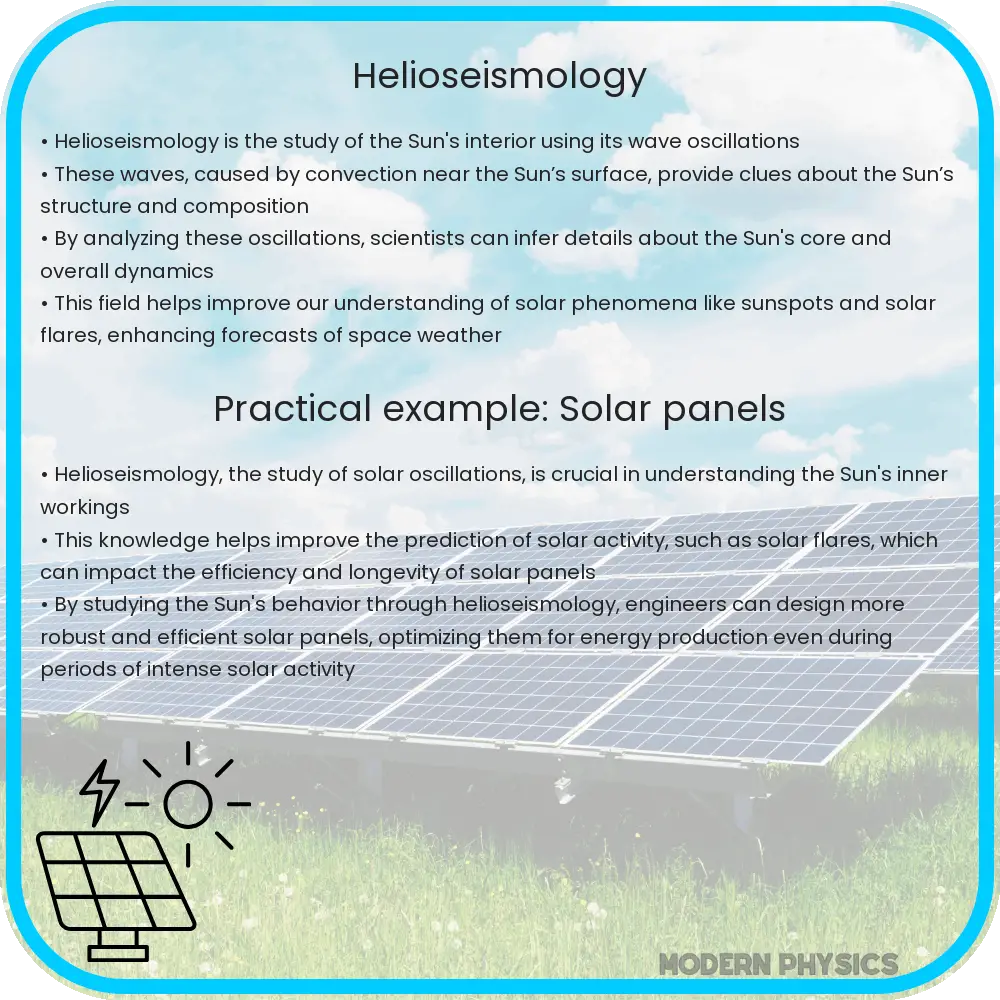
Helioseismology is a branch of astronomy that studies the internal structure and dynamics of the Sun through its oscillations. Similar to how geologists use seismic waves to explore Earth’s interior, helioseismologists study sound waves that reverberate through the Sun’s plasma. These sound waves are triggered by the turbulent convection near the Sun’s surface and offer a window into the solar interior that is otherwise invisible to us.
The Nature of Solar Waves
The Sun’s oscillations manifest as waves that travel through its interior and cause surface fluctuations. These waves are classified into different modes based on their harmonic properties. The most prominent are the pressure modes (p-modes), where the restoring force is provided by pressure changes, and the gravity modes (g-modes), driven by buoyancy forces. While p-modes have been extensively observed, g-modes remain elusive due to their weak surface signals.
Unraveling the Sun’s Structure
By analyzing the frequencies, amplitudes, and life spans of solar waves, helioseismologists can infer various properties of the Sun’s interior, such as temperature, composition, and motion. These data help construct detailed models of the Sun’s internal structure, including its core, radiative zone, and convective zone. For example, helioseismology has provided evidence for the differential rotation of the Sun’s interior, with the equator rotating faster than the poles.
Studying Solar Dynamics
Helioseismology is also crucial for understanding the dynamics of the Sun, including its rotation, magnetic field generation, and energy transport mechanisms. The Sun’s magnetic activity, which peaks every 11 years, is closely linked to the internal dynamical processes. By monitoring the changes in wave frequencies, scientists can study the solar cycle’s impact on the Sun’s internal structure and dynamics.
This field of study not only enhances our understanding of the Sun but also provides insights into the workings of other stars and the overall dynamics of stellar interiors.
Understanding Helioseismology
Helioseismology, a branch of astrophysics, is the study of wave oscillations within the Sun. This discipline is akin to seismology on Earth, which examines the movements of seismic waves caused by earthquakes. However, in helioseismology, the waves are triggered by the turbulent convective motions in the solar interior and not by quakes. These solar waves provide critical insights into the Sun’s internal structure and dynamics.
Solar Waves
The Sun’s oscillations manifest as acoustic waves, technically referred to as ‘pressure modes’ or p-modes. These waves traverse the Sun’s interior, reflecting off its surface and penetrating deep into its core. By studying these oscillations, scientists can infer the properties of the Sun’s internal layers, much like how ultrasound scans allow doctors to view inside the human body.
Solar Structure and Dynamics
Helioseismology allows scientists to construct detailed models of the Sun’s inner structure. Key layers such as the core, radiative zone, and convective zone can be studied in unprecedented detail. This research reveals the temperature, composition, and motion patterns within these layers. For instance, helioseismological data have led to a better understanding of the solar neutrino problem and refined our knowledge of the Sun’s elemental composition.
- Core: The innermost part of the Sun, where nuclear fusion occurs, converting hydrogen into helium and releasing vast amounts of energy.
- Radiative Zone: Surrounding the core, this layer is where energy moves outward primarily via radiation.
- Convective Zone: In this outer layer, energy is transported by convection, leading to the turbulent motions that generate solar oscillations.
Conclusion
Helioseismology has revolutionized our understanding of the Sun, unveiling its internal mechanics and compositions with precision. Through the analysis of solar waves, scientists can peer deep into the Sun’s core, unlocking secrets of its structure and dynamics. This knowledge not only helps in predicting solar activities like flares and sunspots but also enriches our general understanding of stellar physics. As technology advances, helioseismology will continue to illuminate the complex workings of our closest star, providing insights into the fundamental processes that drive not only the Sun but also other stars in the universe.