
Soil emissivity is a measure of soil’s efficiency in emitting thermal radiation, crucial for precision agriculture and environmental monitoring.
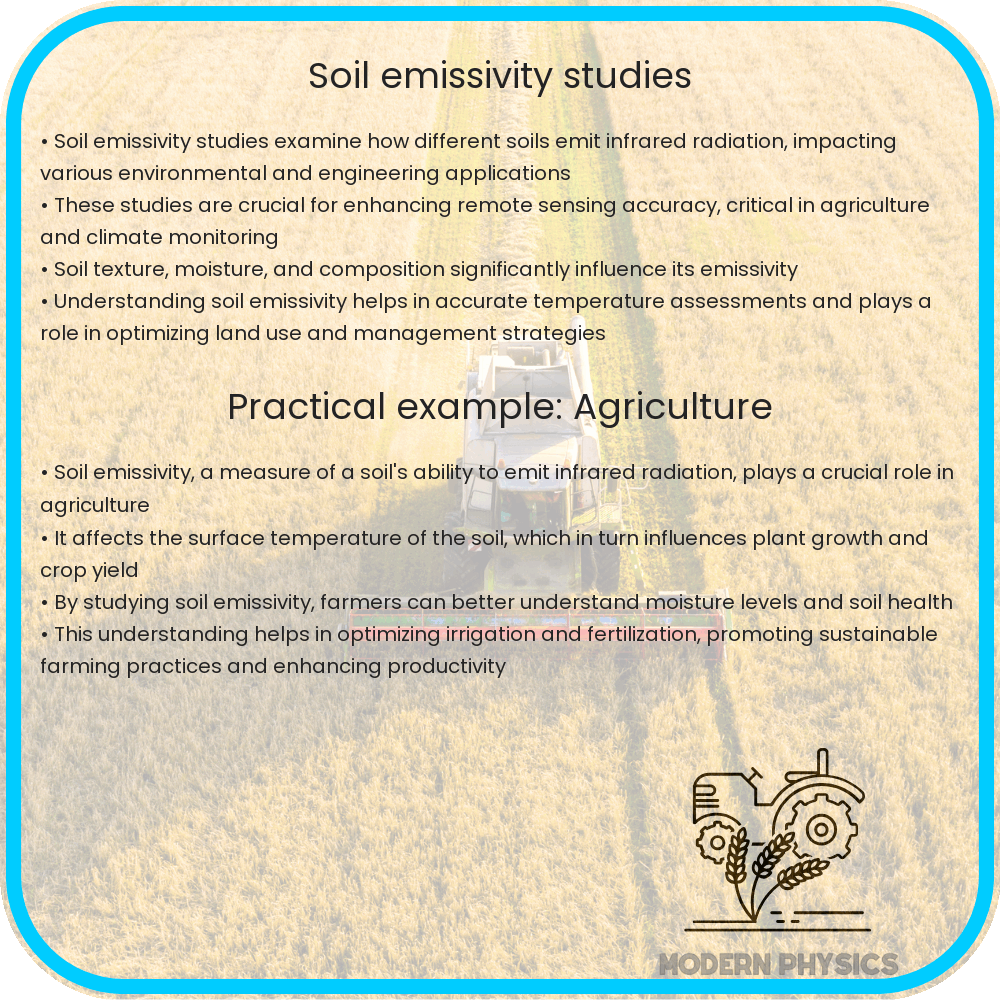
Understanding Soil Emissivity: A Pathway to Enhanced Precision, Yield, and Sustainability in Agriculture
Soil emissivity, a critical but often overlooked factor in environmental science and agricultural engineering, plays a vital role in determining the accuracy of thermal infrared measurements of ground temperature. These measurements are essential for various applications, including meteorology, hydrology, and agriculture climatology. By refining our understanding and measurement of soil emissivity, we can significantly enhance the precision of environmental monitoring and improve agricultural yields and sustainability.
What is Soil Emissivity?
Soil emissivity is a measure of how efficiently soil’s surface emits thermal radiation compared to a perfect black body at the same temperature. Soil emissivity values generally range from 0.95 to 0.98, indicating that soils are nearly perfect emitters of thermal radiation. However, these values vary based on soil type, moisture content, texture, and surface roughness. Therefore, determining an accurate emissivity value is essential for correctly interpreting infrared radiative temperatures and for modifying farming practices to be more climate-smart.
The Impact of Soil Emissivity on Agricultural Precision
Precision agriculture relies on accurate data to optimize the returns on inputs while preserving resources. Thermal infrared imagery, used in evaluating soil properties, plant health, and water use efficiency, depends heavily on soil emissivity measurements. Incorrect emissivity values can lead to erroneous interpretations of satellite or aerial imagery, resulting in suboptimal farming decisions. For instance, if emissivity is underestimated, the inferred temperature of the soil will be higher than its actual temperature, potentially leading to overirrigation.
- Soil Moisture Content: Soil emissivity increases with moisture content, meaning that wetter soils emit more infrared radiation. Precise measurements can therefore assist in irrigation planning and drought assessment.
- Soil Texture and Composition: Clay soils, for example, tend to have higher emissivity than sandy soils due to their finer particles and higher moisture retention capabilities.
- Surface Roughness: Rougher soil surfaces scatter more radiation, affecting the emissivity and, subsequently, the surface temperature readings used in various agricultural models.
Improving Yield and Sustainability Through Emissivity Studies
Accurate soil emissivity data can greatly aid in sustainable farming practices. By ensuring more precise temperature and moisture content readings, farmers can optimize water use and reduce waste, contributing to better crop health and yield. Moreover, with the growing concern over climate change, understanding soil emissivity can help in the modeling of soil carbon storage and turnover, offering insights into how different agricultural practices affect the carbon cycle and sustainability.
Detailed soil emissivity studies equip agronomists and farmers with the insights needed to adjust practices according to micro-climatic conditions. This leads not only to better crop yield but also to a more efficient use of land and water, which is vital in the era of increasing environmental challenges and global food demands.
Technological Advancements and Future Directions in Soil Emissivity Research
The advancement of remote sensing technology has been crucial in pushing the boundaries of how soil emissivity can be assessed and utilized. High-resolution thermal cameras on drones or satellites enable more detailed and frequent data collection. Machine learning algorithms are now being used to better predict soil emissivity from this data, considering factors such as soil chemistries, textures, and historical weather data. Researchers are developing dynamic models that not only reflect current soil conditions but can predict changes due to weather events or farming interventions.
In adopting these advanced technologies, future research is leaning towards creating more sophisticated models that integrate various environmental factors. This integration aims to provide more holistic insights into soil health and environmental sustainability, thereby supporting informed decision-making in agriculture and land management.
Education and Outreach in Soil Emissivity
Educating farmers and agricultural stakeholders about soil emissivity is crucial. While the science might seem complex, breaking it down into more understandable components can help farmers make better-informed decisions. For instance, workshops and training sessions using simple demonstrations of infrared imaging can illustrate how soil composition and moisture affect emissivity and plant health.
Moreover, incorporating soil emissivity education into the curricula of agricultural schools and universities can prepare the next generation of farmers and agricultural scientists. Alongside practical training, the theoretical aspects of emissivity could be highlighted through case studies and collaborative research projects.
Conclusion
Soil emissivity is a fundamental yet nuanced aspect of agricultural science, pivotal for the accurate interpretation of thermal infrared data used in various environmental and agricultural applications. Understanding and accurately gauging soil emissivity’s influence on ground temperature readings not only improves agricultural precision but also sustains yield and enhances overall sustainability. With ongoing technological advancements and increased educational efforts, the enhanced comprehension and application of soil emissivity data hold the promise of revolutionizing precision agriculture. As we continue to face global challenges such as climate change and food security, the role of refined soil emissivity studies becomes increasingly indispensable in crafting solutions that are as innovative as they are necessary.