
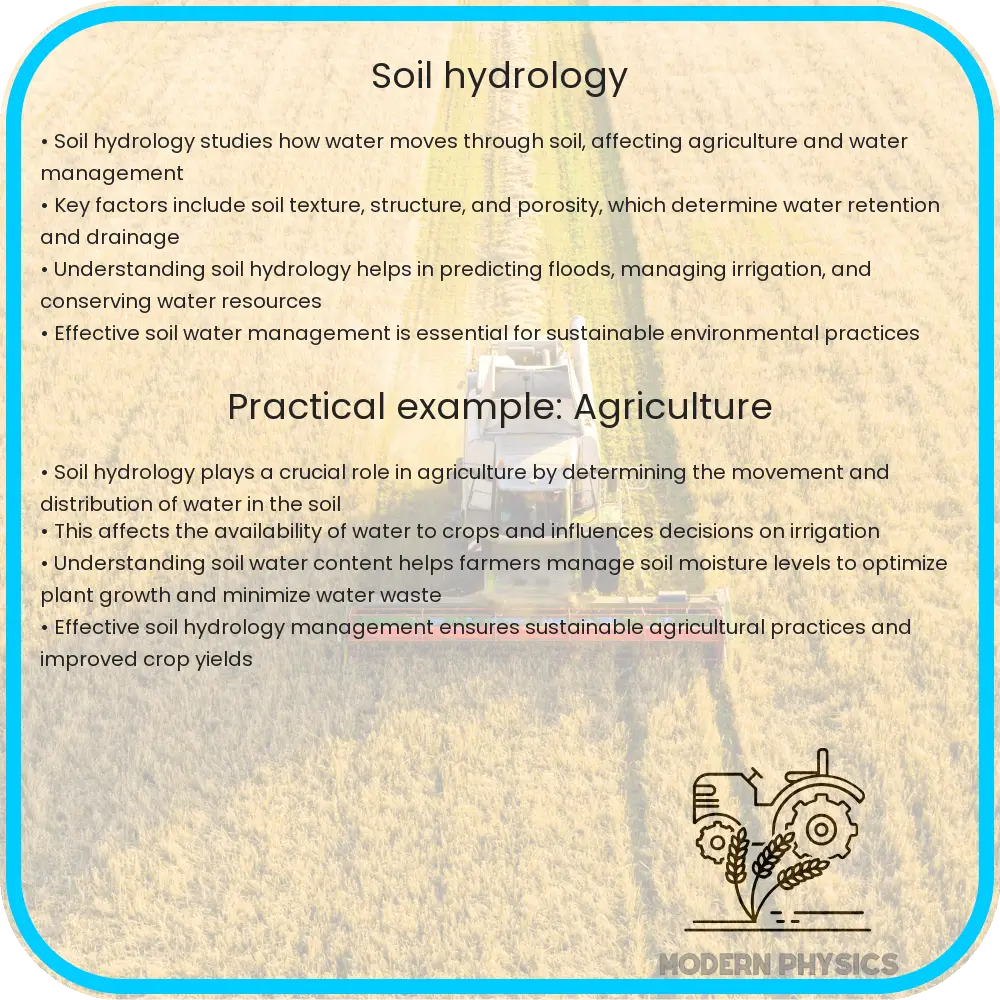
Soil hydrology focuses on the study of water in soil, its effects on ecosystems, agriculture, and land management to sustain productivity.
Introduction to Soil Hydrology
Soil hydrology is a critical branch of environmental physics that focuses on the study of water in soil and its impact on ecosystems, agriculture, and land management. Understanding soil hydrology helps in managing resources efficiently and sustaining agricultural productivity. This article will explore the essential aspects of soil hydrology, including erosion, irrigation practices, and their effects on crop yield.
Understanding Soil Erosion
Soil erosion is a natural process where the top layer of the soil is worn away due to factors like water, wind, and human activities. However, when accelerated by human activities, such as deforestation and inappropriate agricultural practices, erosion can lead to severe environmental and agricultural problems. Erosion affects soil quality, reduces its water-retaining capacity, and can lead to the loss of fertile land.
- Water Erosion: Rainfall and surface runoff are primary causes of water erosion. The impact of raindrops on the soil surface can dislodge soil particles, which are then washed away by runoff water.
- Wind Erosion: In arid and semi-arid regions, wind erosion can be significant, removing loose particles from the surface and potentially causing damage to the soil’s structure and fertility.
Impact of Irrigation on Soil Hydrology
Irrigation is the artificial application of water to the soil, typically for assisting in growing agricultural crops. While effective irrigation can dramatically increase crop yields, improper irrigation practices can lead to several problems:
- Waterlogging: Excessive irrigation can lead to waterlogging, where the water table rises to an excessive level, reducing the oxygen available to plant roots, and hindering their growth.
- Salt Accumulation: In areas with high evaporation rates, irrigation water high in salts can lead to the accumulation of salts in the topsoil, which can be toxic to plants and reduce crop yields.
- Leaching: Heavy irrigation can also push nutrients deeper into the soil, beyond the reach of plant roots, effectively decreasing soil fertility over time.
Relationship Between Soil Hydrology and Crop Yield
The interaction between soil, water, and plant relationships is fundamental in determining the crop yield. Adequate moisture levels in the soil are crucial for the germination of seeds and growth of crops. The availability of water affects the physiological and biochemical processes of plants, influencing their growth rate and productivity.
Conversely, both insufficient and excessive moisture levels can lead to poor plant health and reduced yields. Understanding the balance required in soil moisture levels is essential for maximizing crop production while minimizing environmental impact.
Techniques for Managing Soil Hydrology
To mitigate the negative effects of poor soil hydrology management, various techniques can be applied:
- Contour Plowing: This technique involves plowing along the contour lines of a slope. It helps retain water and reduce runoff, thereby minimizing erosion.
- Terracing: Building terraces on steep slopes creates flat areas that can hold water and soil, reducing both erosion and surface runoff.
- Crop Rotation: Rotating different types of crops can help improve soil structure and reduce vulnerability to erosion. Different root systems help maintain soil porosity and water infiltration.
- Mulching: Applying a layer of mulch on the soil surface helps retain moisture, control weeds, and protect against erosion. It also adds organic matter to the soil as it decomposes.
- Constructed Wetlands: These are engineered systems designed to take advantage of the natural properties of wetlands to treat polluted water, improve water quality, and manage water flow more sustainably.
Advanced Technologies in Soil Hydrology
Recent advancements in technology are providing new tools to better manage and study soil hydrology. Innovative technologies like satellite imaging, remote sensing, and IoT-based soil sensors are revolutionizing our understanding and capability in managing water resources effectively. These tools help in precise irrigation, predicting erosion patterns, and efficient water management tailored to the specific needs of different crop types.
Conclusion
Soil hydrology is an essential field of study that not only impacts agricultural productivity but also environmental sustainability. Effective management of soil and water resources through an understanding of processes like erosion, irrigation, and techniques such as contour plowing and crop rotation, can lead to substantial improvements in crop yield and environmental conservation. Moreover, embracing advanced technologies in monitoring and managing soil hydrology promises even greater efficiency and precision in future agricultural practices. By harnessing both traditional methods and modern technology, sustainable soil hydrology can support thriving ecosystems, sustainable farming, and ultimately, food security worldwide.