
Understanding how different wavelengths of sunlight impact crop growth, health, and yield for improved agricultural practices and climate adaptation.
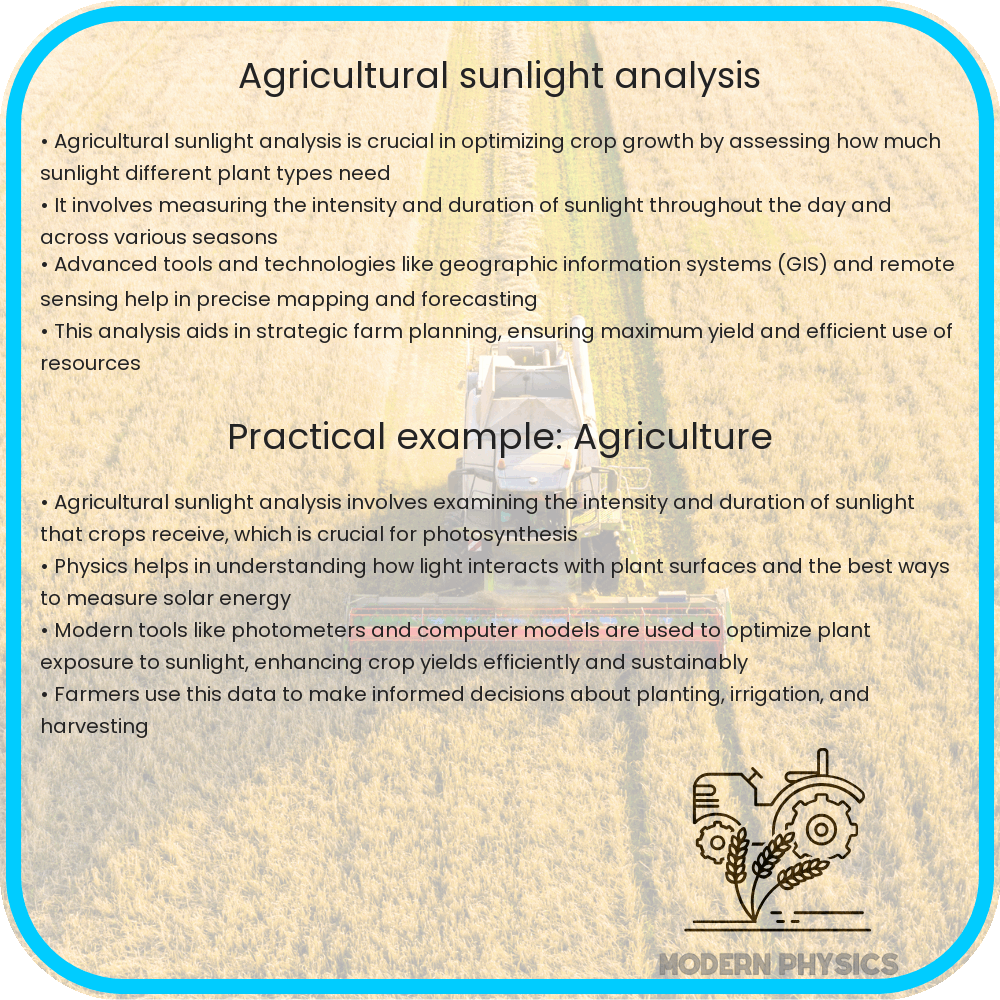
Agricultural Sunlight Analysis: Enhancing Crop Yield, Health, and Adapting to Climate Change
Sunlight, a key component of photosynthesis, is crucial for the growth and health of crops. Agricultural sunlight analysis not only helps in maximizing yield but also assists farmers in adapting their practices to changing climatic conditions. This growing field of study combines principles from several areas of physics to optimize farming strategies, ensuring food security and sustainability.
The Science of Sunlight in Agriculture
At its core, the process by which plants convert light energy from the sun into chemical energy – photosynthesis – can be impacted by various factors including the intensity, quality, and duration of light. Different wavelengths of light influence various aspects of plant growth. For example, blue light can enhance leaf growth, while red light can affect the flowering and fruit production.
Techniques in Sunlight Analysis
- Light Measurement Tools: Devices such as lux meters, pyranometers, and spectroradiometers are employed to measure light intensity and its spectral distribution over agricultural plots.
- Modeling and Simulation: Computational models simulating sunlight and its impact on crops can help in predicting crop health and yield under various conditions.
- Drone and Satellite Imaging: Advanced aerial imagery from drones or satellites enables the analysis of sunlight exposure of crops over large areas, identifying potential problem zones like shading or excess light.
Applications of Sunlight Analysis in Agriculture
Understanding the specific light requirements and patterns can significantly enhance crop yield. Here are several key applications:
- Planting Strategy Optimization: By analyzing sunlight patterns, farmers can optimize planting configurations to maximize light exposure for all plants, even in densely planted fields.
- Seasonal Adjustment: Insights into how sunlight varies with seasons allow farmers to adjust their crop varieties and planting schedules, ensuring that crops receive optimal light throughout their growth cycles.
- Climate Adaptation Strategies: With the ongoing impacts of climate change, sunlight analysis can provide vital data to adapt farming practices to new environmental conditions, potentially reducing the risk of crop failure.
Moreover, sunlight analysis is not just about maximizing production but also about maintaining the health of the crop, which in turn can lead to more sustainable farming practices. By closely monitoring and adapting to the optimal sunlight, use of water and fertilizers can be more controlled and efficient, reducing waste and environmental impact.
Challenges and Innovations
While the benefits are clear, the implementation of effective sunlight analysis techniques in agriculture comes with its challenges. Factors such as the cost of technology, the need for expertise in both agriculture and physics, and the variable nature of weather conditions can complicate widespread adoption. However, ongoing innovations in sensor technology, data analysis, and machine learning are continuously improving the accuracy and accessibility of sunlight analysis tools.
For instance, AI-driven models that predict how clouds and atmospheric conditions will affect sunlight intensity can help in real-time farm management decisions. Furthermore, the integration of these technologies into smart farming systems is making it possible for even small-scale farmers to benefit from these advancements.
Future Prospects and Educational Impact
As the demand for food increases alongside global population growth, the importance of innovative agricultural practices cannot be overstated. The field of agricultural sunlight analysis is set to expand, with more research directed towards enhancing the efficiency of photosynthesis under various light conditions. This could lead to the development of genetically modified crops that are more adaptable to fluctuating sunlight patterns, ensuring robust growth even in less-than-ideal environmental conditions.
Moreover, the intersection of physics and agriculture opens up exciting educational opportunities. By integrating these subjects, educational institutions can prepare students to tackle real-world problems through a multidisciplinary approach. Initiatives that encourage hands-on experience with sunlight analysis tools and techniques can foster a new generation of agricultural scientists and engineers who are well-equipped to enhance food sustainability in the future.
Conclusion
In conclusion, agricultural sunlight analysis represents a crucial convergence of physics and farming where scientific understanding meets practical application. By employing detailed analysis of sunlight exposure and adapting farming practices to maximize the benefits from natural light, agriculture can achieve greater yields and healthier crops. This is particularly vital in our era of climate change and population growth, where efficient and sustainable farming practices are more important than ever. The continued evolution of technology and the innovative spirit of the agricultural sector are paving the way for brighter, more food-secure future.
With challenges like technology costs and the need for specialized knowledge being actively addressed through innovations in AI and the growth of educational programs, the path forward is promising. The synergy between improved crop production and reduced environmental impact underscores the potential of agricultural sunlight analysis not just as a tool for individual farmers, but as a global solution to ongoing food production challenges. It stands as a beacon of hope and an example of how the fusion of different scientific disciplines can produce tangible benefits for humanity.