
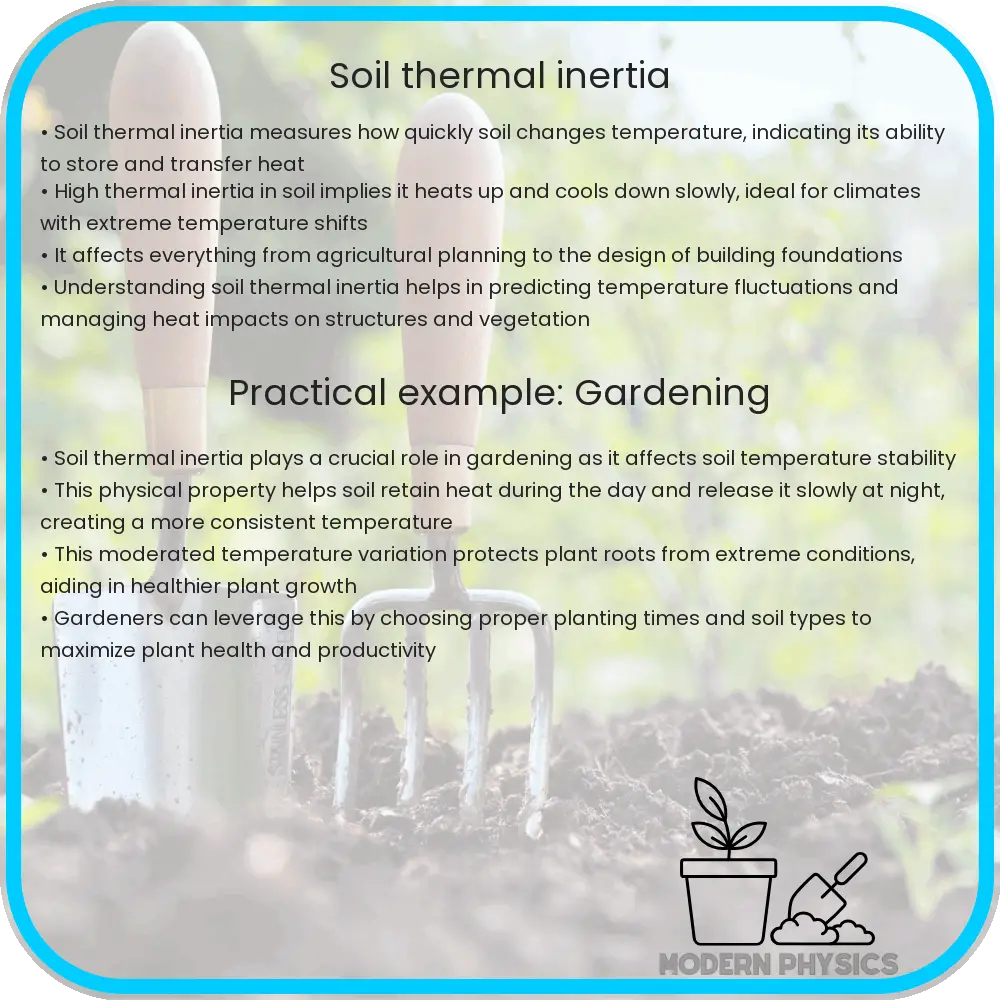
Soil thermal inertia measures soil’s resistance to temperature changes, impacting crop growth and environmental consistency.
Understanding Soil Thermal Inertia
Soil thermal inertia plays a crucial role in agricultural science, particularly in enhancing crop growth and maintaining soil health. This physical property of soil affects how quickly it can change temperature, which in turn influences several other environmental conditions essential for plant development. In this article, we explore the concept of soil thermal inertia, how it is measured, and its implications for agricultural applications.
What is Soil Thermal Inertia?
Thermal inertia is a measure of a material’s resistance to changes in temperature. In the context of soil, it is a product of its specific heat capacity, density, and thermal conductivity. High thermal inertia indicates that the soil can absorb a significant amount of heat without a corresponding large change in temperature. Conversely, soils with low thermal inertia warm up and cool down quickly.
Mathematically, the thermal inertia (It) of the soil can be expressed as:
It = sqrt(k * ρ * c)
Where:
- k is the thermal conductivity (W/m*K),
- ρ (rho) is the soil density (kg/m3),
- c is the specific heat capacity (J/kg*K).
Impact of Soil Thermal Inertia on Crop Growth
The thermal properties of soil influence several aspects of the microclimate around plant roots. For example, soils with high thermal inertia tend to maintain more stable temperatures. This stability can be particularly beneficial in areas with large temperature fluctuations between day and night. Stabilizing soil temperature helps in promoting optimal metabolic rates and growth patterns in plants.
Additionally, a steady temperature regime prevents the stress associated with rapid temperature changes, which can be detrimental to root development and nutrient absorption. By moderating extremities in temperatures, high thermal inertia soils support consistent plant growth throughout various seasons.
Improving Soil Health Through Managed Thermal Inertia
Soil thermal inertia can also indirectly impact soil health by affecting water evaporation rates, nutrient cycling, and microorganism activity. Soils that heat up and cool down quickly tend to lose moisture more rapidly, which can lead to drier conditions that are not conducive to crop growth or soil organism viability.
In contrast, soils with higher thermal inertia provide a more moderated microclimate that can be beneficial for the retention of moisture, promoting better nutrient uptake and healthier plant and microbial communities. These conditions not only enhance current crop yield but also improve the long-term sustainability of the soil.
Applications and Agricultural Techniques
Understanding and utilizing the concept of soil thermal inertia involves a mix of natural management and technological intervention. One common approach is the use of mulching, which affects both thermal conductivity and heat capacity by adding organic matter to the soil. This technique can help adjust the thermal properties of the soil to create more favorable conditions for plant growth.
Additionally, farmers can select appropriate crop varieties that are better suited to the existing soil thermal properties of their croplands. Advanced techniques, such as controlled environment agriculture (CEA), leverage this knowledge to optimize root zone temperatures, thereby maximizing growth rates and yields in both traditional and high-tech farming systems.
Implementation of technologies like thermal sensors and automated irrigation systems further aid in monitoring and adjusting soil temperatures, ensuring that crops are grown under optimal thermal conditions. These innovations represent the intersection of physics and agricultural science, demonstrating how an understanding of basic physical properties can lead to advances in crop production and sustainability.
Advancements in Measuring Soil Thermal Inertia
Technological advancements have significantly enhanced the ability to measure and analyze soil thermal inertia accurately. Modern instruments, like heat flux sensors and infrared thermometers, provide precise data that can be used to gauge the thermal properties of soil effectively. These tools help agronomists and farmers make informed decisions about irrigation, planting, and harvesting times based on the soil’s thermal characteristics.
Additionally, remote sensing technologies, such as those used in satellites or drones, offer the possibility of large-scale thermal inertia measurements. This wide-area data collection is invaluable for managing agricultural operations across extensive farms or even regional agro-climatic zones.
Challenges and Future Prospects
Despite the potentials of high soil thermal inertia for improving agricultural productivity, several challenges remain. Variability in soil composition, moisture levels, and organic content can lead to discrepancies in thermal inertia measurements and impact the effectiveness of management strategies. Hence, tailored approaches that consider local soil conditions are essential for achieving optimal results.
Future research may focus on integrating artificial intelligence and machine learning techniques with thermal inertia data to predict and automate farming operations more accurately. These developments could revolutionize precision agriculture, making it more adaptive to climate variations and resource availability.
Conclusion
Soil thermal inertia is a fundamental but often overlooked aspect of agricultural sciences that plays a significant role in crop growth and soil health. By understanding and managing this property, farmers can enhance plant development, maintain moisture levels, and improve the microclimate around crops. Technological interventions and advancements in measurement methods have further enabled precise control and management of soil conditions, leading to more sustainable and profitable farming practices.
As we look toward the future, the integration of new technologies and customized strategies based on specific soil properties will likely become standard practices in the quest to meet global food demands efficiently. Thus, continuing to explore and exploit the science of soil thermal inertia not only supports current agricultural needs but also prepares us for the challenges of tomorrow’s farming landscapes.