
Learn about smart dust sensors, microscopic devices that monitor and transmit data on environmental and structural conditions.
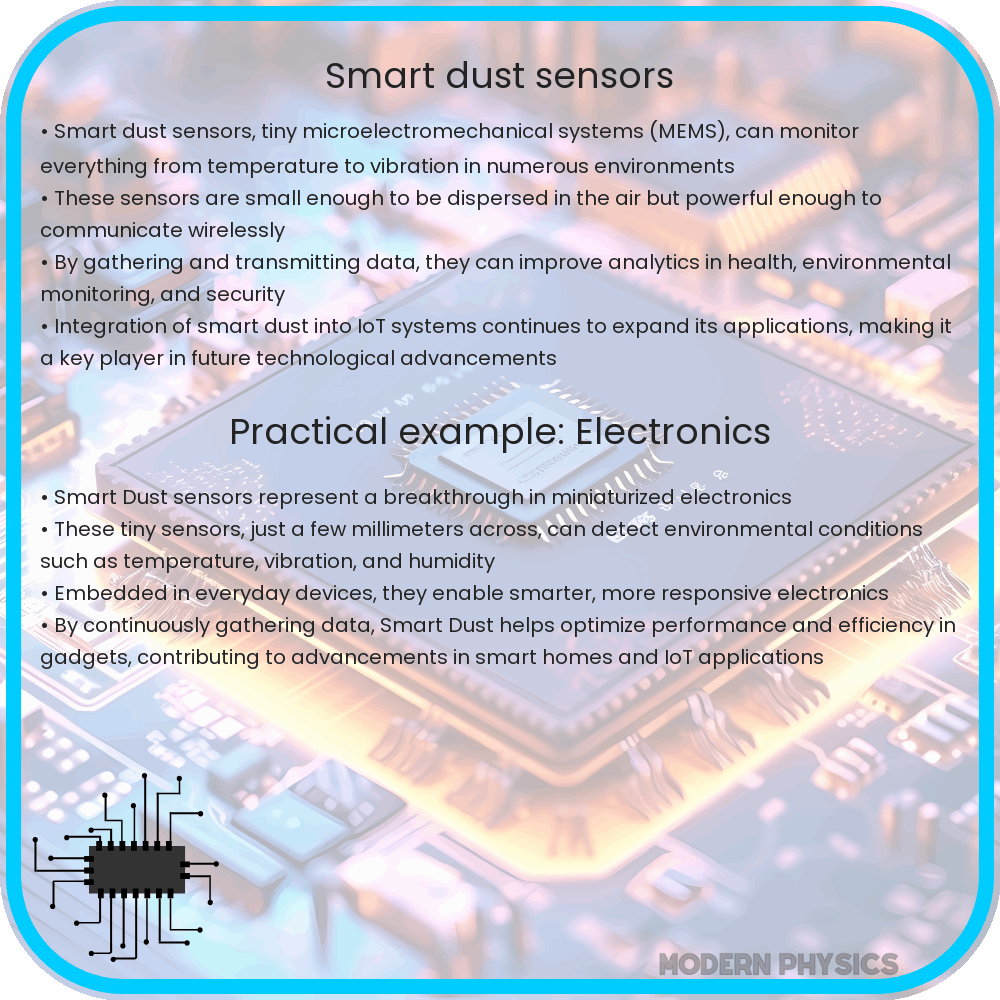
Introduction to Smart Dust Sensors
Imagine a world where tiny sensors, no bigger than a grain of sand, can monitor everything from the air quality in your home to the structural integrity of bridges and buildings. This is not the setting of a science fiction novel; this is the reality that smart dust sensors are bringing to the forefront of technology and materials science.
What are Smart Dust Sensors?
Smart dust sensors consist of microelectromechanical systems (MEMS), which are tiny devices that integrate mechanical and electrical components at a microscopic scale. These sensors can collect data on temperature, light, vibration, magnetism, and chemicals, then wirelessly transmit this information for analysis. Despite their minuscule size, they are a powerhouse of technology, each particle containing components for sensing, computation, communication, and power supply.
The Role of Materials Science
The development of smart dust is heavily reliant on advances in materials science. The fabrication of such small devices requires materials that are not only highly conductive and responsive but also durable enough to withstand various environmental conditions. Innovations in nanotechnology, specifically in the synthesis of nanomaterials like graphene and quantum dots, have significantly propelled the capabilities of these sensors.
Applications Across Industries
Smart dust sensors hold the potential to revolutionize a myriad of industries due to their versatility and the breadth of data they can provide:
- Environmental Monitoring: These sensors can be dispersed in the atmosphere to monitor air quality, detect pollutants, and even track the spread of pollen or pathogens.
- Healthcare: Embedded within medical tools, smart dust can provide real-time diagnostics and monitoring, such as measuring the levels of various compounds in the bloodstream or detecting anomalies in organ function.
- Structural Health Monitoring: By embedding these sensors in construction materials, engineers can receive data on the health of infrastructure, detecting cracks, corrosion, or other potential points of failure before they become critical issues.
Challenges Ahead
Despite their promising capabilities, the deployment of smart dust sensors faces several challenges. The foremost concern is power supply; how to continuously power millions of tiny sensors is a subject of ongoing research, with current solutions leaning towards energy harvesting techniques like piezoelectric or solar energy. Privacy and security are also major concerns, as the widespread adoption of these sensors could potentially lead to unprecedented levels of surveillance.
The journey of smart dust from concept to mainstream application is complex and fraught with hurdles. However, the intersection of advanced materials and innovative engineering continues to push the boundaries, presenting a future where smart dust could be as common as the devices we use today.
Emerging Trends and Future Perspectives
The future of smart dust is linked with the progress in AI and machine learning, enabling these tiny sensors to not only collect data but also make intelligent decisions based on the collected information. This capability could lead to autonomous smart systems, capable of adapting to their environment without human intervention.
As researchers tackle the technical and ethical challenges, the prospect of integrating smart dust sensors into everyday life becomes more plausible, promising a new era of information and automation that could reshape our interaction with the physical world.
Integrating Smart Dust into Consumer Technology
As smart dust technology matures, its integration into consumer technology could become a reality. This implies that everyday items could be embedded with these sensors, making them smarter and more interactive. From smartphones that can detect air quality to smart clothing that monitors health vitals, the possibilities are boundless. The convenience and enhanced functionality that smart dust could bring to consumer products might significantly boost the Internet of Things (IoT), leading to more connected and responsive environments.
Energy Efficiency and Sustainability
One of the key areas for the future development of smart dust is improving energy efficiency and sustainability. Researchers are exploring environmentally friendly materials for sensor components, and energy-efficient ways to power them. This could involve advanced biodegradable materials to reduce waste and eco-friendly energy sources such as body movement or ambient radio frequencies, aiming to ensure that smart dust networks are sustainable and have minimal environmental impact.
Conclusion
The concept of smart dust combines intricate engineering with visionary science and has the potential to revolutionize how we interact with the world. Through the integration of MEMS technology and advancements in materials science, these minute sensors provide vast possibilities from environmental monitoring to healthcare. While challenges such as power supply and privacy concerns remain substantial, ongoing research and ethical discussions are paving the way for responsible and innovative uses of smart dust sensors. As this technology progresses, it could profoundly shape our approach to data gathering, personal health, environmental sustainability, and even our day-to-day convenience, casting a promising outlook on future technological integrations in our lives.