
Explore the captivating world of sailboard dynamics, where stability, motion, and fluid forces merge, offering insights for enthusiasts and pros alike.
Understanding Sailboard Dynamics: Stability, Motion, and Fluid Forces
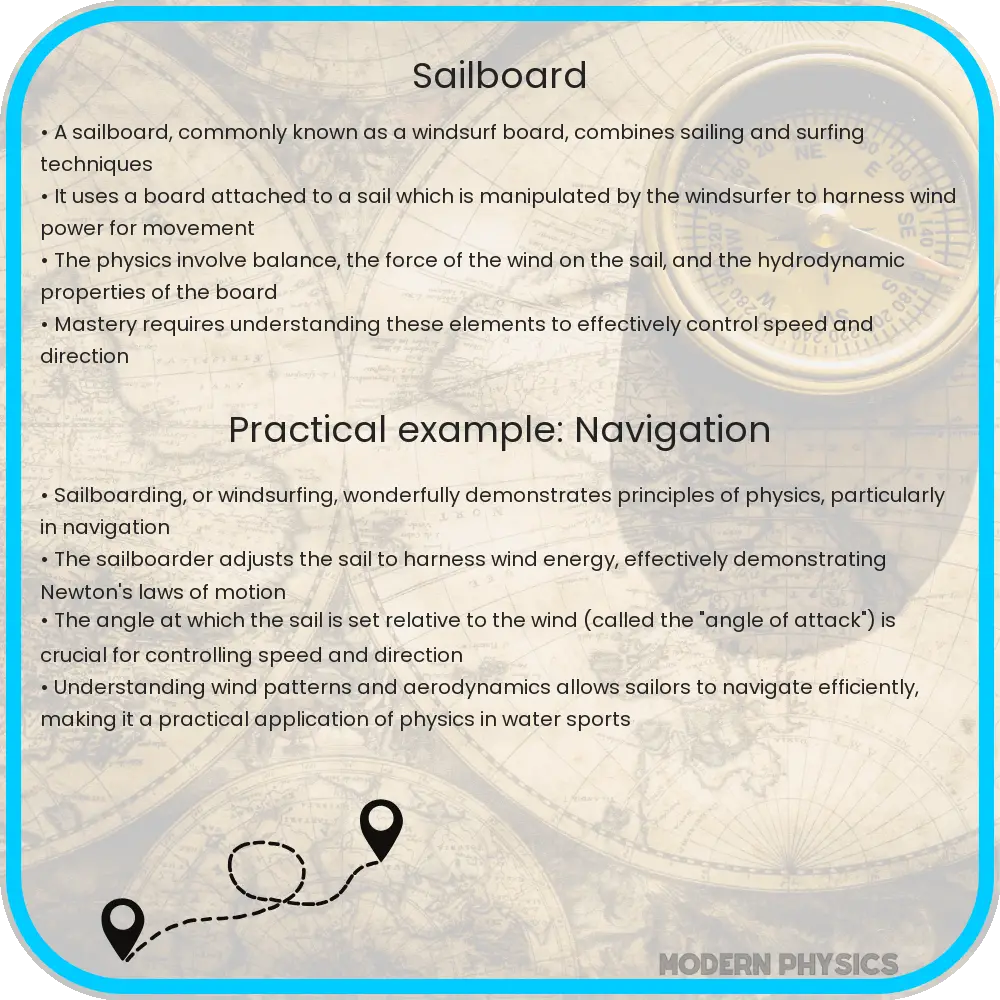
Sailboarding, also known as windsurfing, combines elements of sailing and surfing to create a unique water sport. Understanding the dynamics of a sailboard involves exploring its stability, motion, and the fluid forces acting upon it. These factors are critical in enhancing performance and ensuring the safety of the rider.
Stability of Sailboards
The stability of a sailboard is influenced by both its design and the skill of the rider. The board’s width, volume distribution, and hull shape play a pivotal role in determining its stability. Wider boards with larger volumes provide more stability, which is especially beneficial for beginners. Advanced riders, however, may prefer narrower boards for greater maneuverability.
- Centre of Gravity: The position of the rider’s body, particularly the centre of gravity, is crucial in maintaining balance. A lower centre of gravity increases stability.
- Board and Sail Design: The sailboard’s design, including the sail size and mast position, affects stability. Larger sails can catch more wind but may also make the board harder to control.
Motion and Maneuverability
The motion of a sailboard is governed by the principles of fluid dynamics and Newton’s laws of motion. The rider manipulates the sail to capture wind, which propels the board forward. Steering is achieved by tilting the sail and adjusting the board’s angle relative to the wind.
- Wind Force: The force exerted by the wind on the sail is a combination of lift and drag. Lift propels the board forward, while drag can slow it down.
- Water Resistance: The shape of the hull affects how the board cuts through water. A streamlined design reduces water resistance, enhancing speed and agility.
Fluid Forces at Play
Understanding the fluid forces acting on a sailboard is essential for maximizing performance. These forces include hydrodynamic forces from the water and aerodynamic forces from the air.
Hydrodynamic forces are influenced by factors such as:
- Board Shape: The hydrodynamic lift and drag depend on the hull’s shape and the board’s orientation in the water.
- Water Conditions: Rough or choppy water can increase resistance and impact stability.
Aerodynamic forces are affected by:
- Sail Shape: The curvature and tension of the sail impact how efficiently it can harness wind energy.
- Wind Speed and Direction: Varying wind conditions require the rider to adjust the sail and stance to maintain balance and direction.
Both hydrodynamic and aerodynamic considerations are crucial in the design and operation of sailboards. These aspects collectively determine the board’s behavior in different wind and water conditions, enabling riders to achieve optimal performance.
Optimizing Performance Through Dynamics
To optimize sailboard performance, understanding the interplay between these forces is paramount. Riders must develop a keen sense of how to adjust their stance and sail positioning in response to changing conditions. The art of windsurfing lies in the rider’s ability to harmonize with the fluid environment, adapting to the dynamic forces of wind and water.
- Technique and Experience: Proficient windsurfers can read wind patterns and water textures, adjusting their techniques to utilize these elements effectively.
- Equipment Tuning: Adjusting the rigging, such as mast height and sail tension, can significantly affect performance. Personalizing these settings to suit individual style and conditions is crucial.
Advanced Dynamics in Competitive Sailboarding
In competitive sailboarding, mastering complex dynamics becomes even more critical. Competitors must make rapid decisions and precise movements to outmaneuver opponents and harness the wind effectively.
- Strategic Positioning: In races, strategic positioning relative to competitors and understanding wind shifts can provide a competitive edge.
- High-Speed Maneuvers: Advanced techniques, such as planing (where the board skims over the water’s surface), require a deep understanding of fluid dynamics and board control.
Environmental Considerations
Windsurfers also need to be aware of environmental factors. Variables such as tide changes, underwater terrain, and weather conditions can all impact the sailing experience. Respecting and understanding the natural environment not only ensures safety but also enhances the overall experience.
Conclusion
The dynamics of sailboarding encompass a complex interplay of stability, motion, and fluid forces. A comprehensive understanding of these elements is vital for both recreational and competitive windsurfing. By mastering the balance between equipment design, environmental conditions, and personal skill, windsurfers can achieve remarkable harmony with the natural forces at play. This blend of science and art makes sailboarding a uniquely challenging and rewarding sport, offering endless opportunities for exploration and growth.
Whether a beginner learning to balance and steer or a seasoned competitor carving through waves at high speed, the journey of mastering sailboard dynamics is an exhilarating and perpetual challenge. It’s a sport where physics meets finesse, and where each ride is a new lesson in the beautiful complexity of nature’s forces.