
Explore the essentials of sailing dynamics: delve into stability, maneuvering, control, and advanced sailing techniques for optimal performance.
Sailing Dynamics: Understanding Stability, Maneuvering, and Control
Sailing, an art as old as civilization itself, is governed by a complex interplay of forces and principles. To fully appreciate and master sailing, one must understand the key aspects of sailing dynamics, which include stability, maneuvering, and control. These elements are crucial for both the safety and performance of a sailing vessel.
Stability in Sailing
Stability in sailing refers to a boat’s ability to resist capsizing and return to an upright position after being tilted by wind or waves. This stability is determined by two main factors: the shape of the hull and the distribution of weight within the boat. A wider hull typically offers greater initial stability, while a deeper and heavier keel improves overall stability.
- Metacentric Height (GM): A key concept in understanding stability is the metacentric height. It’s the distance between the metacenter, a point where the buoyant force acts, and the center of gravity (G). A larger GM indicates greater stability.
- Righting Moment: This is the force that helps a boat return to its upright position. It’s the product of the boat’s weight and the distance between its center of gravity and the center of buoyancy when heeled.
Maneuvering in Sailing
Maneuvering involves changing the boat’s direction or speed. This is achieved through the coordinated use of sails, rudder, and sometimes the hull shape. Effective maneuvering requires understanding the forces at play:
- Hydrodynamic Forces: These are forces exerted by water on the boat’s hull, affecting speed and direction.
- Aerodynamic Forces: Generated by wind acting on the sails, these forces are crucial for propulsion and maneuvering.
- Rudder Dynamics: The rudder controls the boat’s direction, and its effectiveness is dependent on the flow of water over its surface.
Control in Sailing
Control in sailing is about maintaining a desired course or position. It’s a balance between the sail settings, the angle of the boat to the wind (known as the ‘point of sail’), and rudder position. Sail trim – adjusting the sails for optimal performance – is vital for effective control. Sailors must constantly adjust to changing wind and sea conditions, requiring a deep understanding of sail dynamics.
Effective control also involves understanding the concept of ‘Apparent Wind’, which is the wind felt on the boat. It’s a combination of the true wind and the wind created by the boat’s own motion. Sailors adjust their sails based on the apparent wind to maximize efficiency and control.
Understanding these dynamics is essential for safe and successful sailing. In the next section, we will delve deeper into practical applications of these principles and explore advanced concepts in sailing dynamics.
Advanced Concepts in Sailing Dynamics
Building on the fundamentals of stability, maneuvering, and control in sailing, it’s important to delve into more advanced concepts that enhance a sailor’s skill set. These include understanding the physics of lift and drag, mastering the art of tacking and jibing, and recognizing the impact of environmental factors on sailing performance.
Lift and Drag in Sailing
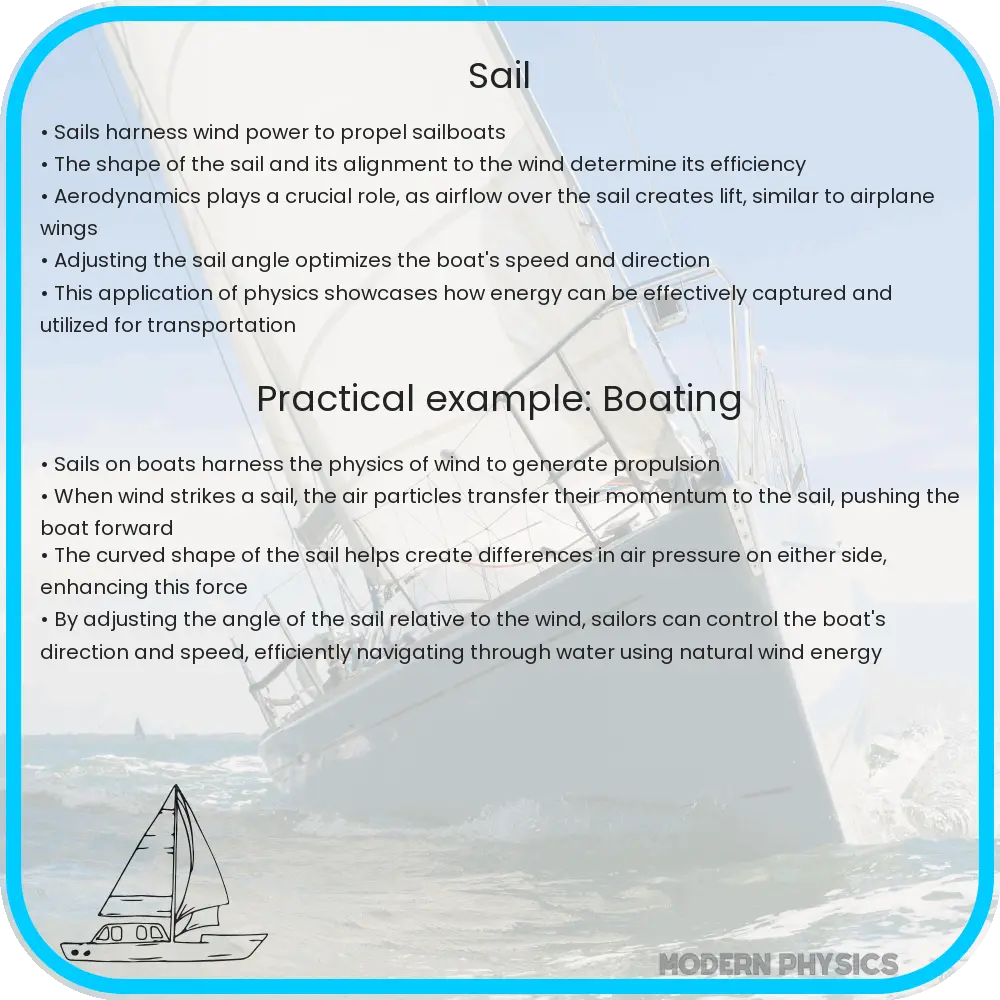
Lift and drag are two aerodynamic forces that play a crucial role in sailing. Lift is generated by the sails, functioning similarly to airplane wings, allowing a boat to move not just downwind but also across and slightly into the wind.
- Lift: Created by the pressure difference between the windward and leeward sides of the sails, enabling the boat to move forward.
- Drag: The resistance felt by the boat moving through water and air. Minimizing drag is key to maintaining higher speeds.
Tacking and Jibing Techniques
Tacking and jibing are maneuvers used to change direction in relation to the wind. Tacking refers to turning the bow through the wind, while jibing involves turning the stern. Mastery of these techniques is essential for effective navigation, especially in variable wind conditions.
Environmental Impact on Sailing
Environmental factors such as tides, currents, and wave patterns significantly impact sailing. Understanding these elements and how they interact with the boat’s dynamics is crucial for effective sailing strategy.
- Tides and Currents: These can alter the boat’s course and speed. Anticipating and adjusting for these changes is vital for accurate navigation.
- Wave Patterns: Waves affect the boat’s motion and stability. Skillful sailors use waves to their advantage, reducing drag and maintaining speed.
Conclusion: The Harmony of Science and Skill in Sailing
In conclusion, sailing is a blend of science and skill, where understanding the principles of stability, maneuvering, and control is just the beginning. Advanced knowledge of aerodynamics, coupled with practical skills like tacking and jibing, equips sailors to handle a wide range of sailing conditions. Moreover, an awareness of environmental factors like tides and currents enhances a sailor’s ability to navigate efficiently and safely.
Whether you’re a seasoned sailor or a beginner, appreciating these dynamics transforms sailing from a mere activity into an art form. It’s a continuous learning journey where the wind and waves become teachers, guiding one towards mastery of the seas. As technology evolves and our understanding of these principles deepens, the horizon of sailing possibilities continues to expand, promising ever more thrilling and rewarding experiences on the water.