
Explore how optical mixing rods enhance light uniformity and efficiency in photonics, detailing mechanics, materials, and applications in optical tech.
Understanding Optical Mixing Rods
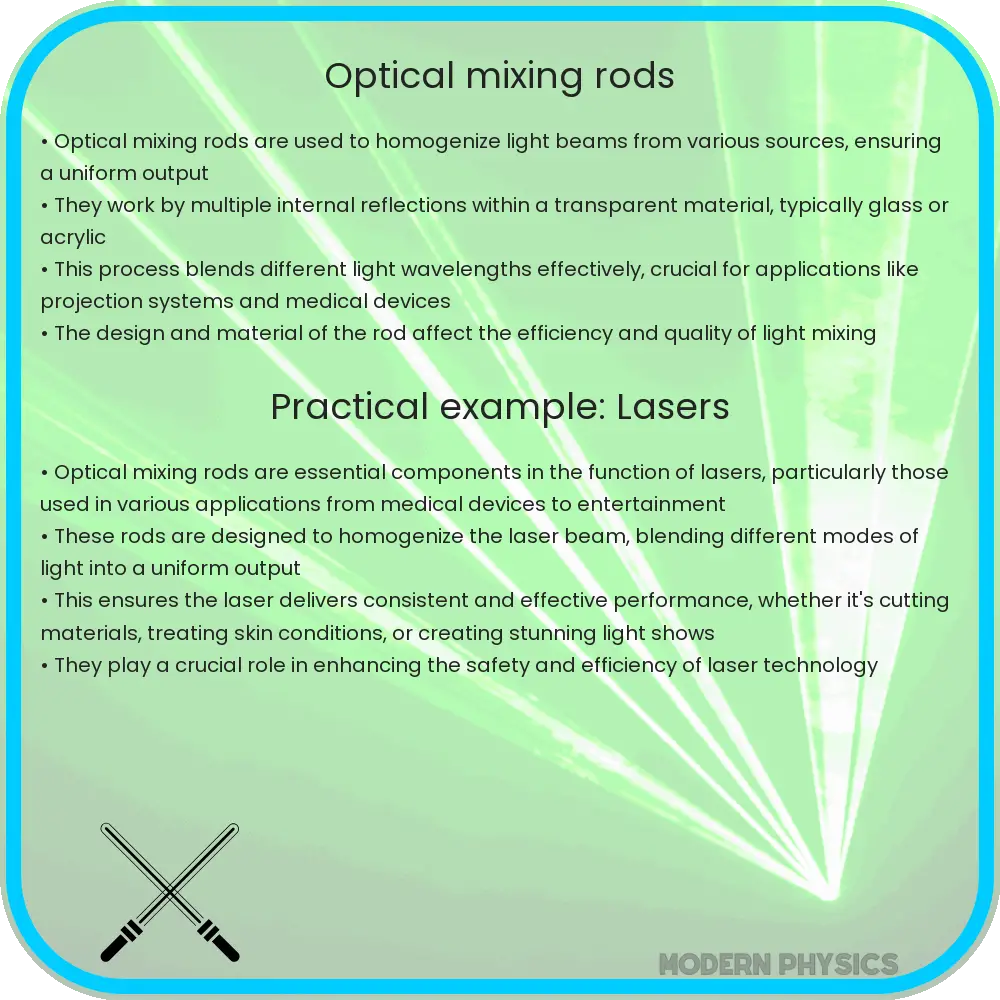
Optical mixing rods, also known as light homogenizing rods, are critical components in the fields of photonics and optics. They are designed to ensure uniform light distribution from a source, which is essential in applications requiring consistent illumination across a target area. This article delves into the mechanics behind optical mixing rods, their efficiency, and the clarity they bring to optical systems.
The Mechanics of Optical Mixing Rods
Optical mixing rods work by manipulating light paths through internal reflection. Constructed from high-grade optical materials such as fused silica or borosilicate glass, these rods have a hexagonal or square cross-section. The principle behind their operation is total internal reflection (TIR), where light entering one end of the rod is reflected within its walls until it exits the other end. This process ensures that light beams crisscross and mix thoroughly, leading to a homogenized output.
Enhancing Efficiency with Optical Mixing Rods
The efficiency of an optical mixing rod is determined by its ability to deliver a uniform light output while minimizing losses. Factors influencing efficiency include the rod’s aspect ratio, surface quality, and the material’s refractive index. A higher aspect ratio (length to diameter) and smoother surfaces improve the homogenization process by reducing scattering and absorption losses. Additionally, selecting a material with an appropriate refractive index ensures optimal TIR conditions, further enhancing light transmission efficiency.
Clarity and Uniformity in Light Distribution
Clarity in the context of optical mixing rods refers to the purity and uniformity of the light output. By evenly distributing light, these rods eliminate hot spots and shadows, which is crucial for applications such as imaging, photolithography, and medical lighting. The quality of the homogenization directly impacts the clarity of the final application, making the choice of rod material and design paramount.
As we explore further, it becomes evident that optical mixing rods play a pivotal role in advancing optical technologies. Their ability to ensure even light distribution not only enhances the efficiency of optical systems but also contributes significantly to the clarity and quality of the resulting applications.
Material Considerations for Optical Mixing Rods
The choice of material for optical mixing rods is critical for achieving desired performance outcomes. Fused silica and borosilicate glass are commonly used due to their high transmission rates and resistance to thermal shock. Fused silica, in particular, offers excellent UV transmission, making it ideal for applications requiring UV light homogenization. Borosilicate glass, on the other hand, is preferred for its durability and cost-effectiveness in visible to near-infrared applications.
Customization and Applications
Optical mixing rods can be customized to meet specific application requirements. This includes varying the rod length, cross-sectional shape, and surface finish. Such customizations allow for optimization in diverse fields, from laser delivery systems and projection displays to lighting for machine vision. The adaptability of optical mixing rods to different light sources and their capacity to improve light uniformity makes them indispensable in advancing optical technology.
Future Outlook and Innovations
The future of optical mixing rods looks promising, with ongoing research and development focusing on improving their efficiency and versatility. Innovations such as nanostructuring the surface of the rods to enhance light mixing capabilities or integrating photonic crystal structures to tailor the light output spectrum are on the horizon. These advancements aim to open up new possibilities for optical mixing rods in emerging technologies such as quantum computing and ultra-high-resolution imaging.
Conclusion
Optical mixing rods stand at the confluence of physics and engineering, offering a simple yet elegant solution to a complex problem: achieving uniform light distribution. Their role in enhancing the efficiency, clarity, and uniformity of light in various optical systems cannot be overstated. From improving the precision of medical imaging techniques to enabling the clarity of digital projectors, optical mixing rods have broadened the horizons of what is possible in optical technology. As we look to the future, the continued innovation in the design and application of these rods promises to further elevate the capabilities of optical systems, making the exploration of light’s potential virtually limitless.