
Optical sorting machines use advanced sensors and imaging technology to separate materials based on optical properties, ensuring precision, speed, and efficiency in various industries.
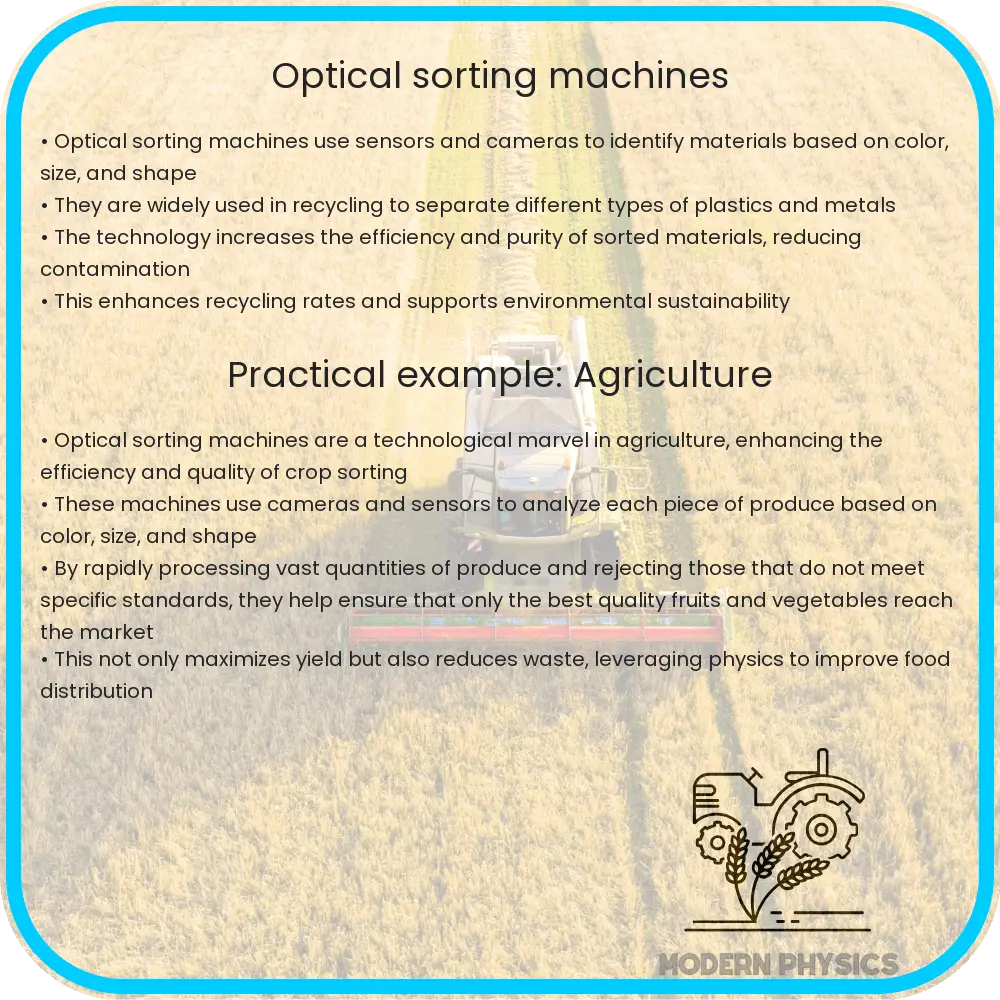
Optical Sorting Machines: Precision, Speed & Efficiency
Optical sorting machines are extraordinary devices that use advanced technology to separate materials based on their optical properties, such as color, shape, size, and structural composition. These machines play a critical role in various industries, including food production, recycling, and mining. Let’s delve into how these powerful tools combine precision, speed, and efficiency to revolutionize sorting processes.
How Optical Sorting Machines Work
At the heart of optical sorting machines is their capability to detect differences in materials using sensors. These sensors capture detailed images and data, allowing the machine to identify and differentiate items on a conveyor belt. Here’s a step-by-step breakdown of the sorting process:
- Material Feeding: The raw material is fed onto a conveyor belt.
- Image Acquisition: High-resolution cameras or sensors capture images of the materials as they move along the conveyor.
- Image Processing: The system processes these images, analyzing various features such as color, shape, and size.
- Decision Making: Based on programmed criteria, the system decides whether to accept or reject each item.
- Ejection: Precise mechanical or air jet systems remove unwanted material from the conveyor.
Precision in Sorting
The precision of optical sorting machines is primarily determined by their imaging and processing technologies. Advanced sensors and high-definition cameras enable the detection of minute differences in material properties. For instance, in the food industry, these machines can identify defective or contaminated products by spotting variations in color or shape that are often imperceptible to the human eye.
In mathematical terms, the precision of the sorting can be described as a percentage efficiency. If “Nt” represents the total number of items and “Nc” represents correctly sorted items, the precision (P) is given as:
\[ P = \left(\frac{N_{c}}{N_{t}}\right) \times 100 \% \]
The Speed Advantage
Optical sorting machines are designed to operate at incredibly high speeds, far exceeding the capabilities of manual sorting. The integration of rapid image processing algorithms and swift ejector systems ensures that large volumes of material can be processed in a short amount of time. This efficiency is vital for industries where time and throughput directly impact profitability and productivity.
Efficiency
The efficiency of optical sorting machines is a product of both their speed and precision. By minimizing manual intervention and maximizing the detection and removal of undesired materials, these machines significantly reduce waste and enhance the overall quality of the end product. They also contribute to energy savings by optimizing the sorting process to be as streamlined as possible.
- Reduced Waste: Higher accuracy in detecting contaminants or defects leads to less material being discarded unnecessarily.
- Cost Savings: The automated nature of these machines translates to lower labor costs and faster processing times.
- Improved Quality: Consistently higher-quality output bolsters brand reputation and customer satisfaction.
In conclusion, optical sorting machines effectively marry precision, speed, and efficiency to provide invaluable benefits across multiple industries. As technology continues to improve, these machines will become even more integral to optimizing and enhancing industrial processes.
Applications of Optical Sorting Machines
Optical sorting machines are employed in a wide range of industries, each benefiting from the specific advantages these devices offer. Here are some notable applications:
- Food Industry: Ensuring food safety and quality by removing foreign materials and defective products from production lines. Optical sorters are used for grains, nuts, fruits, vegetables, and many other food items.
- Recycling: Enhancing the efficiency of recycling processes by sorting materials such as plastics, metals, and glass. This contributes to environmental sustainability by improving recycling rates and reducing landfill waste.
- Mining: Increasing the yield and purity of mined materials by separating valuable ores from waste rock.
- Pharmaceutical Industry: Ensuring the integrity of pharmaceutical products by removing defective pills or capsules based on color and shape.
- Waste Management: Automating the separation of recyclable waste materials from non-recyclable ones, thus facilitating more efficient waste processing.
Technological Components
Optical sorting machines depend on several key technological components to achieve their high efficiency and precision:
- Sensors and Cameras: These are the eyes of the system, capturing high-resolution images and data required for image processing.
- Image Processors: Advanced algorithms analyze the captured images to detect specific properties such as color, texture, and shape.
- Control Units: These units make real-time decisions based on the processed data, ensuring that the appropriate materials are sorted correctly.
- Ejection Mechanisms: High-speed air jets or mechanical arms act swiftly to remove undesired materials off the conveyor belt.
Future Trends and Developments
The future of optical sorting machines looks promising, with several emerging trends and technological advancements on the horizon:
- Artificial Intelligence (AI) and Machine Learning (ML): Integrating AI and ML can improve the accuracy and adaptability of sorting machines. These systems can learn from their sorting history and optimize their processes over time.
- Enhanced Sensors: The development of hyperspectral imaging and other advanced sensors can provide even more detailed material characterization.
- Integration with IoT: Internet of Things (IoT) technology allows for real-time monitoring and diagnostics, improving maintenance and operational efficiency.
- Miniaturization: Future optical sorting machines may become more compact and versatile, allowing them to be used in a broader range of settings and applications.
Conclusion
In conclusion, optical sorting machines are transforming various industries by offering unparalleled precision, speed, and efficiency. These machines not only improve the quality and safety of products but also contribute to cost savings and waste reduction across multiple sectors. As technology continues to evolve, we can expect even greater advancements in optical sorting capabilities, making these machines an indispensable part of modern industrial processes. Whether in food production, recycling, or mining, the future holds exciting prospects for enhancing the effectiveness and reach of optical sorting technologies.