
Explore quantum nanoplasmonics: merging quantum mechanics with plasmonics for breakthroughs in sensing, imaging, and quantum computing.
Exploring the Frontiers of Quantum Nanoplasmonics
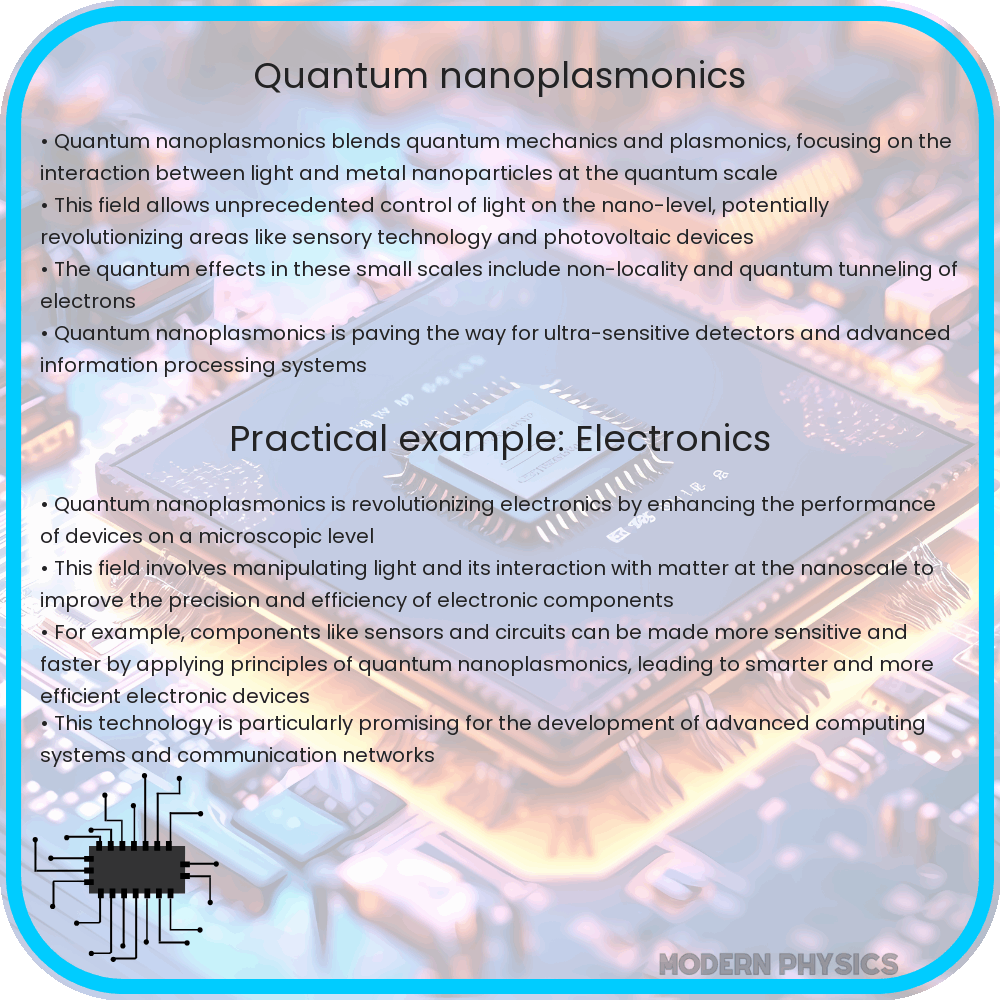
Quantum Nanoplasmonics is a cutting-edge field that merges the principles of quantum mechanics with plasmonics, the study of plasmonic oscillations of free electrons in metals. This convergence enables unprecedented control and manipulation of light at the nanoscale, far beyond the diffraction limit of traditional optics. This innovation opens new avenues for applications ranging from ultra-sensitive sensing to high-resolution imaging, and even quantum computing.
The Essence of Quantum Nanoplasmonics
At the heart of quantum nanoplasmonics lies the ability to exploit the interactions between light and metal nanoparticles to create plasmons—coherent oscillations of electrons at the surface of the metal. When quantum mechanics is applied, these interactions reveal new phenomena that allow for precise control over light, including its confinement, amplification, and manipulation at scales much smaller than the wavelength of light itself.
Advancements in Light Control and Sensing
One of the most promising applications of quantum nanoplasmonics is in the development of highly sensitive sensors capable of detecting single molecules. This is achieved by leveraging the enhanced electromagnetic fields generated at the nanoscale, which significantly amplify the signals of molecules present in extremely low concentrations. Moreover, the field is advancing towards the creation of devices that can control the quantum states of light, paving the way for quantum information processing and secure communication networks.
Innovations in Imaging and Photovoltaics
Beyond sensing, quantum nanoplasmonics is revolutionizing the field of imaging by breaking the limits of resolution set by conventional optics. Nanoplasmonic lenses and microscopy techniques are being developed to observe phenomena at the atomic scale, providing insights into the structure and behavior of materials at unprecedented detail. Additionally, the field is contributing to the enhancement of photovoltaic devices. By manipulating light at the quantum level, researchers are improving the efficiency of solar cells, making renewable energy sources more viable and efficient.
Quantum nanoplasmonics stands at the forefront of technological innovation, merging the abstract principles of quantum mechanics with the tangible benefits of enhanced light control. As research progresses, the potential applications of this field continue to expand, promising to revolutionize industries from healthcare to energy and beyond.
Pushing the Boundaries: Quantum Computing and Beyond
The realm of quantum computing also stands to benefit immensely from advancements in quantum nanoplasmonics. By harnessing the principles of quantum mechanics, researchers are developing plasmonic materials and devices capable of performing quantum computations. These quantum plasmonic systems offer the potential for processing information at speeds unattainable by classical computers, heralding a new era of computing power and efficiency.
Challenges and Future Directions
Despite its promising prospects, the field of quantum nanoplasmonics faces several challenges. The fabrication of nanoscale materials and devices requires extreme precision and control, and understanding the complex interactions between light and matter at the quantum level is still an evolving area of study. Moreover, ensuring the stability and coherence of quantum states in plasmonic systems is crucial for practical applications, demanding innovative solutions and continued research.
Looking ahead, the future of quantum nanoplasmonics lies in overcoming these challenges through interdisciplinary collaboration and technological innovation. Continued advancements in nanofabrication techniques, quantum mechanics, and material science are essential for unlocking the full potential of this field. Researchers are also exploring the integration of quantum nanoplasmonics with other areas of quantum technology, such as quantum sensing and quantum communication, to create synergies that amplify the capabilities of each domain.
Conclusion
Quantum nanoplasmonics represents a frontier of scientific research that blends quantum physics with the manipulation of light at the nanoscale, offering groundbreaking possibilities for a range of applications. From ultra-sensitive sensors and advanced imaging techniques to the future of quantum computing, this field holds the promise of transforming technology and society in profound ways. Despite the challenges ahead, the relentless pursuit of knowledge and innovation in quantum nanoplasmonics continues to push the boundaries of what is possible, shining a light on a future filled with potential. As we delve deeper into the quantum realm, the next chapter of scientific discovery and technological advancement eagerly awaits, promising to redefine our understanding of the universe and our place within it.