
Explore the cutting-edge field of nanoscale plasmonics, its applications in tech and medicine, challenges, and the future of light manipulation.
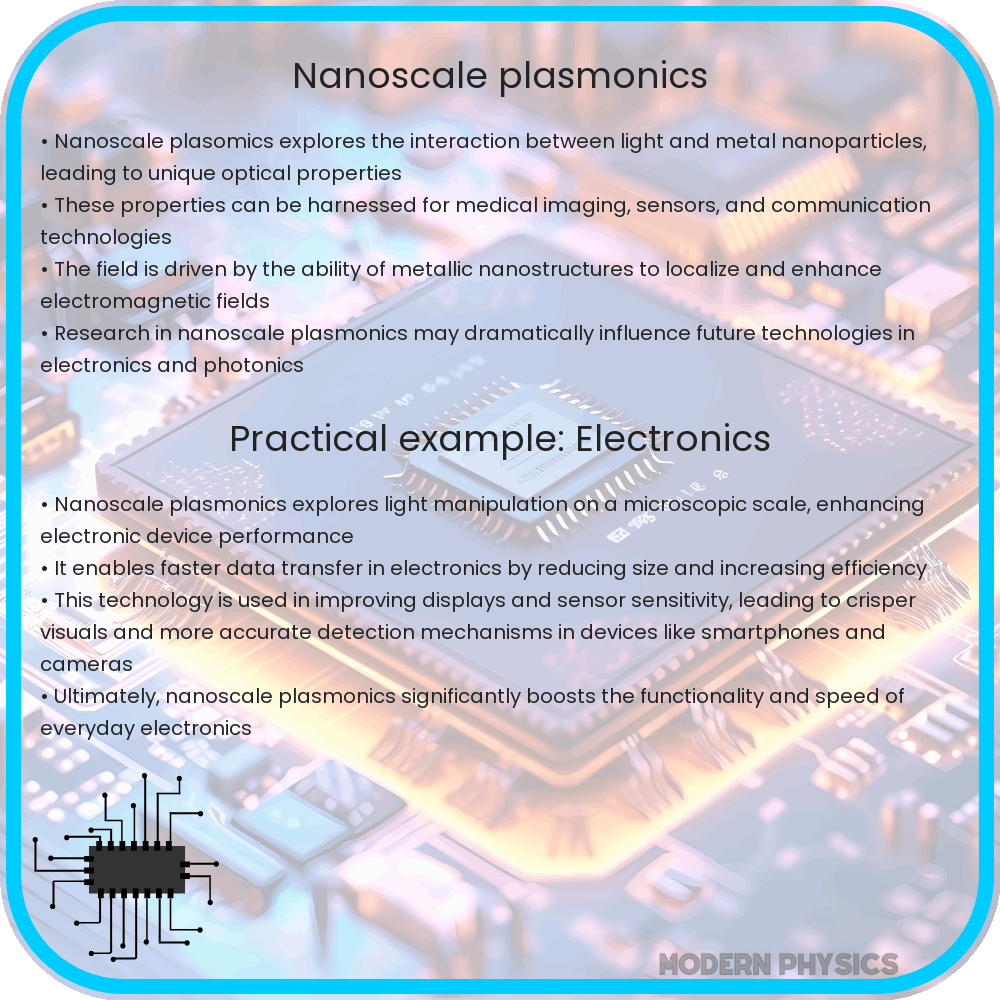
Nanoscale Plasmonics: Pioneering the Future of Technology
Nanoscale plasmonics, a vibrant field at the intersection of nanotechnology and optics, is steering the path towards revolutionary advancements in various sectors, including telecommunications, medicine, and environmental monitoring. This domain exploits the unique properties of plasmonic nanoparticles, which can confine and manipulate light at sizes smaller than the wavelength of light itself, enabling unprecedented applications that were once deemed impossible.
Core Principles and Mechanisms
At the heart of nanoscale plasmonics is the phenomenon known as surface plasmon resonance (SPR), a resonant oscillation of conduction electrons at the interface between negative and positive permittivity materials stimulated by incident light. This interaction leads to the generation of surface plasmons, waves that travel along the metal-dielectric interface with significantly enhanced electromagnetic fields.
Advanced Applications in Modern Technology
- Photonic Devices: Leveraging SPR, researchers are developing ultra-compact photonic devices for data transmission and processing at speeds far beyond current capabilities. These include plasmonic waveguides and switches that could form the backbone of next-generation optical computing systems.
- Medical Diagnostics and Therapy: Plasmonic nanoparticles are being used to improve the sensitivity of diagnostic assays through enhanced molecular detection capabilities. Furthermore, their ability to localize energy at the nanoscale facilitates targeted cancer therapy techniques, such as photothermal therapy, where nanoparticles are used to destroy cancer cells with minimal damage to surrounding healthy tissues.
- Environmental Sensing: The sensitivity of plasmonic structures to their surrounding environment makes them ideal for detecting chemical and biological substances at ultra-low concentrations, offering new horizons in environmental monitoring and pollution control.
Emerging Trends and Future Directions
The relentless push towards miniaturization in technology has positioned nanoscale plasmonics as a key player in the future of nanophotonics and nano-electronics. Innovations such as plasmonic metamaterials are opening new avenues for manipulating light in ways that challenge our traditional understanding of optics, promising transformative impacts across scientific research and industry applications. As researchers continue to unlock the potentials of this fascinating field, we stand on the cusp of a new era in technological advancements, driven by the tiny, yet mighty forces of nanoscale plasmonics.
Challenges and Considerations in Nanoscale Plasmonics
Despite its promising prospects, nanoscale plasmonics faces several challenges that must be addressed to fully realize its potential. One of the primary concerns is the intrinsic loss in metallic components, which can lead to significant energy dissipation and limit the efficiency of plasmonic devices. Researchers are exploring alternative materials, such as graphene and transition metal dichalcogenides (TMDs), which offer lower loss at certain frequencies. Additionally, the precise fabrication of nanoscale structures poses technical difficulties, necessitating advanced lithography and self-assembly techniques.
Interdisciplinary Collaboration for Innovation
The advancement of nanoscale plasmonics is not confined to physics or engineering alone; it thrives on interdisciplinary collaboration. The integration of insights from chemistry, materials science, and biology is essential for developing new plasmonic materials and biocompatible applications. Such collaborative efforts are paving the way for innovative solutions to complex problems, from creating more efficient solar cells to developing non-invasive medical diagnostic tools.
The Road Ahead for Nanoscale Plasmonics
Looking forward, the journey of nanoscale plasmonics is set to impact the foundational aspects of how we interact with technology. With ongoing research focused on overcoming current limitations and exploring new possibilities, the future of plasmonics is bright. Innovations in this field have the potential not only to advance existing technologies but also to catalyze the creation of entirely new applications, from cloaking devices to quantum computing components. The versatility and scope of nanoscale plasmonics promise a future where the limits of technology are bound only by the extent of our imagination.
Conclusion
Nanoscale plasmonics stands at the forefront of a technological revolution, harnessing the power of light at the nanometer scale to unlock a myriad of advancements in science and engineering. As we navigate the challenges and explore the vast potentials of this field, the collaborative efforts across various disciplines are essential in driving innovation forward. With its ability to manipulate light in unprecedented ways, nanoscale plasmonics is not just shaping the future of technology; it is redefining the boundaries of what is possible. As we continue to delve deeper into the nanoworld, the insights and technologies emerging from plasmonics will undoubtedly play a pivotal role in shaping our world, offering solutions to some of the most pressing challenges and opening new avenues for exploration and discovery.