
Explore the principles, applications, and recent advances of Quantum Electrodynamics in cavities, a key area in quantum optics and technology.
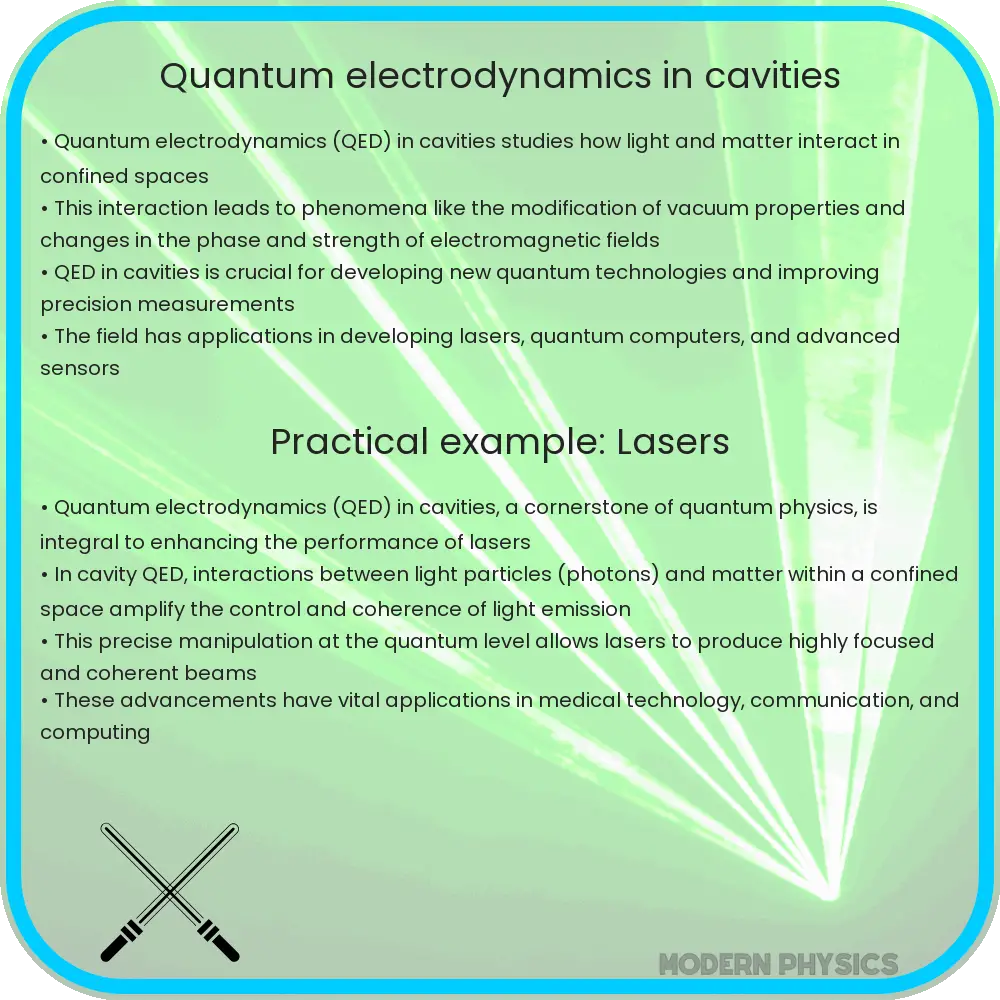
Quantum Electrodynamics in Cavities: An Overview
Quantum Electrodynamics (QED) in cavities, a subfield of quantum optics, is a fascinating area of physics that explores the interaction between light and matter at the quantum level within a confined space. This discipline has witnessed remarkable advances over the past few decades, leading to a plethora of applications in both fundamental science and technology.
Principles of Cavity Quantum Electrodynamics
At the heart of cavity QED lies the concept of light-matter interaction. This interaction becomes significantly pronounced when photons, the quantum particles of light, are confined in a small space like a cavity. In such a scenario, the electromagnetic field modes are quantized, leading to discrete energy levels. The basic setup of a cavity QED experiment typically involves atoms or artificial atoms (like quantum dots) interacting with a confined electromagnetic field in a cavity. The cavity, often a high-quality mirror setup, ensures that photons bounce back and forth, increasing the interaction time with the atoms.
Key Applications of Cavity QED
Cavity QED systems have found applications in various fields, including quantum computing, precision measurement, and quantum communication. One of the most notable applications is in the development of quantum computers, where cavity QED systems can be used for quantum information processing and storage. The ability to control the interaction between light and matter at the quantum level makes these systems ideal for manipulating qubits, the basic units of quantum information.
Another significant application is in the field of precision measurement. Cavity QED enhances the interaction between light and matter, which can be exploited to make highly sensitive measurements. For instance, changes in the frequency of the cavity’s electromagnetic field can indicate minute changes in physical conditions like temperature or pressure.
Moreover, cavity QED is instrumental in advancing quantum communication technologies. The strong coupling between light and matter in these systems enables the efficient transfer of quantum information, which is essential for the development of secure quantum communication networks.
Recent Advances in Cavity QED
Recent advancements in cavity QED have been driven by improvements in technology and a deeper understanding of quantum mechanics. Enhanced cavity designs, like photonic crystal cavities and microtoroidal resonators, have allowed for stronger and more controlled interactions between light and matter. Additionally, breakthroughs in material science, particularly in the development of two-dimensional materials and nanostructures, have opened new avenues for exploring light-matter interactions at the nanoscale.
Advances in computational techniques have also played a crucial role. Sophisticated algorithms and powerful computational tools are enabling researchers to model and simulate complex cavity QED systems with greater accuracy, paving the way for novel applications and theoretical insights.
Technological Implications of Cavity QED
The technological implications of advancements in cavity QED are profound. One of the most promising areas is the development of quantum sensors. These sensors, based on cavity QED principles, can detect and measure physical phenomena with unprecedented precision. This capability has potential applications in fields ranging from astronomy to medicine, where detecting faint signals and minute changes is crucial.
Furthermore, cavity QED is integral to the evolution of quantum networks. By facilitating the strong interaction between photons and matter, these systems can serve as nodes in quantum networks, enabling long-distance quantum communication and secure information transfer. This development is vital for future communication systems, promising to revolutionize data security and privacy.
Challenges and Future Directions
Despite its impressive advancements, cavity QED still faces significant challenges. One of the primary challenges is maintaining quantum coherence in cavity systems, which is crucial for practical applications. Environmental disturbances, such as thermal fluctuations and electromagnetic interference, can disrupt quantum coherence, posing a significant hurdle in developing robust quantum devices.
Additionally, scaling up cavity QED systems for practical applications remains a challenge. While individual cavity systems have demonstrated remarkable control and precision, integrating them into larger, scalable systems without losing their quantum properties is a complex task that researchers are actively working to solve.
Looking ahead, the future of cavity QED seems bound for further groundbreaking discoveries and innovations. Researchers are continuously exploring new materials and designs for cavities, aiming to achieve stronger light-matter interactions and greater control over quantum states. The integration of cavity QED with other emerging technologies, such as nanotechnology and machine learning, also holds promising potential for new applications and further advancements in the field.
Conclusion
Quantum Electrodynamics in cavities represents a pivotal intersection of quantum mechanics, material science, and technology. It has not only deepened our understanding of quantum phenomena but also laid the groundwork for revolutionary technological advancements. As researchers continue to overcome existing challenges and push the boundaries of what is possible, the future of cavity QED looks bright, with its impact resonating across various scientific and technological domains. The exploration of this quantum frontier will undoubtedly continue to unveil new mysteries and opportunities, potentially reshaping our world in ways we have yet to imagine.