
Explore how cavity QED setups unlock quantum precision, impacting computing, communication, and sensing, and driving future technologies in quantum mechanics.
Cavity QED Setups: Unveiling the Path to Quantum Precision and Innovation
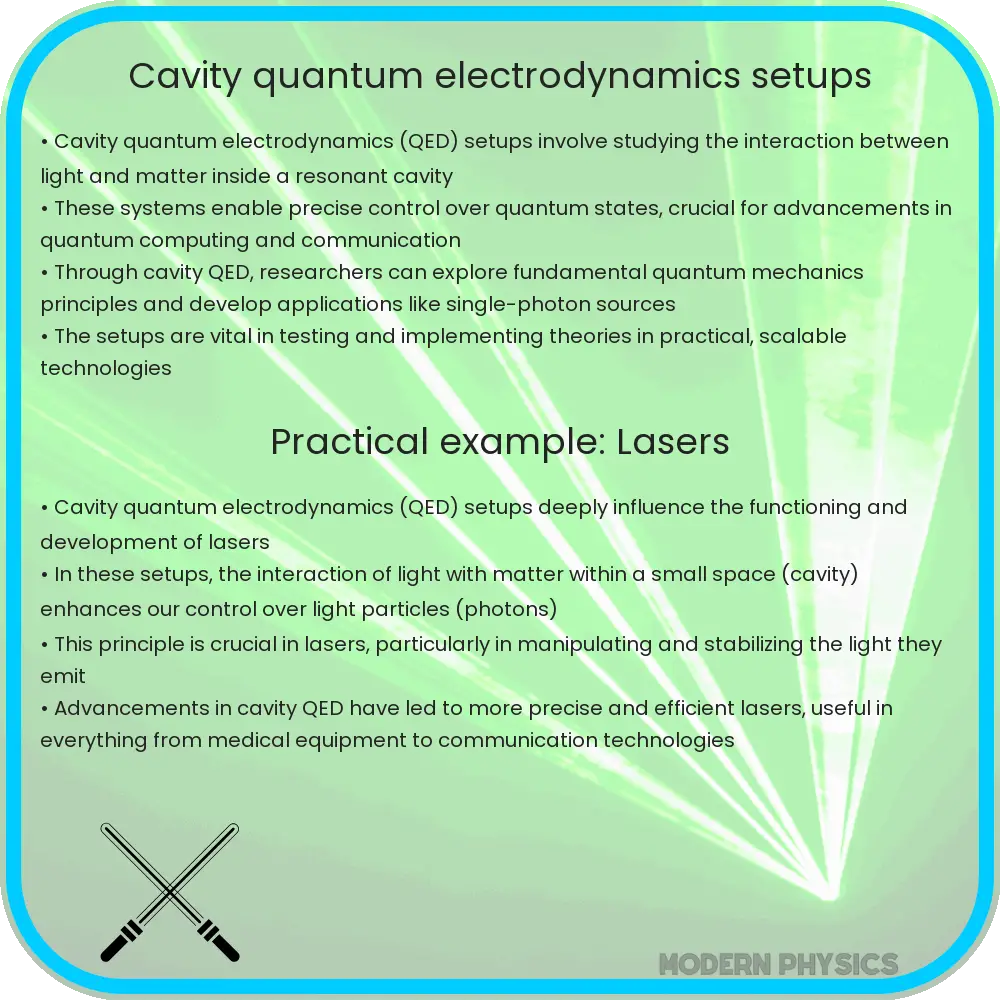
Cavity Quantum Electrodynamics (QED) represents a fascinating frontier in the realm of quantum physics, where the interaction between light (photons) and matter (such as atoms, molecules, or quantum dots) is studied within a highly controlled environment. This field has seen significant advancements, thanks to innovative setups that allow for unprecedented levels of control and precision. In these setups, cavities—essentially mirrors placed very close together—trap photons, allowing them to interact with matter in a way that can be finely tuned and measured.
The heart of cavity QED technology lies in its ability to manipulate and measure quantum states with incredible accuracy. This is achieved through the design of the cavity itself, which can be engineered to support specific modes of electromagnetic fields. These modes can then interact with quantum systems, such as atoms or artificial atoms (quantum dots), placed within the cavity. The precise control over these interactions paves the way for exploring fundamental quantum phenomena and has practical applications in quantum computing, communication, and sensing.
- High-Finesse Cavities: One of the key components in cavity QED setups is the use of high-finesse cavities, which have very reflective mirrors. This design ensures that photons can bounce back and forth thousands of times, increasing their interaction time with the matter inside. Such cavities are crucial for studying phenomena like the strong coupling regime, where the rate of interaction between light and matter exceeds any loss processes, allowing for coherent quantum state manipulation.
- Single-Atom Control: Cutting-edge techniques now enable the trapping and manipulation of single atoms within cavities. This level of control is essential for exploring quantum entanglement and the generation of non-classical light states. By precisely positioning a single atom in the mode of a cavity, researchers can achieve strong coupling, leading to the coherent exchange of energy between the atom and the photon, a cornerstone for quantum information processing.
- Quantum Dot Integration: Quantum dots offer another avenue for cavity QED experiments. These semiconductor nanostructures can be embedded within cavities, where they act like artificial atoms. The advantage of quantum dots lies in their tunable properties, such as emission frequency, which can be adjusted through external parameters like electric or magnetic fields. This tunability facilitates the integration of cavity QED systems with solid-state electronics, broadening the scope of potential applications.
The synergy between advanced cavity designs and quantum systems underlies the remarkable progress in cavity QED. By harnessing the unique properties of photons and matter within finely tuned environments, scientists are not only probing the depths of quantum mechanics but are also laying the groundwork for future technologies.
Advancements and Applications in Cavity QED
The exploration of cavity QED setups is not just a theoretical endeavor but also a practical one, with implications that stretch across various domains of science and technology. Innovations in this field are enabling the development of quantum networks, highly sensitive detectors, and quantum simulators that could revolutionize how we process information, measure phenomena, and understand the quantum world.
One of the most promising applications of cavity QED is in the realm of quantum computing. The precise control over atom-photon interactions within cavities provides a reliable platform for quantum bits (qubits), the basic unit of quantum information. By leveraging the entanglement generated within these systems, researchers aim to build quantum computers that surpass the capabilities of classical computers in solving certain problems, such as cryptography and complex simulations.
Furthermore, cavity QED systems are integral to the development of quantum communication networks. The ability to generate and manipulate entangled photons allows for the implementation of quantum cryptography protocols, ensuring secure communication channels that are fundamentally protected by the laws of quantum mechanics. This technology is poised to redefine the security landscape, offering protection against the potential threats posed by quantum computing to current encryption methods.
Another exciting application is in the field of quantum metrology, where cavity QED setups are used to create sensors with unprecedented sensitivity. These sensors exploit quantum phenomena to measure physical quantities, such as time, magnetic fields, and gravitational forces, with accuracy far beyond that of classical devices. Such sensitivity opens up new possibilities in navigation, medical imaging, and fundamental physics research.
Conclusion
In summary, cavity QED setups are at the forefront of quantum science and technology, offering a window into the intricate dance between light and matter at the quantum level. The precise control and measurement capabilities afforded by these systems are not only expanding our understanding of quantum mechanics but are also driving innovations in computing, communication, and sensing. As research in this field continues to advance, we can expect to see further breakthroughs that will pave the way for new quantum technologies, transforming our approach to information, security, and measurement. The journey into the quantum realm, facilitated by cavity QED, promises to unlock mysteries of the universe while offering practical solutions to some of the most complex challenges of our time.