
Explore the cutting-edge field of polaritonics, where light and matter intertwine, promising revolutionary applications in technology and quantum computing.
Understanding Polaritonics: An Overview
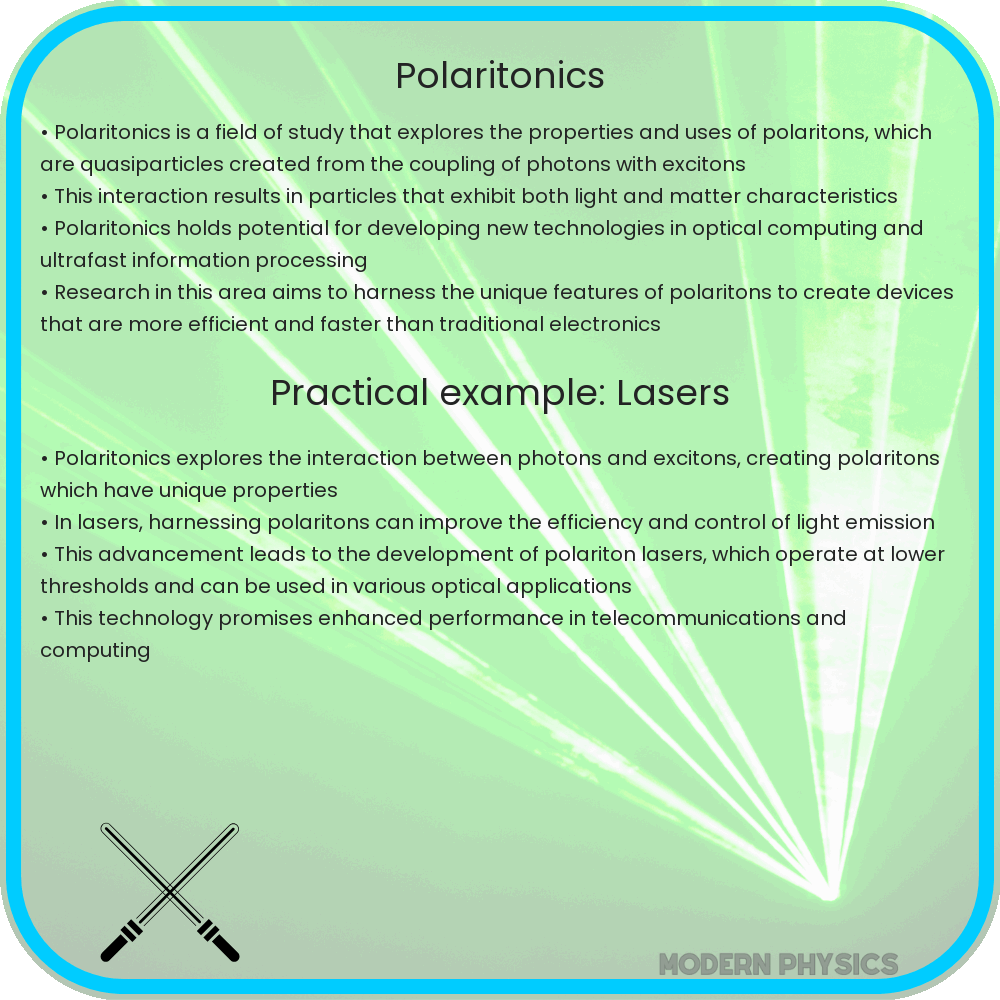
Polaritonics is an emerging field at the confluence of quantum physics and optoelectronics, revolving around the study and manipulation of polaritons. Polaritons are quasiparticles resulting from the coupling of photons with excitons – the bound states of an electron and a hole. This coupling leads to distinct optical properties, making polaritonics a promising avenue for advanced technological applications.
Theoretical Foundations of Polaritonics
At its core, polaritonics explores the interactions between light and matter at a fundamental level. The key to understanding polaritonics lies in the concept of strong coupling. When photons confined in a microcavity interact with excitons in a semiconductor, they can enter a regime of strong coupling. This interaction creates new states known as polaritons, characterized by their part-light, part-matter nature. These polaritons exhibit unique dispersion relations, described by the equation E(k) = ħω(k), where E is the energy, ħ is the reduced Planck constant, and ω(k) is the angular frequency of the polariton as a function of its wavevector k.
Applications of Polaritonics
Polaritonics has the potential to revolutionize various technological domains. One significant application is in the development of ultra-fast and energy-efficient optoelectronic devices. For instance, polaritonic lasers, unlike conventional lasers, do not rely on population inversion and can operate at much lower thresholds, making them more energy-efficient. Additionally, the unique properties of polaritons can be harnessed for developing advanced photonic circuits, offering faster data processing speeds than traditional electronic circuits.
Cutting-Edge Developments
Recent advancements in polaritonics have opened new frontiers in both theoretical and applied physics. Researchers have successfully created various types of polaritons, such as exciton-polaritons and phonon-polaritons, each offering different applications. The field is also exploring the use of 2D materials like graphene, where the strong light-matter interaction can lead to novel polaritonic phenomena. This research is not just academic; it’s paving the way for next-generation technologies in computing, telecommunications, and sensing.
Another area of interest is in quantum computing. The quantum nature of polaritons could be exploited for creating quantum bits (qubits), which are the fundamental building blocks of quantum computers. Unlike traditional bits, qubits can exist in multiple states simultaneously, offering exponential increases in computing power for certain types of calculations.
Advanced Theoretical Concepts in Polaritonics
In the theoretical realm, polaritonics challenges and extends our understanding of quantum mechanics. The Bose-Einstein condensation (BEC) of polaritons, a state where multiple polaritons occupy the same quantum state, creates an ideal platform for studying quantum phenomena in a solid-state environment. This is crucial for developing quantum simulators, which can model complex quantum systems that are beyond the reach of classical computers. Moreover, the manipulation of polariton spin – analogous to the spin of electrons – offers a pathway to spintronics, integrating magnetic properties in optical devices.
Material Science and Polaritonics
The exploration of new materials plays a vital role in advancing polaritonics. Transition metal dichalcogenides (TMDCs) and perovskites are examples of materials that exhibit strong exciton binding energies, making them suitable for polaritonic applications at room temperature. The integration of these materials into polaritonic devices promises not only enhanced performance but also the potential for new functionalities.
Challenges and Future Directions
Despite its promising prospects, polaritonics faces several challenges. One of the primary concerns is the creation and stabilization of polaritons at room temperature, which is essential for practical applications. Additionally, controlling the interaction between polaritons and their environment, such as phonons and impurities, remains a complex task. Addressing these challenges requires interdisciplinary efforts, combining insights from quantum physics, material science, and engineering.
Conclusion: The Promise of Polaritonics
Polaritonics stands at the forefront of modern physics and engineering, offering revolutionary prospects in various fields. From ultra-efficient lasers and advanced photonic circuits to quantum computing and simulation, the potential applications are vast and diverse. The synergy of theoretical insights and material science advancements is driving this field towards groundbreaking discoveries. As researchers overcome current challenges, we can expect polaritonics to play a pivotal role in shaping future technologies, offering solutions that are currently unimaginable. In essence, polaritonics is not just a scientific discipline; it’s a gateway to the next era of technological evolution.