
Explore the fundamentals of optical cavities, their resonance, stability, and precision in laser systems, and their impact on advanced optical applications.
Understanding Optical Cavities: Resonance, Stability, and Precision
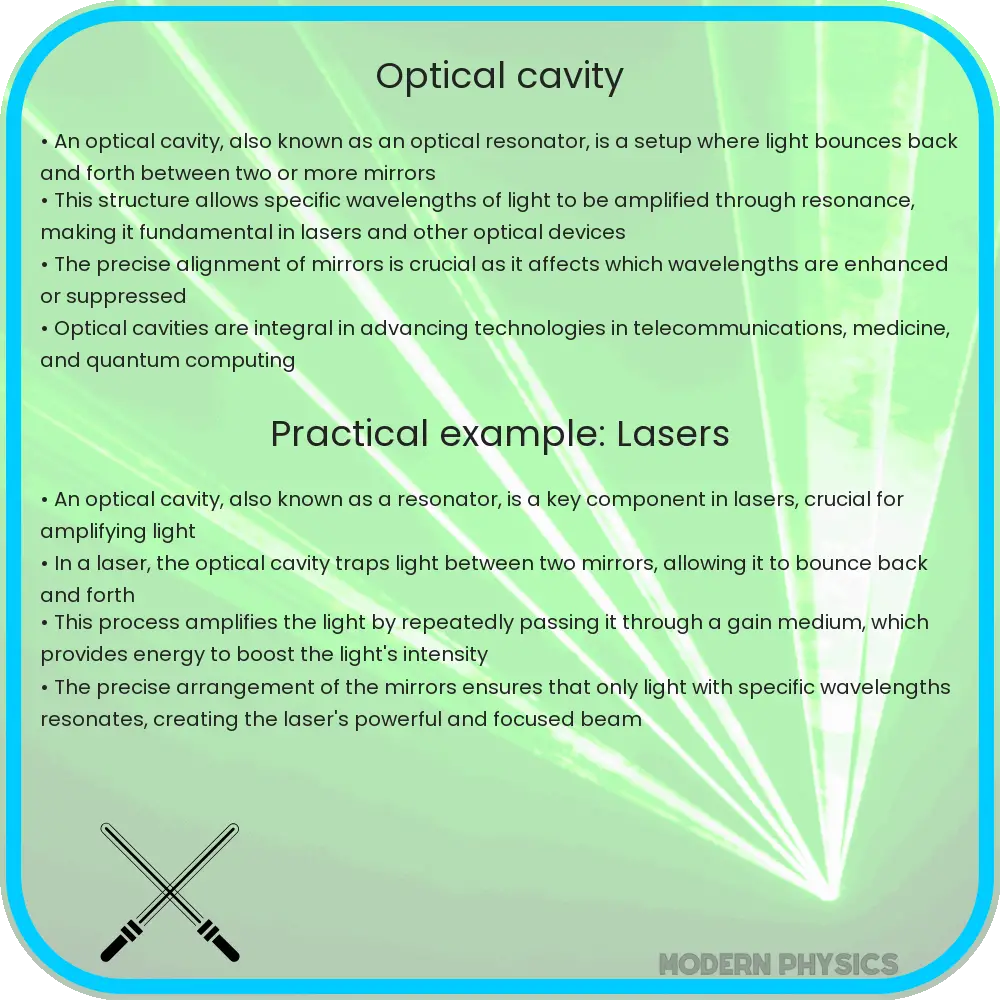
An optical cavity, also known as a resonator, is a set-up of mirrors that forms a closed loop. These systems are fundamental in physics and engineering, serving as the backbone for lasers, optical sensors, and various spectroscopic techniques. The principles of resonance, stability, and precision govern their operation, making them critical for enhancing the performance of optical systems.
Resonance in Optical Cavities
Resonance within an optical cavity occurs when light waves constructively interfere with each other as they bounce back and forth between mirrors. This phenomenon is critical for amplifying light in laser applications. The condition for resonance is determined by the cavity’s length, L, and the wavelength, λ, of the light, satisfying the equation \(L = m\lambda/2\), where \(m\) is an integer. This relationship ensures that the light waves are in phase with each other, leading to maximum intensity inside the cavity.
Stability of Optical Cavities
The stability of an optical cavity refers to its ability to confine light within its structure over time. Stability is influenced by the geometry of the cavity and the alignment of its mirrors. A key metric for assessing stability is the G-parameter, calculated as \(G = 1 – (L/R_1)(L/R_2)\), where \(L\) is the cavity length and \(R_1\) and \(R_2\) are the radii of curvature of the two mirrors. For a cavity to be stable, the G-parameter must satisfy the condition \(0 \leq G \leq 1\). Stable cavities ensure consistent performance in applications requiring precise control of light, such as high-resolution spectroscopy.
Precision in Optical Cavity Design
Precision in optical cavity design is paramount for achieving high-quality, reproducible results. Factors such as mirror reflectivity, material dispersion, and thermal stability play critical roles. High reflectivity mirrors ensure minimal light loss, while materials with low dispersion reduce the spread of different wavelengths, maintaining sharp resonances. Additionally, designing cavities to withstand thermal fluctuations is crucial for maintaining resonance conditions and stability over a wide range of operating temperatures.
This introductory exploration highlights the significance of resonance, stability, and precision in optical cavities. These principles are not only foundational for understanding how optical cavities work but are also essential for optimizing their performance in scientific and industrial applications.
Optical Cavity: A Pillar of Modern Optics
An optical cavity, also known as an optical resonator, is a fundamental component in the field of optics, crucial for enhancing and controlling the interaction between light and matter. This setup allows light to bounce back and forth between two or more mirrors, creating a standing wave pattern that significantly amplifies certain wavelengths of light. The phenomena of resonance, stability, and precision in optical cavities underpin many of today’s advanced optical technologies, from lasers to optical sensors.
Resonance in Optical Cavities
Resonance is the core principle behind the operation of optical cavities. It occurs when the cavity length is an integer multiple of half the wavelength of the light, allowing constructive interference to amplify specific light wavelengths. This selective amplification is described by the cavity’s finesse, a measure of its ability to sustain light within it. High finesse indicates that the cavity can support numerous round trips of light, leading to a stronger resonant buildup of the desired wavelengths.
Stability of Optical Cavities
The stability of an optical cavity is paramount for its effective operation, determined by the geometry of its mirrors and their placement. A cavity is considered stable if the light remains confined within the cavity after multiple reflections. The stability criterion, which can be calculated using the g-parameter (g1g2), depends on the curvature of the mirrors and the distance between them. Only certain configurations will ensure that the light does not diverge, making precise design and alignment crucial.
Precision in Optical Cavities
Precision in optical cavities is achieved through meticulous control over cavity length and environmental conditions. Variations in temperature, pressure, or mechanical vibrations can detune the cavity, affecting its resonant frequencies. Advanced techniques, such as Pound-Drever-Hall locking, are employed to stabilize the cavity’s length at a molecular level, ensuring that the cavity remains in resonance with the light. This level of precision is essential for applications requiring high spectral purity and stability, like atomic clocks and quantum computing.
Conclusion
The exploration of optical cavities reveals a world where resonance, stability, and precision play critical roles in harnessing the power of light. The ability to amplify, maintain, and precisely control light within these cavities has paved the way for breakthroughs in numerous fields, including telecommunications, medicine, and quantum technology. As we continue to push the boundaries of what is possible with optical cavities, their significance in the advancement of optical sciences cannot be overstated. The ongoing research and development in this area promise to unlock even more innovative applications, further demonstrating the indispensable nature of optical cavities in the modern technological landscape.