
Explore the future of electronics with quantum diodes, offering unmatched efficiency and speed, and their impact on technology and sustainability.
Quantum Diodes: Paving the Way for Revolutionary Electronics
The realm of electronics is on the brink of a significant transformation, thanks to the advent of quantum diodes. These advanced components are set to redefine efficiency and speed in electronic devices. In this article, we delve into the intricacies of quantum diodes, exploring their structure, functioning, and potential applications that could revolutionize our technological landscape.
Understanding Quantum Diodes
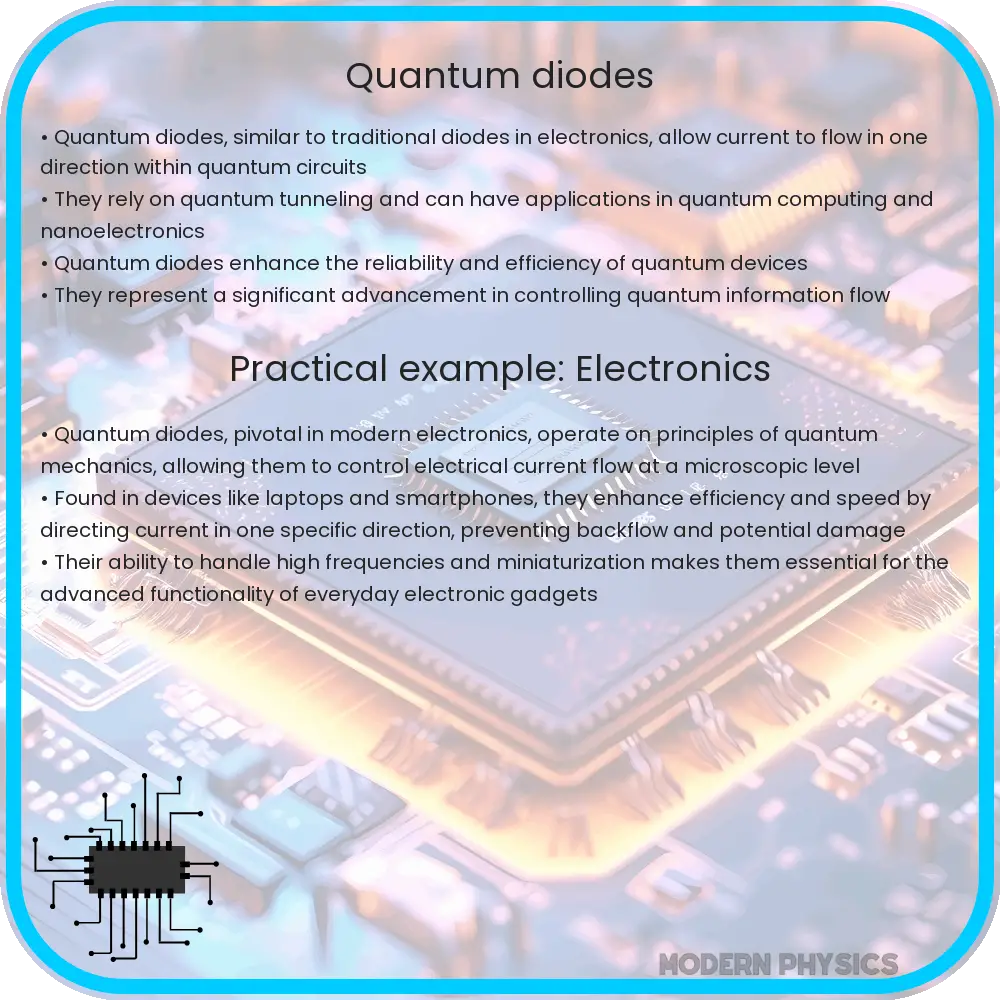
A quantum diode is a semiconductor device that operates based on quantum mechanical principles. Unlike traditional diodes that utilize the movement of electrons across a p-n junction, quantum diodes manipulate electron wave functions to achieve unparalleled efficiency and speed. This quantum approach allows for faster electron transmission with minimal energy loss, making them highly efficient.
Structure and Composition
The architecture of a quantum diode is a marvel of nanotechnology. It typically consists of layers of semiconductor materials, often silicon or germanium, interspersed with other elements to enhance quantum properties. These layers are engineered at the atomic level to facilitate the quantum tunneling effect, which is pivotal in their operation.
Quantum Tunneling: The Core Phenomenon
Quantum tunneling is the phenomenon that sets quantum diodes apart from their conventional counterparts. It refers to the quantum mechanical effect where particles such as electrons can traverse through energy barriers that would be insurmountable in classical physics. This ability to ‘tunnel’ through barriers enables electrons in quantum diodes to move more freely, thereby increasing conductivity and reducing power consumption.
Enhanced Efficiency and Speed
The efficiency of quantum diodes is significantly higher than traditional diodes. They exhibit minimal resistance and, consequently, reduced heat generation. This not only enhances the energy efficiency but also extends the lifespan of the device. Furthermore, the fast electron transmission rate in quantum diodes translates into higher operational speeds, making them ideal for high-frequency applications.
Potential Applications
Quantum diodes are set to have a profound impact across various sectors. In computing, they promise to accelerate processing speeds dramatically, paving the way for more powerful and efficient computers. In telecommunications, they can be used to enhance signal clarity and data transmission rates, potentially revolutionizing internet and communication networks. Additionally, their energy efficiency makes them suitable for sustainable technology applications, including solar cells and energy-efficient lighting systems.
The advent of quantum diodes marks a significant milestone in the field of electronics, heralding a new era of ultra-efficient and high-speed devices. Their potential applications span a wide range of industries, promising not only to enhance existing technologies but also to catalyze the development of novel electronic innovations.
Challenges and Future Prospects
Despite their immense potential, quantum diodes face several challenges that must be addressed. One of the primary concerns is the complexity of manufacturing at the quantum level. Precision engineering at such a small scale requires advanced technology and significant investment. Moreover, the quantum behaviors of these diodes can be influenced by external factors like temperature and electromagnetic interference, necessitating sophisticated isolation and stabilization techniques.
Integration into Current Technology
Integrating quantum diodes into existing electronic systems poses another challenge. Current electronic infrastructure is designed around traditional semiconductor components. Adapting these systems to accommodate the unique properties of quantum diodes requires significant reengineering, which could be both time-consuming and costly. However, the long-term benefits of improved efficiency and speed offer a compelling incentive for this transition.
Research and Development
Research in the field of quantum electronics is rapidly advancing. Scientists and engineers are continually discovering new materials and methodologies to enhance the performance and reliability of quantum diodes. Ongoing research focuses on overcoming the current limitations and expanding the practical applications of these devices.
Environmental Impact
An often-overlooked aspect of quantum diodes is their potential environmental impact. By reducing energy consumption and heat waste, these components could play a significant role in creating greener and more sustainable technology. This aligns with global efforts to reduce carbon footprints and combat climate change, making quantum diodes not just a technological advancement but also an environmentally conscious choice.
Conclusion
Quantum diodes represent a groundbreaking development in the field of electronics, offering unprecedented levels of efficiency and speed. While they face challenges in manufacturing, integration, and environmental stability, ongoing research and development are steadily overcoming these hurdles. The future of quantum diodes is undeniably promising, poised to revolutionize computing, telecommunications, and a myriad of other sectors. As we continue to explore the vast potential of quantum mechanics in electronics, quantum diodes stand out as a beacon of innovation, guiding us towards a more efficient, faster, and sustainable technological future.