
Explore the revolutionary world of plasmonic nano-lasers, their science, applications, and future prospects in nanophotonics and technology.
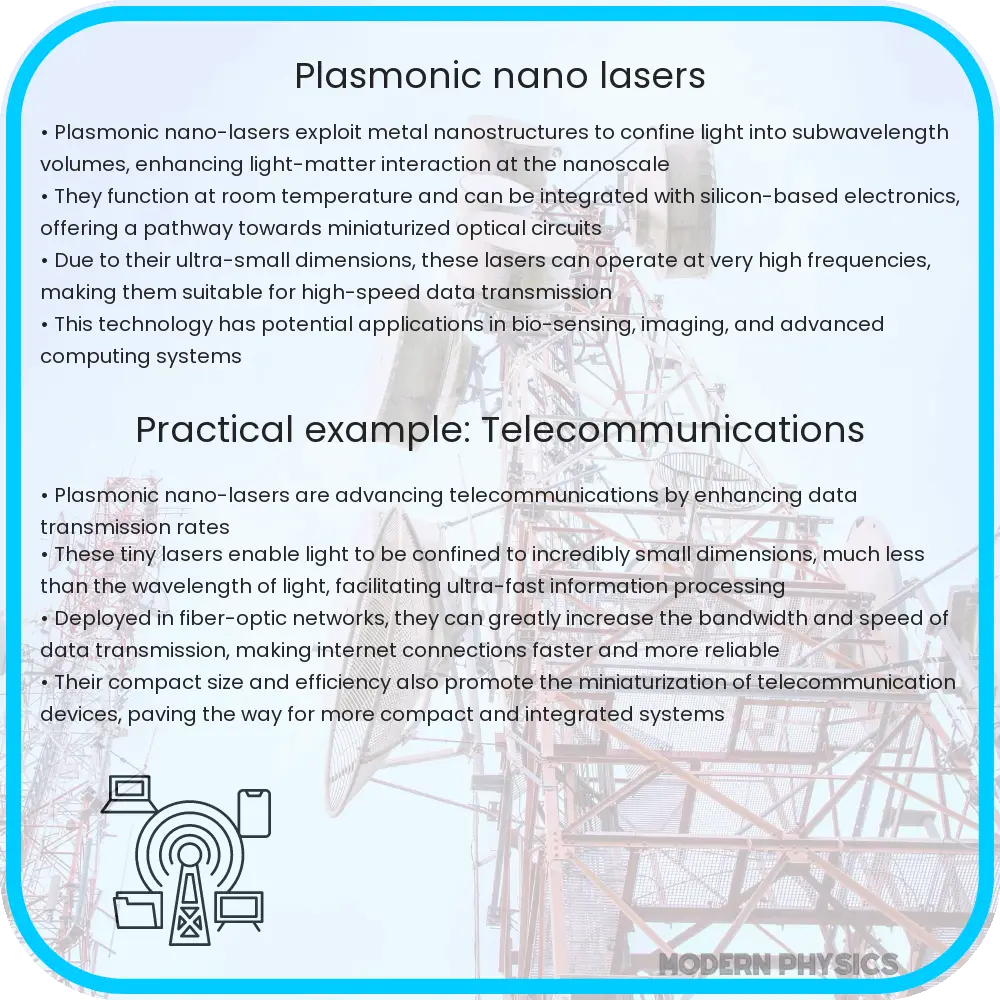
Understanding Plasmonic Nano-Lasers
Plasmonic nano-lasers represent a groundbreaking advancement in the field of nanophotonics, combining the fields of plasmonics and laser technology. These ultra-compact light sources, typically on the nanoscale, are crucial for the future of optical computing, high-resolution imaging, and advanced sensing applications.
The Science Behind Plasmonic Nano-Lasers
At the heart of plasmonic nano-lasers is the concept of surface plasmon polaritons (SPPs). SPPs are oscillations of electrons at the interface between a metal and a dielectric material, like air or glass. By confining light to dimensions smaller than its wavelength, these lasers overcome the diffraction limit, a fundamental barrier in traditional optics. This phenomenon is achieved through the use of noble metals like gold (Au) or silver (Ag), which support these surface plasmon waves.
Components and Functionality
Plasmonic nano-lasers are composed of three key components:
- Gain Medium: The core element, typically a semiconductor like Gallium Arsenide (GaAs) or Indium Gallium Arsenide (InGaAs), that amplifies light.
- Metallic Structures: These are responsible for supporting surface plasmon polaritons and include materials like gold (Au) and silver (Ag).
- Nanostructures: Precisely engineered structures, such as nanowires or nanoparticles, that confine and manipulate light at the nanoscale.
Advantages of Plasmonic Nano-Lasers
Plasmonic nano-lasers offer several significant advantages over traditional laser systems:
- Miniaturization: Due to their ability to confine light beyond the diffraction limit, these lasers can be significantly smaller than conventional lasers.
- High-Speed Operation: The small size and fast response of the gain medium enable extremely high operational speeds, essential for computing and communication technologies.
- Enhanced Local Field Intensity: The concentration of electromagnetic fields near the metallic structures leads to enhanced local field intensity, beneficial in sensing and imaging applications.
These characteristics make plasmonic nano-lasers a promising technology for a range of applications, from medical diagnostics to on-chip optical computing. The integration of these tiny yet powerful light sources could herald a new era in nanotechnology and optics.
Applications and Future Prospects of Plasmonic Nano-Lasers
Plasmonic nano-lasers hold immense potential for various applications due to their unique properties. Some of the key areas where they can make a significant impact include:
- Optical Computing: Their small size and fast response times make them ideal for use in optical computing, potentially leading to faster and more energy-efficient computers.
- High-Resolution Imaging: These lasers can achieve high-resolution beyond the diffraction limit, essential in medical imaging and materials science.
- Advanced Sensing: The enhanced local field intensities make them suitable for detecting minute quantities of chemicals or biological agents, useful in environmental monitoring and healthcare.
- Telecommunications: They could play a role in the development of ultra-fast and compact components for optical communication systems.
Challenges and Research Directions
Despite their potential, plasmonic nano-lasers face several challenges that need addressing:
- Thermal Management: The significant heat generation in these tiny structures poses a challenge for sustained operation, necessitating efficient thermal management strategies.
- Material Durability: The degradation of materials under high optical intensities is another issue that requires attention for long-term application.
- Integration with Existing Technologies: Integrating these nano-lasers with current photonic and electronic systems is crucial for practical applications.
Current research is focused on overcoming these challenges, exploring novel materials, and improving design methodologies to enhance performance and durability.
Conclusion
The advent of plasmonic nano-lasers marks a significant milestone in nanophotonics, offering unprecedented control over light at the nanoscale. Their potential to revolutionize fields like computing, telecommunications, and sensing is immense. As research continues to surmount the existing challenges, we can anticipate the emergence of more efficient, compact, and versatile optical devices. The future of plasmonic nano-lasers is not only promising but also crucial for the advancement of technology at the intersection of light and matter.
With ongoing advancements, plasmonic nano-lasers are poised to open new horizons in science and technology, paving the way for innovations that were once thought impossible. The integration of these miniature lasers into everyday technology could very well be the next giant leap in the evolution of optics and photonics.