
Explore the advancements in quantum dot photodetectors: their enhanced sensitivity, speed, resolution, challenges, and future applications.
Understanding Quantum Dot Photodetectors
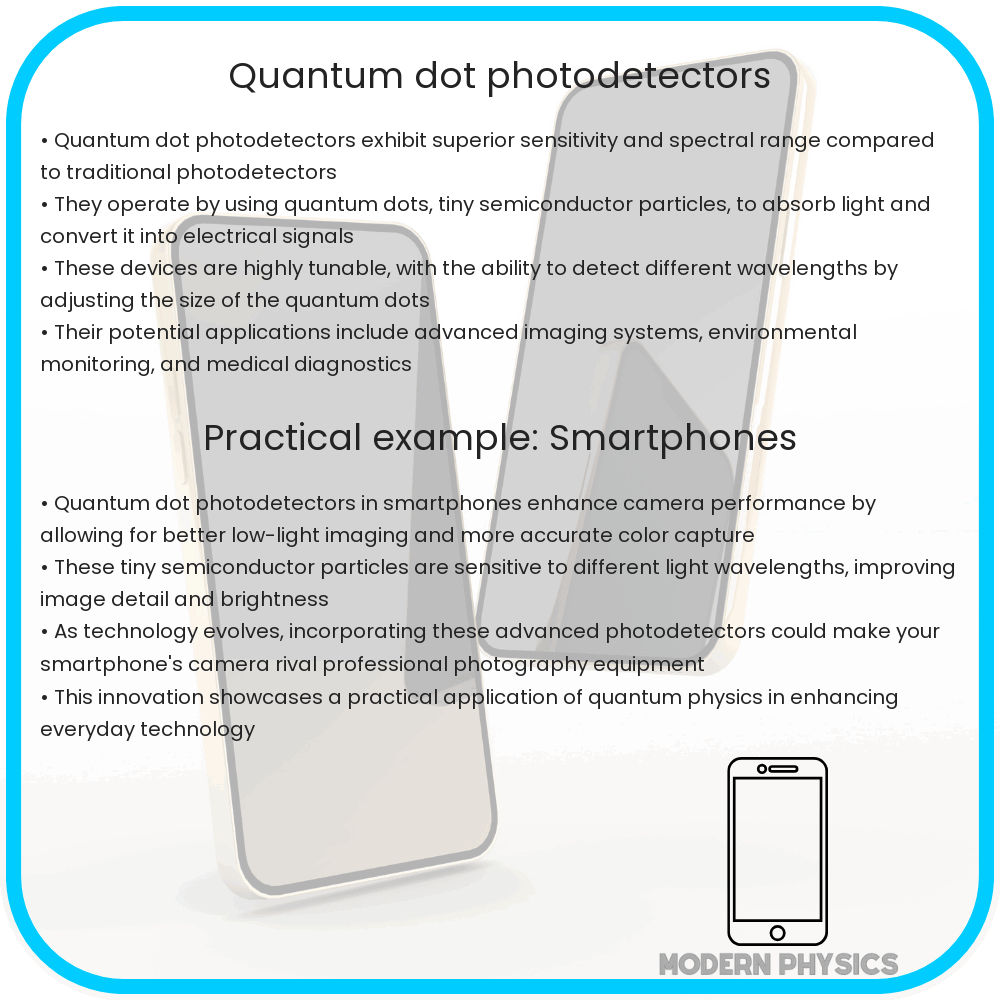
Quantum Dot Photodetectors represent a significant advancement in the field of optoelectronics, offering unprecedented enhancements in sensitivity, speed, and resolution. These photodetectors utilize quantum dots (QDs) – nanometer-scale semiconductor particles – to convert light into electrical signals with remarkable efficiency. This article delves into the principles, advantages, and potential applications of quantum dot photodetectors.
Principles of Quantum Dot Photodetectors
At the core of quantum dot photodetectors are quantum dots, tiny semiconductor particles typically ranging from 2 to 10 nanometers in diameter. At these scales, quantum mechanical effects become significant, endowing QDs with unique optical and electronic properties. The most notable is the quantum confinement effect, where the energy levels of the dots can be precisely controlled by changing their size. This tunability allows for specific absorption and emission wavelengths, making QDs highly efficient in light detection and conversion.
Enhanced Sensitivity and Spectral Range
One of the foremost advantages of quantum dot photodetectors is their enhanced sensitivity. Quantum dots have a high surface-to-volume ratio, which facilitates greater interaction with light. This attribute, combined with the ability to fine-tune their energy gaps, allows for the detection of a wider range of wavelengths, from ultraviolet to visible to infrared. This versatility is a significant step up from traditional photodetectors, which often have limited spectral sensitivity.
Improved Speed and Resolution
Quantum dot photodetectors also excel in terms of speed and resolution. The small size of quantum dots leads to a decrease in the capacitance of the photodetector, enabling faster response times to light changes. Additionally, QDs can be densely packed, increasing the resolution of the photodetector. This means that quantum dot-based devices can capture images or detect light with higher clarity and detail than their conventional counterparts.
Potential Applications
The unique attributes of quantum dot photodetectors open up a range of potential applications. These include high-resolution imaging in medical diagnostics, advanced surveillance systems, and enhanced optical communication technologies. Their ability to detect a broad spectrum of light also makes them ideal for applications in renewable energy, particularly in solar cell technology, where they can efficiently harness a broader range of the solar spectrum.
In summary, quantum dot photodetectors stand at the forefront of photodetection technology, offering enhancements in sensitivity, speed, and resolution. Their potential applications span diverse fields, promising to revolutionize the way we capture and utilize light.
Challenges and Future Directions
Despite their numerous advantages, quantum dot photodetectors face certain challenges. Stability and durability under various environmental conditions remain a concern. Quantum dots, especially those made of certain materials, can degrade over time when exposed to air and light. Additionally, the synthesis of high-quality, uniform quantum dots is complex and often expensive, posing a barrier to large-scale production and commercialization. Researchers are actively working to overcome these challenges, developing more stable quantum dot materials and cost-effective production methods.
Integration with Existing Technologies
A crucial aspect of the evolution of quantum dot photodetectors is their integration with existing technologies. For instance, integrating quantum dot technology with silicon-based electronics could lead to more efficient and compact sensors. This integration is not straightforward due to differences in material properties and fabrication techniques, but progress in this area could significantly broaden the applicability and impact of quantum dot photodetectors.
Environmental and Health Considerations
As with any emerging technology, the environmental and health implications of quantum dots are an important consideration. The toxicity of certain quantum dot materials, like those containing heavy metals, is a concern for both environmental and health safety. Research is ongoing to develop less toxic alternatives, such as silicon-based quantum dots, which could mitigate these risks while maintaining the functional advantages of quantum dot photodetectors.
Conclusion
Quantum dot photodetectors mark a new era in photodetection technology, with their enhanced sensitivity, speed, and resolution offering transformative potential across various fields. From high-resolution medical imaging to advanced renewable energy solutions, the applications of these devices are vast and impactful. However, challenges in stability, production, and integration with existing technologies must be addressed to fully realize their potential. Furthermore, consideration of environmental and health safety remains paramount as this technology advances. The ongoing research and development in this domain not only aim to optimize the performance of quantum dot photodetectors but also to ensure their sustainable and safe integration into our daily lives and industries.