
Explore the cutting-edge world of photon antibunching detectors, key for quantum computing, secure communication, and advancing quantum technology.
Introduction to Photon Antibunching Detectors
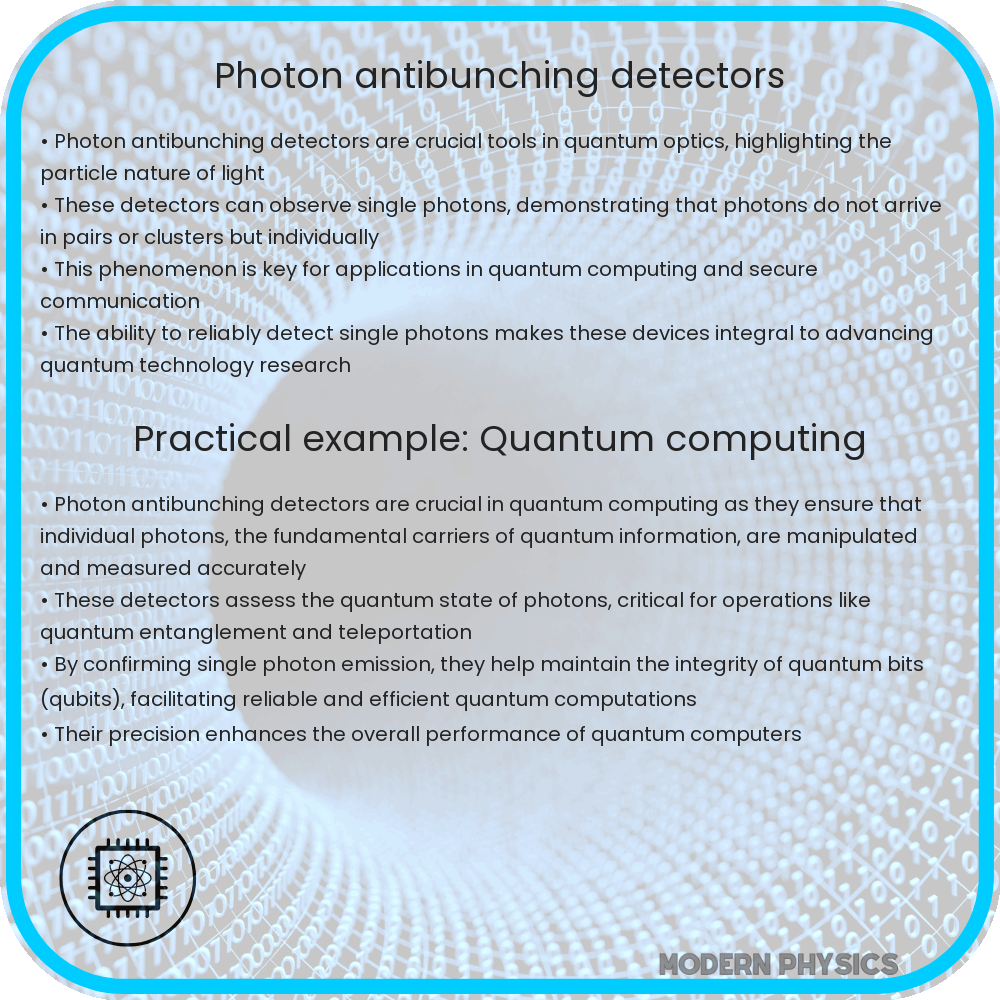
Photon antibunching detectors are at the forefront of quantum technology, marking a significant leap in our ability to measure and manipulate light at the quantum level. These cutting-edge devices are crucial for a range of applications, from quantum computing and secure quantum communication to advanced metrology and imaging techniques. Understanding the precision, speed, and quantum technological advancements facilitated by photon antibunching detectors is essential for anyone keen on the future of optical and quantum sciences.
Understanding Photon Antibunching
Photon antibunching refers to a quantum phenomenon where photons are emitted one at a time from a light source, such as a single photon emitter, rather than in pairs or groups. This effect is a cornerstone of quantum optics, providing direct evidence of the quantum nature of light. Photon antibunching detectors are designed to exploit this phenomenon, offering unparalleled precision and speed in detecting single photons.
The Role of Precision in Photon Antibunching Detectors
The precision of photon antibunching detectors is paramount, enabling the detection of individual photons with minimal noise and error. This high level of accuracy is vital for applications requiring exact quantum state measurements, such as in quantum cryptography, where the security of communication channels depends on the integrity of quantum keys generated by single photons. Precision in these detectors is achieved through sophisticated design and materials that minimize the likelihood of false counts and ensure the accurate identification of single photon events.
Speed: A Critical Factor
Speed is another critical aspect of photon antibunching detectors. The ability to detect photons in rapid succession without losing accuracy is essential for real-time quantum communication and high-speed quantum computing. Fast detection times also enable the study of dynamic quantum processes and the development of responsive quantum systems. Advanced materials and electronics are employed to enhance the response time of these detectors, allowing them to operate efficiently at high photon fluxes.
Quantum Technology Advancements
Photon antibunching detectors are a testament to the advancements in quantum technology. They not only embody the principles of quantum mechanics but also push the boundaries of what’s possible in quantum computing, communication, and sensing. By leveraging the unique properties of photons, these detectors pave the way for new quantum technologies that could revolutionize various sectors, including cybersecurity, healthcare, and beyond.
Applications and Impact of Photon Antibunching Detectors
Photon antibunching detectors have a wide array of applications, significantly impacting multiple fields. In quantum computing, they enable the detection of single photons for quantum bit (qubit) manipulation, a fundamental operation for quantum information processing. In secure quantum communication, these detectors ensure the integrity of quantum key distribution (QKD) systems, providing a level of security unattainable by classical methods. Additionally, in the realm of scientific research, they facilitate the exploration of quantum phenomena and the development of new quantum materials and technologies.
Challenges and Future Directions
Despite their impressive capabilities, photon antibunching detectors face challenges, particularly in terms of efficiency and integration into larger quantum systems. The efficiency of these detectors is crucial for maximizing the detection of photons, which is still an area of ongoing research and development. Furthermore, integrating these detectors into scalable quantum networks and computing architectures remains a complex task, necessitating advancements in quantum engineering and materials science.
The future of photon antibunching detectors lies in overcoming these challenges and harnessing their full potential. Research is focused on improving detector efficiency, reducing noise, and enhancing speed through innovative materials and technologies. Moreover, the integration of these detectors into practical quantum systems is a key goal, with efforts aimed at developing compact, reliable, and scalable devices for commercial and research applications.
Conclusion
Photon antibunching detectors stand as a pivotal innovation in quantum technology, offering unmatched precision and speed in the detection of single photons. Their application spans quantum computing, secure communication, and fundamental quantum research, highlighting their significance in the advancement of quantum technologies. Despite facing challenges related to efficiency and integration, ongoing research and development promise to address these issues, paving the way for broader adoption and implementation. As we continue to explore the quantum realm, photon antibunching detectors will undoubtedly play a crucial role in shaping the future of quantum science and technology, opening new frontiers for discovery and innovation.