
Explore the role of optical metrology in nanotechnology, covering its precision, speed, innovations, and impact on industry and research.
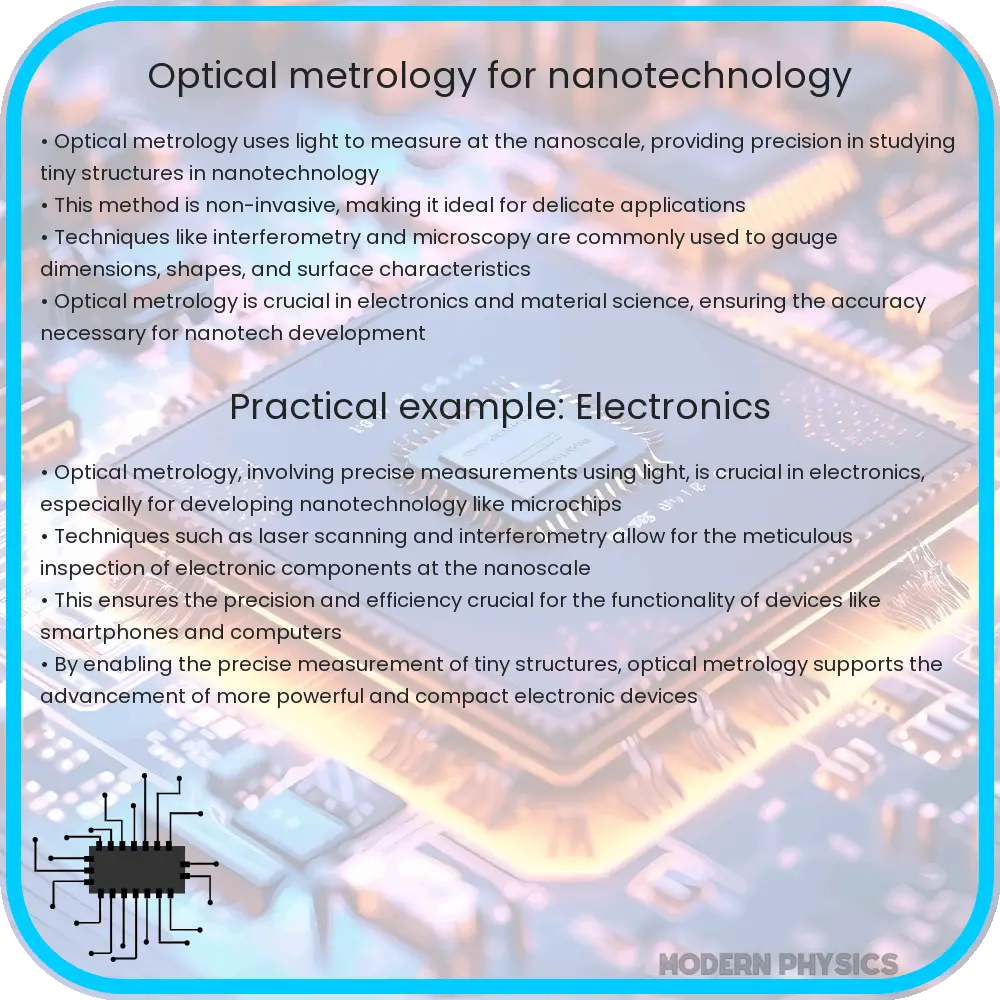
Optical Metrology: A Revolution in Nanotechnology Precision and Speed
Optical metrology, a non-contact measurement technology, is increasingly becoming an indispensable tool in the realm of nanotechnology. This technique leverages light to measure at the nano-scale, offering unparalleled precision and speed. As nanotechnology continues to advance, the demand for accurate, fast, and innovative measurement solutions is more critical than ever.
The Importance of Precision in Nanotechnology
In the field of nanotechnology, where materials and structures often operate on the atomic or molecular scale, precision is paramount. A minor deviation, measured in nanometers (10-9 meters), can significantly impact the functionality and reliability of nanoscale devices. Optical metrology addresses this need by providing high-resolution imaging and analysis, enabling researchers and engineers to visualize and measure with exceptional accuracy.
Advancements in Speed
Traditional measurement methods can be time-consuming, often requiring direct contact with the sample, which might lead to contamination or damage. Optical metrology, in contrast, offers speedy measurements without compromising the integrity of the sample. This rapid data acquisition is crucial in industries where time is of the essence, such as in semiconductor manufacturing where throughput is a key performance metric.
Innovation in Optical Metrology Techniques
The field of optical metrology has seen significant advancements, with innovative techniques emerging to meet the diverse needs of nanotechnology applications. Techniques like confocal microscopy, interferometry, and spectroscopy have been adapted and refined. Confocal microscopy, for instance, provides high-resolution 3D images of nanostructures, while interferometry can measure surface topography with nanometer-level precision. Spectroscopy, on the other hand, offers insights into the chemical composition and electronic properties of nanomaterials.
Application Areas in Nanotechnology
Optical metrology finds applications across various domains of nanotechnology. In semiconductor manufacturing, it is used for critical dimension measurements and defect analysis. In material science, it aids in the characterization of nanomaterials like graphene and quantum dots. Additionally, in the field of biotechnology, it enables the study of biological nanostructures with high fidelity.
With the continuous evolution of optical metrology, its role in driving precision, speed, and innovation in nanotechnology is becoming increasingly significant.
Challenges and Future Directions
Despite its many advantages, optical metrology faces challenges in the nanotech realm. One major challenge is the diffraction limit of light, which poses a fundamental barrier to the resolution achievable. Advances in super-resolution techniques and the development of novel light sources and detectors are addressing this issue. Another challenge is the interpretation of complex data, which often requires sophisticated algorithms and software.
Integrating Optical Metrology with Other Technologies
Integrating optical metrology with other nanoscale measurement techniques, such as electron microscopy and atomic force microscopy, is an emerging trend. This integration allows for a more comprehensive understanding of nanostructures, combining the best features of each method. For instance, while optical metrology provides quick and non-destructive measurements, electron microscopy offers higher resolution, and atomic force microscopy gives detailed surface topography information.
Advancing Towards Automation and AI
The integration of artificial intelligence (AI) and machine learning with optical metrology is another exciting development. AI algorithms can significantly enhance data analysis, leading to more accurate and faster interpretation of results. Automation in optical metrology not only improves throughput but also reduces the possibility of human error, leading to more consistent and reliable measurements.
Impact on Industry and Research
The advancements in optical metrology are profoundly impacting both industry and research. In sectors like electronics, photonics, and biotechnology, the ability to measure and analyze at the nanoscale accelerates innovation and improves the quality and performance of products. In academic and research settings, advanced optical metrology tools are enabling groundbreaking discoveries in nanoscience and material research.
Conclusion
Optical metrology, with its unmatched precision, speed, and innovative approaches, is playing a pivotal role in the advancement of nanotechnology. As it continues to evolve, overcoming challenges and integrating with other technologies and AI, its impact will only grow. This technology not only drives industrial innovation but also empowers scientific research, making it a cornerstone in the journey towards mastering the nanoworld. The future of nanotechnology is inextricably linked to the advancements in optical metrology, heralding an era of unprecedented precision and possibilities in the microscopic realm.