
Explore the generation of nonclassical light and its role in quantum entanglement and coherence, paving the way for advances in quantum technologies.
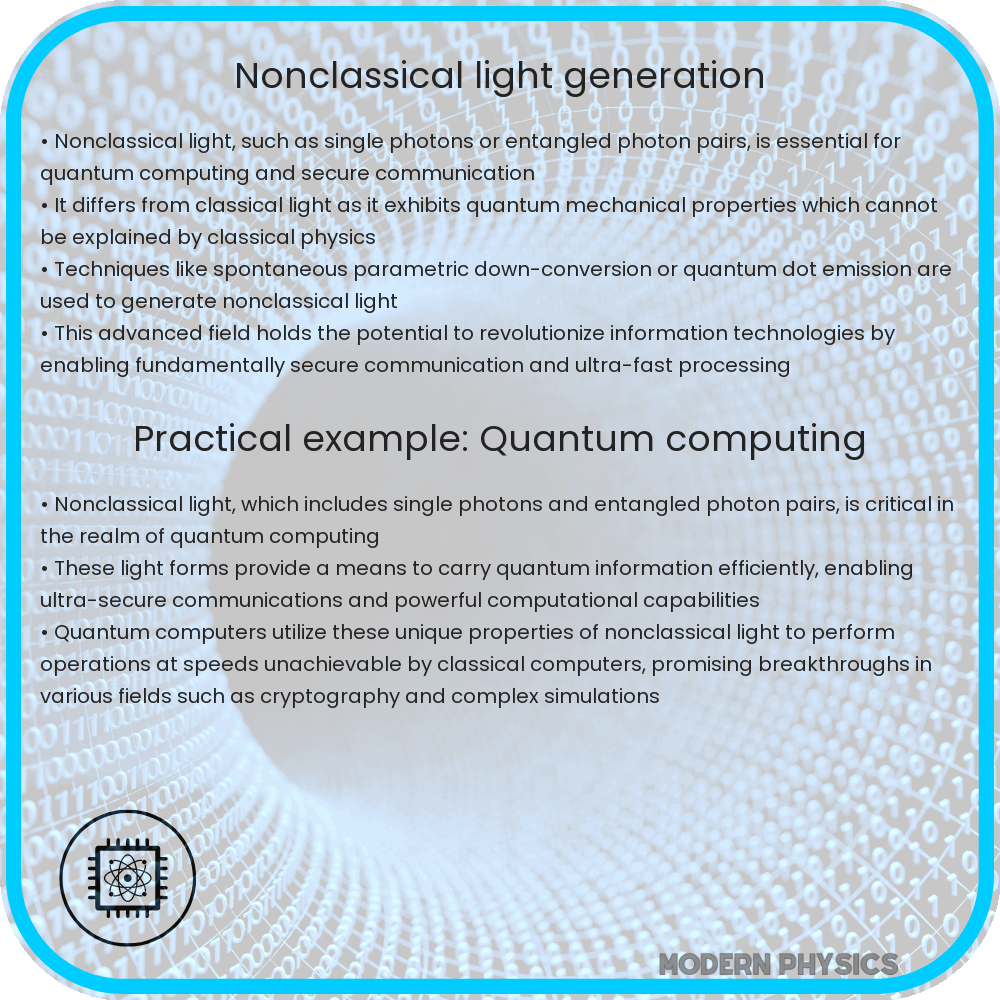
Exploring the Frontiers of Quantum Mechanics: Nonclassical Light Generation
Nonclassical light, a cornerstone of quantum optics, diverges fundamentally from classical light in terms of its statistical properties and coherence. Its generation and manipulation are pivotal in understanding quantum entanglement and coherence, phenomena that challenge our classical perceptions of physics. This article delves into the mechanisms behind nonclassical light generation and its critical role in advancing quantum technologies.
Quantum Entanglement and Coherence: The Heart of Nonclassical Light
Quantum entanglement, a phenomenon where particles become interconnected such that the state of one (no matter the distance) instantly influences the state of another, is a fundamental aspect of nonclassical light. This peculiar characteristic of quantum mechanics underpins a range of applications from quantum computing to secure communications. Coherence, on the other hand, refers to the fixed phase relationship between the electromagnetic wavefronts that constitute light. In the quantum realm, maintaining coherence over time allows for the superposition of states, enabling quantum systems to perform tasks inconceivable with classical systems.
Techniques for Generating Nonclassical Light
Several sophisticated techniques have been developed to generate nonclassical light, each harnessing different aspects of quantum mechanics:
- Spontaneous Parametric Down-Conversion (SPDC): A nonlinear optical process where a photon splits into two lower-energy photons inside a nonlinear crystal, often used to produce entangled photon pairs.
- Quantum Dot Single-Photon Sources: Semiconductor nanocrystals that can emit single photons on demand, crucial for quantum computing and cryptography.
- Four-Wave Mixing (FWM): A nonlinear optical process that allows the generation of entangled photons in fiber optics, facilitating quantum communication over long distances.
Each method offers unique advantages and challenges in the quest to harness nonclassical light for technological advancements. The ability to generate, manipulate, and measure nonclassical light not only tests the bounds of quantum mechanics but also paves the way for revolutionary applications in the field of quantum information science.
Advancements and Applications in Quantum Technologies
The exploration of nonclassical light extends beyond theoretical interest, driving significant advancements in quantum technologies. Quantum computing, for instance, leverages the principles of superposition and entanglement to process information at speeds unattainable by classical computers. Similarly, quantum cryptography utilizes the fundamental properties of quantum mechanics, such as the no-cloning theorem and quantum key distribution (QKD), to ensure secure communication channels that are theoretically impervious to eavesdropping.
Moreover, the field of quantum metrology and sensing benefits from nonclassical light through the enhancement of measurement precision beyond classical limits. The use of squeezed light states, where the quantum uncertainty is redistributed, enables the detection of signals (such as gravitational waves) with unprecedented sensitivity. These applications exemplify the transformative potential of quantum technologies, reshaping industries from cybersecurity to healthcare and beyond.
Challenges and Future Directions
Despite the promising advancements, the generation and utilization of nonclassical light present several challenges. Maintaining quantum coherence over practical distances and timescales, efficiently generating and detecting single photons, and scaling quantum systems for commercial applications are among the hurdles facing researchers. Addressing these challenges requires not only technological innovation but also theoretical breakthroughs to deepen our understanding of quantum mechanics.
The future of quantum technologies hinges on our ability to harness nonclassical light more efficiently. Ongoing research is focused on improving the materials and methods for generating quantum light, developing robust quantum networks, and creating scalable quantum computing architectures. As these efforts progress, the integration of quantum technologies into everyday life becomes increasingly feasible, promising a new era of computing, communication, and sensing capabilities.
Conclusion
The generation of nonclassical light represents a pivotal chapter in the ongoing exploration of quantum mechanics, offering a window into the profound implications of quantum entanglement and coherence. As we continue to unravel the mysteries of the quantum world, the advancements in generating and manipulating nonclassical light not only enrich our understanding of fundamental physics but also unlock revolutionary technological potentials. With each breakthrough, we edge closer to a future where quantum technologies redefine what is possible, heralding an era of unparalleled computational power, secure communication, and measurement precision. The journey into the quantum realm continues to be an exhilarating fusion of theory and application, promising to reshape our technological landscape in unimaginable ways.